Showing posts with label Neo-Martyrs. Show all posts

Thursday, July 7, 2022

Fr. Alexey Young - On the New Martyrs under the Turkish Muslim Yoke

On the third Sunday after Pentecost, the Church honors the memory of the Martyrs of the Turkish Yoke. The following article is condensed from a lecture delivered at the St. Herman Summer Pilgrimage, Platina CA, August, 1982, and first printed in Orthodox America.


'Where are the Mighty of the Earth?' - Sunday of the New Martyrs of the Turkish Yoke

by Fr Alexey Young

OrthoChristian.com


On May 29, 1453, the troops of the Moslem leader, Mohammed II took the great city of Constantinople. For more than 1000 years Orthodox Christians had assumed that the Byzantine Christian Empire would stand until the Second Coming of Christ. They had always called their city the “God-protected City,” and indeed, until now it had been protected by Heaven. But when their Emperor, Constantine XI, fell in battle, the holy city of Byzantium became the capital of a new empire, the Ottoman Empire, ruled by a pagan people, enemies of Christ and Christianity, the Moslems. It was a dark, dark time for Orthodox Christians in that part of the world.

In their violent hatred of Christianity, the Moslem Turks embarked on a course of persecution designed to effectively muzzle the flock of Christ. Their strategy was no less cruel than that of atheist communists in the Soviet Union; the parallels are striking. Most of the churches of Constantinople (whose name was changed to Istanbul, just as years later Petersburg was changed to Leningrad) were converted to mosques. Their movable icons were destroyed and whole walls of inspiring and radiantly beautiful mosaics were covered with paint or plaster. Crosses were torn off domes and broken off the roofs of churches. The Moslems guaranteed Christians a definite place in Turkish society; but it was a place of guaranteed inferiority. Orthodox Christians were required to pay an annual head tax, like cattle. To the Turks they were unbelievers, and they had absolutely no rights of citizenship. They even had to wear distinctive dress. They could not marry Moslems, nor could they engage in missionary work of any kind; in fact, it was a crime, usually punishable by death, to convert a Moslem to the Christian Faith.

As if these measures were not enough, the Moslems actively undertook to control the Church itself. The Sultan ironically considered himself the “protector” of Orthodoxy, supposedly guaranteeing the existence of the Church, but actually keeping it in the vise of a terrible stranglehold. Under this system each Patriarch had to pay a stiff fee to the Sultan before he could be enthroned. Unable to raise the funds himself, the Patriarch was forced to exact a fee from each new bishop before installing him in his diocese, and this burden was eventually placed on the flocks. Taking advantage of this financially lucrative situation, the Turks forced re-elections of the Patriarch with undue rapidity. The majority of the Sultans themselves were sick, demon-ridden men, whose irrational rule and unbridled power only heightened the already demoralizing effect of Turkish rule on the Church. It is not without reason that an Englishman living in Istanbul in the seventeenth century wrote these words: “Every good Christian ought with sadness to consider and with compassion to behold this once glorious Church tearing and rending out her bowels and giving them as food to vultures and ravens."

The aim of Orthodoxy in the Ottoman Empire became, simply, one of survival. Little could they know, in 1453, that the heavy sword of Islam would weigh upon them not for a generation or two, but for five hundred years, five long centuries of darkness and difficulty. But even under such ruinous circumstances, God did not allow the light of Christianity to be extinguished. It was kept alive through the courageous confession of the New Martyrs of the Turkish Yoke.

Saturday, April 10, 2021

The Six-Thousand Martyrs of Georgia (†1615)

On April 10 we commemorate two large groups of Georgian Orthodox martyrs under the sword of Islam: the Six-Thousand (†1615) recounted below, and the Martyrs of the Kvabtakhevi Monastery, who were burned alive by their Muslim tormentors in 1386.

Better known are the 100,000 Holy Martyrs of Tbilisi in 1227, who refused to deny Christ and were beheaded, thus receiving their heavenly crowns.


The Six-Thousand Martyrs of Georgia (†1615)

From The Prologue of Ochrid for April 10


In the wilderness of David-Garejeli in Georgia, there were twelve monasteries in which many monks practiced and lived the ascetical life for centuries. 

In 1615 A.D., the great king of Persia, Shah Abbas I, attacked Georgia, devasted it and beheaded many Christians. Once while hunting early in the morning on the Feast of the Resurrection, Shah Abbas noticed many lights in the mountains. They were the monks from the twelve monasteries in procession around the Church of the Resurrection with lighted tapers in hand. When the Shah discovered that they were monks, he asked in amazement: "Has not all of Georgia been given over to the sword?" He then ordered his solders to immediately go and behead all the monks. 

Sunday, May 13, 2018

Serbian Orthodox Church to canonize three holy neo-martyrs, killed for refusing to convert to Islam

A young monk, a simple baker, and a pure maiden — each bravely confessing to the death their Orthodox Christian Faith in Jesus Christ — are soon to be formally recognized as saints and martyrs by the Serbian Orthodox Church.

These three — Gregory of Peć, Vasilije of Peć, and Bosiljka Rajičić, who lived during the 17th-18th centuries — are among the "great cloud of witnesses," the thousands of holy neo-martyrs killed by the Muslim Turks during the Ottoman occupation. You can learn about many of them in the landmark book, Witnesses for Christ, Orthodox Christian Neomartyrs of the Ottoman Period, 1437-1860, by Nomikos Michael Vaporis.

The plight of the Holy Neomartyrs under the Ottoman yoke is part of the historical continuity of Muslim persecution of Christians across the centuries from Muhammad's time until now, wherever Islam has conquered. We see the exact same phenomenon in our own day in such geographically far flung nations as Egypt and Indonesia, Nigeria and Malaysia, Pakistan and Sudan, etc. Different languages, different geographies, different politics, yet all these countries are among the worst persecutors of Christians in the world, and they are all Muslim majority countries. In fact, about 80% of the 50 worst countries for persecution of Christians are Muslim.

We are now well into the 21st century and this new era of Christian martyrs under the sword of Islam. Those still in denial about the true nature of Islam may be helped to see clearly by the witness of the Holy Neo-Martyrs under the Muslim Turks, and by the witness of todays New Martyrs, all of whom were killed for refusing to deny Jesus Christ and convert to Islam.

Two of these accounts also tell of Christian maidens being kidnapped by Muslims, who then tried to force the girls to covert to Islam and marry their captors, a practice sanctioned by Muhammad and the Koran [1], and prevalent today in Egypt, Nigeria, Iraq, and other Muslim countries.


Serbian Church canonizes Three Martyrs

OrthoChristian.com, May 12, 2018:


(Belgrade) At its latest session, from April 28 to May 10, the Holy Synod of the Serbian Orthodox Church resolved to canonize three holy martyrs among the saints, reports The Union of Orthodox Journalists.

The official canonization of Sts. Gregory of Peć, Vasilije of Peć, and Bosiljka Rajičić and those who suffered with them will soon be held.

***

St. Gregory of Peć (17th-18th C.) was a young monk of the monastery of the Patriarchate of Peć. He was martyred after refusing to convert to Islam. Miracles began to take place at the place where he was secretly buried by faithful Christians and a small church was later built on the site. Atheist authorities demolished the church and built an institute in the mid-20th century, although the martyr’s incorrupt relics were discovered during the demolishing of the church. His memory will be celebrated on January 22/February 7.

Monday, December 21, 2015

The Revealing of Neo-Martyr St. Ephraim of Nea Makri in 1950

St Ephraim was martyred by the Muslim Turks over six-hundred years ago, but like the newly-appeared Martyrs Raphael, Nicholas and Irene, his story was concealed by God's providence, only to be revealed in our days.

The lives of these newly-revealed Neo-Martyrs are a sign and call to us to persevere in Christian faith, godliness and holiness, and to be strengthened to defend our faith in the Lord Jesus Christ even unto death. They ought also to be a great encouragement to those who struggle and persevere in isolation and obscurity, for God preserves and rewards the righteous, and reveals them in His time.


The Revealing of Neo-Martyr Ephraim of Nea Makri
Read the full account of St Ephraim here.

...These things remained forgotten for nearly 500 years, hidden in the depths of silence and oblivion until January 3, 1950 (December 21, O.S.). By then a women's monastery had sprung up on the site of the old monastery. Abbess Makaria (+ April 23, 1999) was wandering through the ruins of the monastery, thinking of the martyrs whose bones had been scattered over that ground, and whose blood had watered the tree of Orthodoxy. She realized that this was a holy place, and she prayed that God would permit her to behold one of the Fathers who had lived there.

After some time, she seemed to sense an inner voice telling her to dig in a certain spot. She indicated the place to a workman whom she had hired to make repairs at the old monastery. The man was unwilling to dig there, for he wanted to dig somewhere else. Because the man was so insistent, Mother Makaria let him go where he wished. She prayed that the man would not be able to dig there, and so he struck rock. Although he tried to dig in three or four places, he met with the same results. Finally, he agreed to dig where the abbess had first indicated.

In the ruins of an old cell, he cleared away the rubble and began to dig in an angry manner. The abbess told him to slow down, for she did not want him to damage the body that she expected to find there. He mocked her because she expected to find the relics of a saint. When he reached the depth of six feet, however, he unearthed the head of the man of God. At that moment an ineffable fragrance filled the air. The workman turned pale and was unable to speak. Mother Makaria told him to go and leave her there by herself. She knelt and reverently kissed the body. As she cleared away more earth, she saw the sleeves of the saint's rasson. The cloth was thick and appeared to have been woven on the loom of an earlier time. She uncovered the rest of the body and began to remove the bones, which appeared to be those of a martyr.

Tuesday, December 15, 2015

Swedish Government in “State of Panic” After ISIS Letters Give Citizens Three Days to Convert to Islam or Be Decapitated

Time to read this book...
The ISIS letter relates the classic "invitation" to Islam, which is commanded in the Koran and by the words and example of Muhammad:

“Fight those who believe not in Allah nor the Last Day, nor hold that forbidden which hath been forbidden by Allah and His Messenger, nor acknowledge the religion of Truth, (even if they are) of the People of the Book, until they pay the Jizya with willing submission, and feel themselves subdued” (Qur’an 9:29). 
Muhammad said: “Fight against those who disbelieve in Allah. Make a holy war…When you meet your enemies who are polytheists, invite them to three courses of action. If they respond to any one of these you also accept it and withhold yourself from doing them any harm. Invite them to (accept) Islam; if they respond to you, accept it from them and desist from fighting against them…. If they refuse to accept Islam, demand from them the Jizya. If they agree to pay, accept it from them and hold off your hands. If they refuse to pay the tax, seek Allah’s help and fight them." (Sahih Muslim 4294.)


Time to read this book too...!
Wherever Islam spreads and Muslim numbers increase, this is the result. Mark Durie has dedicated an entire book to this very topic, titled The Third Choice: Islam, Dhimmitude and Freedom. It is one of the most important books on Islam for a Christian to read. 

How may Orthodox Christians prepare themselves for the trials ahead? 
1. By an ever deepening life in Christ through the Church, the sacraments, repentance and confession. 
2. By daily prayer and reading of the Holy Scriptures, especially the Gospel. 
3. By reading the lives of saints, especially the accounts of the Holy NeoMartyrs under the Ottoman Muslims, as found in the book Witnesses for Christ: Orthodox Christian Neomartyrs of the Ottoman Period, 1437-1860. 
4. Reading accounts of martyrs during our own age. This would include during the Soviet horror (see New Confessors of Russia, St Herman Press), and of new martyrs of the 21st century under the sword of Islam, a number of which can be found on the left-hand column of this blog.

Brothers and sisters, let us be faithful to Jesus Christ even to the end, that we may inherit the crown which He has promised to those who love Him and look for His Coming!


Swedish Government in “State of Panic” After ISIS Letters Give Dozens of Citizens Three Days to Convert to Islam or Be Decapitated
Raymond Ibrahim, December 13, 2015


According to a report by RT Arabic published on December 12, the “Swedish government is in a state of panic after dozens of its citizens received threatening letters signed by ISIS and offering them three choices, either conversion to Islam, payment of jizya, or decapitation.”

Monday, October 26, 2015

Monkmartyr Joseph of Dionysiou on Mt Athos (Oct 26)

This story should shock us all and call us to repentance. 

An obedient monk travels with a repentant apostate who, like many others under the Ottoman yoke, wished to wipe away the sin of denying Christ by confessing Him publicly in the city where his apostasy took place. But the penitent's faith and courage collapses, and he betrays not only Jesus Christ — a second time! — but also the godly monk Joseph, blaming him for turning him from Islam. The monk Joseph refuses to deny his Lord and God, and is tortured and eventually killed by the Muslims, inheriting the crown of glory.

Dramas like this are played out every day in the Middle East, Africa, Central Asia, Indonesia, and throughout the Islamic world. Would we confess Jesus Christ even unto death?

Monkmartyr Joseph of Dionysiou on Mt Athos (Oct 26)
OCA, October 26, 2015

Saint Joseph was a monk of Dionysiou Monastery on Mt. Athos, where he shone forth with the virtues of monastic life. He was an iconographer, and he painted the icon of the holy Archangels on the iconostasis of Dionysiou’s main church.

In obedience to the instructions of Igumen Stephen, St Joseph traveled to Constantinople with Eudocimus, who had apostasized from Orthodoxy to become a Moslem. Eudocimus repented, and wished to wipe out his sin through martyrdom.

When faced with torture and death, however, the unfortunate Eudocimus denied Christ again, blaming Joseph for turning him from Islam.

St Joseph was arrested and threatened with death. In spite of many tortures, he refused to convert to Islam. This holy martyr of Christ was hanged on February 17, 1819, and so he obtained an incorruptible crown of glory.

Some sources list his commemoration on February 17, while others list him on September 14 or October 26.


Wednesday, July 1, 2015

New Martyrs of the Turkish Yoke

Learning of and becoming inspired by the accounts of the neo-martyrs of the Orthodox Church is essential for our time, in which Muslim persecution of Christians is a truly global phenomenon, and in which pressure against traditional, orthodox Christians in the West generally and the United States in particular is mounting by fits and spasms.

by Fr. Alexey Young (Schema-Hieromonk Ambrose in monastic tonsure)

via Orthodox America, (The following article is condensed from a lecture delivered at the St. Herman Summer Pilgrimage, August, 1982)

On May 29, 1453, the troops of the Moslem leader, Mohammed II , took the great city of Constantinople. For more than 1000 years Orthodox Christians had assumed that the Byzantine Christian Empire would stand until the Second Coming of Christ. They had always called their city the "God-protected City," and indeed, until now it had been protected by Heaven. But when their Emperor, Constantine XI , fell in battle, the holy city of Byzantium became the capital of a new empire, the Ottoman Empire, ruled by a pagan people, enemies of Christ and Christianity, the Moslems. It was a dark, dark time for Orthodox Christians in that part of the world.

In their violent hatred of Christianity, the Moslem Turks embarked on a course of persecution designed to effectively muzzle the flock of Christ. Their strategy was no less cruel than that of atheist communists in the Soviet Union today; the parallels are striking. 

Most of the churches of Constantinople (whose name was changed to Istanbul, just as years later Petersburg was changed to Leningrad) were converted to mosques. Their movable icons were destroyed and whole walls of inspiring and radiantly beautiful mosaics were covered with paint or plaster. Crosses were torn off domes and broken off the roofs of churches. 

The Moslems guaranteed Christians a definite place in Turkish society; but it was a place of guaranteed inferiority. Orthodox Christians were required to pay an annual head tax, like cattle. To the Turks they were unbelievers, and they had absolutely no rights of citizenship. They even had to wear distinctive dress. They could not marry Moslems, nor could they engage in missionary work of any kind; in fact, it was a crime, usually punishable by death, to convert a Moslem to the Christian Faith.

Tuesday, May 12, 2015

Neo-Martyr St. Argyri: 'She Regarded Her Hardships as Comforts'

For Christian women and even young girls in Islamic lands, persecution often takes the form of unwanted advances from Muslim men, abductions and rape, and attempts at forced conversion to the false religion of Muhammad.

In Neo-Martyr Argyri we see a powerful witness — martyria (Greek) — who suffered 17 years of prison and torture, and ultimately death, for rejecting a Muslim man's advances and refusing to deny Jesus Christ.

Notice in her 'Life' how we are told that even though in prison, "she humbled her body through fasting. Her heart was filled with such love for Christ that she regarded her hardships as comforts."

Neo-Martyr Argyri gave her life for Christ three centuries ago, yet the same barbaric Muslim persecutions against Christians are occurring today throughout the Islamic world. Let us pray for our Christian brothers and sisters as they climb their Golgotha and bear witness to our Lord, God and Savior Jesus Christ!

OCA via Lessons from a Monastery — April 30, 2015

Icon of St. Argyri at a monastery
near Giannitsa in Greece
The holy New Martyr Argyri (or Argyra, commemorated April 30) lived in Proussa, Bithynia, and came from a pious family. She was a beautiful and virtuous woman. When she was eighteen, she married a pious Christian, and they moved into a neighborhood inhabited by many Moslems.

After only a few days, she was approached by a Turkish neighbor, the son of the Cadi (magistrate). He boldly declared his love for her, and tried to convert her to his religion. She rejected his advances, saying that she would rather die than be married to a Moslem. She did not tell her husband, fearing that he would go after the Turk and then be punished for it.

The Moslem brought her to trial and testified that she had assented to his advances, but then had laughed and said she was only joking. His lies were corroborated by false witnesses, and Argyri was sent to prison.

The saint’s husband, hoping to get her a fair trial, appealed to Constantinople. There the accuser repeated his lies before the judge. St Argyri said that she was a Christian, and that she would never deny Christ. The judge ordered her to be flogged, then sentenced her to life in prison.

Sunday, August 24, 2014

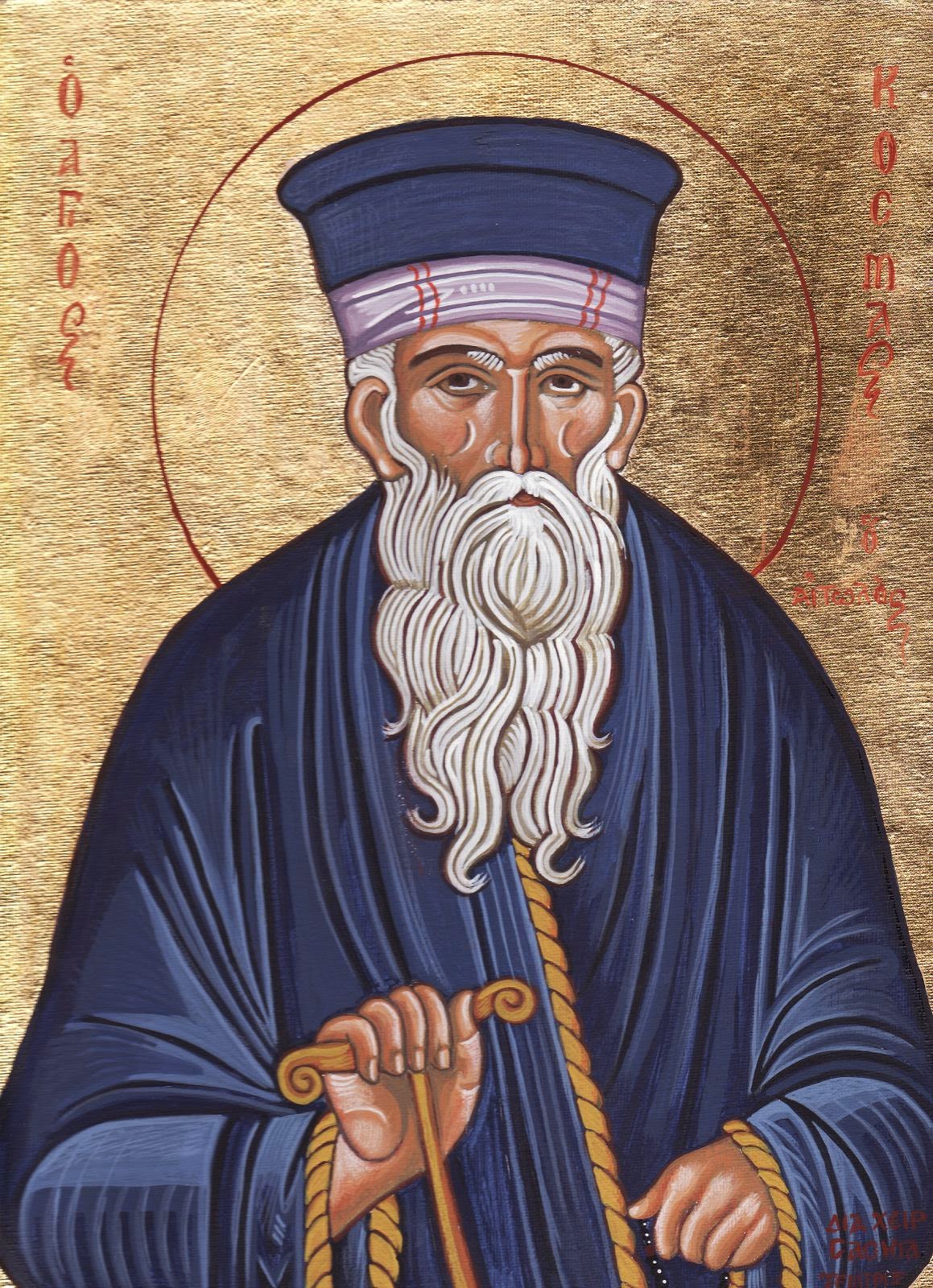
St Kosmas of Aitolia (Aug 24) - Equal to the Apostles, Holy Neo-Martyr under the Muslim Turks

- Life, Teachings, and Significance of a Modern-Day Apostle -

"The impact Father Kosmas had on the people-both lay and clergy-was such that he was considered a saint many years before he was cruelly put to death by the Turks. The secret of his great success was due, above all, to the fact that he not only preached the Gospel but lived it in such a way that many who heard him were moved to follow in his footsteps."  (Nomikos Michael Vaporis, Life of St. Kosmas Aitolos together with an English Translation of his Life and Teachings, Source.)

St Kosmas of Aitolia
During these early years of the Third Jihad, where Christians from Africa to the Middle East, and from Central Asia to Indonesia, are being just as viciously persecuted by Muslims as Christians were in previous centuries, we must turn for sure and salvific guidance to the lives and teachings of the Holy Confessors and Neo-Martyrs under the Turkish yoke, as well as those under the first wave of jihad in the seventh and eighth centuries, and the second jihad in the twelfth through fifteenth centuries. This is why I feature posts on the saints of the Orthodox Church, who balance bold refutations of the false religion of Islam with pure Christian catechism, and who witness to Christ by their very lives.

So it is with St. Kosmas Aitolos, who embraced the call of missionary to the Greek people, strengthening them in their faith and through his patient preaching, teaching and establishing of Christian schools, rallied the Christians to resist the pressures exerted on them by their Muslim overlords:
Kosmas had made up his mind to do missionary work, and he could think of no better place to do so than in his homeland, particularly in the remote corners of the rugged peninsula where the lack of churches and flight from persecution had dimmed the light of Christianity. He was determined to revitalise the Christian spirit of every isolated village of Greece and to bring back to the forlorn the age-old Hellenic pride which the Muslims had ground into the dust. (Source)

At the same time, St. Kosmas taught his Christian flocks to love and forgive their enemies with the love of Christ Himself:
"We who are pious Christians, should love our enemies and should forgive them. We should feed them. We should give them drink. We should pray to God for their souls and then say to God: 'My God, I beg you to forgive me as I forgive my enemies'. But if we don't forgive our enemies, even if we shed our blood for the love of Christ, we'll go to hell." (Source)

Thursday, July 31, 2014

Archbishop Mark (Arndt) of Berlin on Islam and Muslim Persecution of Christians


Islam is at its core anti-human... Reading the Quran, you will see that all of this [extremism] lies at the foundation of Islam. One must look truth in the eye: this is all anti-human, it is directed against humanity... 
Yes, there were times when Muslims tried to live in peace with their neighbors, they even acknowledged that we Christians are people, too. But for many, those times have passed, and now they reveal who they really are.  — Archbishop Mark (Arndt) of Berlin (Full citation below.)

How refreshing and encouraging to read clear, direct truth from an Orthodox Christian hierarch, in which he does not offer such false platitudes as the following:

Thursday, May 1, 2014

The Venerable New Martyrs Akakios of Neochorion, Euthymios of Peloponnesos and Ignatios the New

"There is only one true Faith, that of the Orthodox Christians. How can I believe in the false prophet Mohammed?" — Holy New Martyr Euthymios of Peloponnesos

"They despised the false prophet and antichrist from Hagar, and strengthened and confirmed the Orthodox Faith with their own blood, proclaiming Christ the Savior to be God and man." — from the Oikos for Holy Neomartyrs Akakios, Euthymios and Ignatios

MYSTAGOGY — May 1, 2014


The Holy Mountain has for centuries been a source of Repentance and Salvation for thousands. During the difficult years of the Turkish yoke, many turned to the Monasteries for spiritual direction. This was most evident in the numerous Neomartyrs, many of whom converted to Islam, but having realized the gravity of their sin, repented, and sought a way to prove their love for Christ. Three of these New Martyrs, Sts. Euthymios, Ignatios and Akakios are commemorated together on May 1st, likely because they lived in similar times, abandoned Christ for Islam, but repented and lived in asceticism on the Holy Mountain (specifically the Skete of the Honorable Forerunner of Iveron Monastery), and finally witnessed for Christ in martyrdom.

Friday, April 11, 2014

Holy Hieromartyr Gregory V, Patriarch of Constantinople (†1821)

As we approach the Lord's Passion Week, it seems timely to consider one of the most prominent of the Neo-martyrs.

By Hieromonk Makarios of Simonos Petra
MYSTAGOGY - April 10, 2014 

Born in 1745 in the bosom of a poor family from Dimitsana in the Peloponnese, Saint Gregory received his earliest education from his uncle who was a hieromonk, and then went to live with him in Smyrna. Becoming a monk in the monastery on the island of Strophades, he completed his theological studies on Patmos. On his return to Smyrna, Metropolitan Procopios, who showed him a fatherly affection, made him archdeacon and then ordained him priest. When Procopios was elevated to the Patriarchate in 1788, he consecrated Gregory to succeed him.

For twelve years, the holy hierarch governed the great and wealthy city of Smyrna, the metropolis of Hellenism in Asia Minor, with wisdom and apostolic zeal. He had several churches rebuilt there, founded schools and organized a system of charity for the underprivileged. In 1797, he was elected Ecumenical Patriarch and immediately undertook to enhance the patriarchal dignity by having the Phanar palace rebuilt. He also founded a publishing house in which he edited books in the vernacular, which contributed greatly to the cultural and spiritual awakening of the Greek people. The holy hierarch was vigilant about the strict observance of the ecclesiastical canons and the moral rectitude of the clergy. In those troubled times, when the Greeks, who had been held under the Ottoman yoke for almost four centuries, were brewing up for a general uprising, the Patriarch, aware of his pastoral responsibilities, exerted himself to temper the warlike spirits while secretly nurturing national feeling.

After just a year and a half, he was denounced to the Sultan by some bishops whom he had reprimanded for their conduct, and was exiled to Chalcedon and then to the Monastery of Iveron on the Holy Mountain. During this forced stay on Athos, the Saint visited all the monasteries, preached the word of God and was a model of monastic life to all. He then gave the blessing to Saint Euthymios (March 22) to go and offer himself for martyrdom, and expressed his joy and pride at the news of the martyrdom of Saint Agathangelos (19 April), thus showing that he considered death for love of Christ to be the supreme goal and crown of the Christian life.

Sunday, March 30, 2014

Coptic Woman ‘Martyred for the Cross’ — ‘Body Torn’

The early 21st century is the time of the 'Third Jihad' (See Islam 101 for a good overview of the first two jihads), and we are seeing an increasing number of New Martyrs being killed because of their faith in Jesus Christ as Lord and God. Here is another account of one of these Neo-Martyrs, the handmaiden of God Mary, whose murderers targeted her because she had a cross hanging from the rearview mirror of her car.

Think on this the next time you get behind the wheel, and see the cross dangling from your own rearview mirror.


Coptic Woman ‘Martyred for the Cross’ — ‘Body Torn’
by Raymond Ibrahim — March 29, 2014

Mary, the latest Christian martyr to be killed in Egypt

On his Twitter account, Coptic Bishop Raphaeil, who also serves as Secretary of the Holy Synod of the Coptic Christian Church, just wrote:

Oh how lucky you are, Mary, you who are beloved of Christ.  They tore your body because of the Cross.  Yet they offered you the greatest service and gave you a name of honor as one who attained the crown of martyrdom.

The bishop also quoted Christ in the Bible, “Yes, the time is coming that whoever kills you will think that he offers God service” (John 16:2).

Mary was killed during clashes between supporters of the Muslim Brotherhood and Egyptian police, when the former, whipped into a frenzy after Friday mosque prayers, attacked a Coptic church, including by opening fire on it.  Along with Mary, three others were killed.

Eyewitnesses confirmed that she was targeted when Brotherhood rioters “noticed that she had a small cross dangling from the rear-view mirror of her car.”

Monday, March 10, 2014

The Martyrdom of Holy Saint Ephraim of Nea Makri

A dear friend brought to church today an icon for the Sunday of Orthodoxy icon procession which arrested my eye, and as I examined it, I felt it must be of the martyrdom of St Ephraim of Nea Makri. My friend confirmed that it was, and I was later able to find the image online, together with an icon of St Ephraim with scenes from his life. I am posting these two icons below, and adding them to my special post on St Ephraim, and invite you to learn about this newly-revealed holy one who suffered and was martyred under the Muslim Turks during the Ottoman tyranny.

The Holy Neo-Martyrs give us warm and vivid examples as to how to live our lives during difficult times of extreme persecution. May we have their blessing!


Sunday, March 2, 2014

Holy New Martyr Kyranna as a Model for our Lives


By Protopresbyter Fr. George Papavarnavas
MYSTAGOGY — Feb 28, 2014

The Holy New Martyr Kyranna lived in the 18th century. She was born in the village of Avyssoka or Vyrsoka - in today's Ossa of Thessaloniki - from reverent parents. She was extremely beautiful, yet this was the reason for her martyrdom. This is because a girl who was beautiful in the years of the Turkish occupation was regarded by her own as a curse and misfortune. For the very beautiful girls were grabbed by the Turks and taken to their harem. 

Saint Kyranna was seen by a janissary, who was a collector of taxes in the village, and wanted to convert her to Islam and marry her. She declined, remaining constant and steadfast in her faith, with the result that she underwent terrible torture. Finally, after having been tortured in prison, they hung her, and in this way she surrendered her soul into the hands of her Bridegroom Christ, whom she loved with all her soul. 

The moment her soul "flew" to the heavens, her body, as well as the area of the prison, were illuminated with a most brilliant light. This light was seen by the imprisoned Christians, and they crossed themselves while glorifying God. This was also seen by some Muslims, however, and they were scared thinking that a fire broke out. The light retreated, but in its place remained a fine exquisite fragrance. 

The body of the Saint was buried by Christians outside of Thessaloniki, in the Cemetery of Saint Paraskevi. Her memory is celebrated in Ossa of Thessaloniki, in the beauteous sacred church erected in her honor in 1840, on January 8 instead of February 28, the day of her repose, obviously so that it does not coincide with Great Lent.

Her life and deeds give us the opportunity to highlight the following:

The Neomartyrs, with their godly life and especially their martyrdom, during the difficulties of the period of the Turkish occupation, gave courage and strength to the enslaved Greeks, reviving their morale and fanning the flame they had within them, which often, due to their many sufferings, was nearly extinguished. They conveyed to them faith, bravery, courage and patience to be able to endure till the end. 

Thursday, February 27, 2014

Saint Philothei the Martyr, Consoler of Christians under the Yoke of Islam (Feb 19)

Here we are presented with another great saint of the Orthodox Church, who humbly but bravely labored in charity and mercy, strengthening the faithful against the predatory Muslims. St. Philothei shines like a female Kosmas of Aitolia, a teacher and encourager of the Church during the dark time of the Ottoman tyranny. She was martyred by the Turkish Muslims due to their hatred of the light of Christ which shone from her upon all.


"Philothei aimed at protecting the daughters of Athens from the disgrace of conversion to Islam... strengthening those under duress or sending them away and hiding them. This was done until their consciences recovered or the danger subsided; and until fear was replaced by a spirit of faith and sacrifice for the sake of the Christian Faith."

Saturday, February 1, 2014

It Is Time To Speak

Matushka Constantina over at Lessons from a Monastery posted this image and word:


In reply to a question concerning the meaning of this statement, Matushka Constantina writes:

I can’t speak directly for what St. Cassiane meant by this because I don’t remember the context in which she said it (I made the image a long time ago). However, there are many times throughout the history of the Church (and even today) when saints stood up and spoke instead of keeping silent. The martyrs who publicly declared their faith in Christ and were put to death could have remained silent when asked if they were Christians but instead of silence they spoke. Similarly, St. Maximos the Confessor spoke out against a prevalent heresy of his times when he could have remained silent and had his tongue cut out. But perhaps the greatest example of “speaking” instead of keeping silent is the holy Forerunner and Baptist John, who spoke out against the sinful lifestyle of Herod when he could have kept silent. 
Saint John Chrysostom says that those who blaspheme should fear even their shadows lest it actually be a Christian overhearing them and land a blow for their blasphemous words. This may be more than “speaking” but nevertheless it illustrates the point that we need to hold our faith so seriously that we speak up when someone is doing or saying false/wrong things so that we will not be condemned by our choice of silence on the Day of Judgement.


Following which I left this comment:

I might suggest that for at least some of us, it is 'Time to Speak' concerning the persecution of our Christian brothers and sisters in Syria, Egypt, and throughout the Islamic world. Just as St Nikodemos the Hagiorite collected and published the stories of Holy NeoMartyrs under the Ottoman yoke to strengthen the faithful, and as various collections of lives of the Russian New Martyrs under the militant atheists continue to be published, so we must now spread the accounts of the Holy New Martyrs of the 21st Century.

Brothers and Sisters, it is 'Time to Speak', not only for the sake of our Christian brethren being persecuted and slaughtered by Muslims, that we might encourage them to stand firm in the Faith and help alleviate their sufferings, but also for the sake of our souls, that we might be ranked with the saints who did not love their lives or their silence, but spoke against injustice, heresy and the lies of the devil.


Tuesday, December 24, 2013

Neo-Martyr Ahmet, an Ottoman Saint (Dec 24)


Pemptousia — 12/23/2013 

In every age, the Church has been adorned with saints. This means that our long-suffering and merciful God, the Consubstantial Trinity, and our Most Holy Lady do not leave the world without consolation. And so prophets, apostles, evangelists, martyrs, hierarchs, saints, hieromartyrs and new martyrs, activating the gifts of the Holy Spirit, have become members of the body of Christ (see I Cor. 12, 27).


Saints are manifested in accordance with the social and historical conditions of their time. Thus, we had the martyrs in the period of the persecutions, whereas in the time of the freedom of the faith and the flowering of education and letters, scholars and important hymnographers made their appearance. The new martyrs arose in the time of Turkish rule, as resistance fighters for Modern Greece and Hellenism, as models of faith and patience. As the apostle says, the testing of faith produces perseverance, which must endure to the end (see James 1, 4).

In the New Martyrology, Saint Nikodimos the Athonite states that it pleased God to manifest the New Martyrs for five reasons: because they contributed to the renewal of the Orthodox faith; they will render those of other faiths speechless on the day of judgement; they are the glory and boast of the Eastern Church and the shame of the heterodox; they are an example of patience and a model for Christians to imitate.

Among the Lives of the New Martyrs, there is also the brief account of Ahmet the Apprentice, who was a Muslim who became a Christian in a miraculous way and was martyred in 1682. We honour his memory on 24 December and 3 May. 

The New Martyrology has this to say: 

Thursday, December 5, 2013

Holy New Martyr Angelis, the Physician of Argos (+ 1813)

Mystagogy — 12/3/2013

Saint Angelis the New Martyr (Feast Day - December 3)
Below is a short summary about Saint Angelis, whose Life was authored by St. Nikephoros of Chios.


Pious in faith, quiet and gentle in character, and obedient was the merciful and zealous Angelis, who took up medicine as his profession in Argos of the Peloponnese. 

In a religious debate with an unbelieving and impious Frenchman who mocked the Christian Faith, he sought to further defend the Christian Faith not merely with words but also through vigorous deeds. He challenged the Frenchman to a public duel to show the power of the Orthodox Faith, allowing the atheist to fully arm himself, while he himself would only be armed with a stick. Angelis went to Confession and received Holy Communion through his spiritual father and received his blessing to become a martyr after much resistance. The Frenchman, in the face of Angelis' faith and courage backed down, and Angelis was declared the winner. 

Angelis despaired however, because he had decided to become a martyr for Christ and thereby show that an Orthodox Christian has no fear of death. He then abandoned medicine and closed the shop in his house, and abandoning all companionship he went to live in silence. 

And suddenly, in an attempt to fulfill his desire for martyrdom, on the Saturday of Lazarus of the year 1813, he denied Christ and became a Muslim! Because he created a scene in a café in Nafplion, and appeared drunk on wine, and did any disorderly thing he could to show his repudiation of Islam, the authorities banished him to the island of Chios. 

Thursday, November 28, 2013

For Thanksgiving - Thoughts on Martyrdom, and the 'Akathist Hymn: Glory to God for All Things!'

New Martyrs of Russia
For the American Feast of Thanksgiving, as Christians we might wish to look beyond merely giving thanks for whatever material blessings we may have, for good health, family, and the like, and raise our minds above, from where we may find grace to give thanks in all things, even in the midst of profound suffering, whether in the agony of Gethsemane or the crucifixion of Golgotha.

Our Christian brothers and sisters in Syria, Egypt, Pakistan, Indonesia, Nigeria, Sudan, and throughout the Islamic world are suffering the bloody ascent of a modern Golgotha, something which may soon envelope the entire globe, something which has already been described as 'apocalyptic', eclipsing the Roman persecutions of the Church during her first three centuries.

Here in the United States, we Christians increasingly find ourselves under assault by a totalitarian central government demanding our tax and tacit support of death and depravity, and a toxic culture of "diversity" and "inclusion," which seeks to exclude truth, love, beauty and holiness. More and more writers are drawing attention to the escalating persecution of Christians in the West and the U.S.A. While we were once attacked "more by sneer than by spear," now the Army, Homeland Security, Department of Justice and other agencies are defining Christians as extremists and potential terrorists and enemies of the State. Ominous signs indeed.

Darkness is falling in America this Thanksgiving. Are we even aware? How will we respond to the final collapse of Christian culture, and the resulting overt persecution? Are we preparing at all for what lies ahead?

Towards the end of my book, Facing Islam, I turn to the martyrs and confessors of the Church to guide us: