Showing posts with label Constantinople. Show all posts

Tuesday, June 27, 2017

Muslim Prayers at Hagia Sophia - A Sign Calling Us to Repent

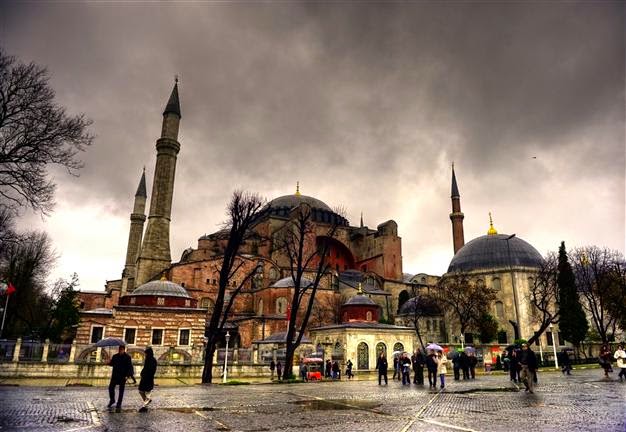
Islamic prayers were recently held at the Hagia Sophia in former Constantinople in a televised event attended by Turkish officials and strongly condemned by the Greek Foreign Ministry. 

This is yet another highly symbolic event inked to this great and ancient church building, which we Orthodox Christians must respond to...


There has been a growing movement within Turkey for several years demanding the re-conversion into a mosque of Hagia Sophia — for centuries the greatest church in all of Christendom. The great church was turned into a mosque in 1453 after the Muslim Turks conquered Constantinople and subjugated the surviving Christian inhabitants. Following the defeat of the Ottoman empire in World War I, the new leader of the secular state of Turkey, Kemal Ataturk, in 1935 put a stop to Islamic prayers in Hagia Sophia, and had it converted into a museum.

Ever since Recep Tayyip Erdogan came to power in Turkey in 2003, calls for turning Hagia Sophia back into a functioning mosque have been steadily increasing. Following one such occurrence in May 2014, I wrote the following:


Muslim Prayers at Hagia Sophia - A Sign Calling Us to Repent 

Erdogan has set his sights on Hagia Sophia, to turn the once luminous church structure into a dark and oppressive mosque again. Such a symbolic achievement would appear to Muslims as a second conquering of Christendom, bolstering Erdogan's push to reinstitute the Islamic caliphate, with Turkey at its head. 
Islam must have such temporal victories and exert political and military domination in order to justify its existence, as Muhammad's successes in battle, culminating in his retaking of Mecca ten years after being driven out in weakness and disgrace, forever set the example for Muslims to follow. 
But worldly success and temporal victories and kingdoms are not the Christian way. 
Christians follow Jesus the Christ, the Son of the Living God, who "had no place to lay His head," who emptied Himself, taking the form of a servant, and who submitted Himself fully to the divine will of the Father, even to the point of death on the cross. Here we have no city, but are called to be pilgrims and aliens, journeying to our heavenly homeland. In the radical words of our Lord Jesus Christ, we are called to take up our cross and follow Him. As Fr Seraphim Rose put it:

"Let us not, who would be Christians, expect anything else from it than to be crucified. For to be a Christian is to be crucified, in this time and in any time since Christ came for the first time. 
"His life is the example—and warning—to us all. We must be crucified personally, mystically; for through crucifixion is the only path to resurrection. If we would rise with Christ, we must first be humbled with Him—even to the ultimate humiliation, being devoured and spit forth by the uncomprehending world. 
"And we must be crucified outwardly, in the eyes of the world; for Christ's Kingdom is not of this world, and the world cannot bear it, even in a single representation of it, even for a single moment."

If the Muslims convert Hagia Sophia into a mosque a second time, then we Christians must see in this God's providential will. If God allows the enemy to reconquer Christian symbols, then we must take it as a warning to not place our trust in mere symbols, but in the Real and True Son of God Himself. We must allow such calamities to spur us on to ever deepening faith and ever more fervent repentance.  
As Islam and the other forces of evil wage open warfare against Christ and His Church in these last times, we are called to be faithful to the end. And if we remain faithful, then, like the Lord, we shall find our victory mystically concealed in our Golgotha.

Scroll down for the latest news story in this drama which extends back to the early Islamic sieges of Constantinople...

Monday, May 29, 2017

The Fall of an Empire ~ The Lesson of Byzantium (VIDEO)

May 29 is the anniversary of the defeat of Constantinople in 1453 by the Ottoman Muslims. This fine documentary, scripted and hosted by Archimandrite Tikhon (Shevkunov), Abbot of Sretensky Monastery in Moscow, presents a uniquely Russian Orthodox perspective on the history and fall of Byzantium, and the lessons to be drawn from the world's greatest and longest-enduring empire.


h/t to Fr Thomas Soroka


The Fall of Constantinople, 29 May 1453

"The great doors of Saint Sophia were forced open, and crowds of angry soldiers came in and fell upon the unfortunate worshippers. Pillaging and killing in the holy place went on for hours. Similar was the fate of worshippers in most churches in the city..."


by Dionysios Hatzopoulos, Romiosini:

In the city everyone realized that the fateful moment had come. In the city, while the bells of the churches rang mournfully, citizens and soldiers joined a long procession behind the holy relics brought out of the churches. Singing hymns, men, women, children, soldiers, civilians, clergy, monks and nuns, knowing that they were going to die shortly, made peace with themselves, with God and with eternity.

When the procession ended the Emperor met with his commanders and the notables of the city. In a philosophical speech he told his subjects that the end of their time had come. In essence he told them that Man had to be ready to face death when he had to fight for his faith, for his country, for his family or for his sovereign. All four reasons were now present. 

Furthermore, his subjects, who were the descendants of Greeks and Romans, had to emulate their great ancestors. They had to fight and sacrifice themselves without fear. They had lived in a great city and they were now going to die defending it. 

As for himself, he was going to die fighting for his faith, for his city and for his people... He thanked all present for their contribution to the defense of the city and asked them to forgive him, if he had ever treated them without kindness. 

Saturday, October 29, 2016

Turkey assigns permanent imam to Hagia Sophia to lead daily prayers...

...Turns clock back to 1453 in second conquest of Constantinople. This is effectively a re-conversion of Hagia Sophia back into a functioning mosque after over 80 years.

"Observers are warning about Turkish President Recep Tayyip Erdogan’s increasingly neo-Ottoman stance..." 

This new move by emboldened Islamic supremacist Erdogan will certainly have an impact on Turkey's relations with Russia, as Russia recently urged Turkey to return Hagia Sophia to the Orthodox Church.

Might this be an unfolding of Elder Paisios' prophecy of a war between Russia and Turkey?


Hagia Sophia gets permanent imam as tensions rise in Aegean
Ekathimerini, October 22, 2016:

Dark clouds over Hagia Sophia...


A few months after a controversial decision by Turkish authorities to allow readings from the Quran to be broadcast from Hagia Sophia in Istanbul, reports on Friday said Turkey had decided to appoint a permanent imam for the venue.

According to the Anadolu state news agency, the country’s religious affairs directorate and the mufti of the Fatih district have agreed to assign a permanent imam who will lead five daily prayers, instead of the current two.

Friday, August 12, 2016

Turkish Authorities Ban Christian Liturgy in Panagia Sumela Monastery

The doors of the Sumela Monastery reopened in June 2010, after 88 years. The Turkish government had given permission to the Ecumenical Patriarchate to have a patriarchal liturgy for the Feast of the Assumption every year. That permission has been suddenly revoked.


That the Greek Orthodox need special permission to celebrate divine services in any of their churches in what is now Turkey is a dark reminder of Islamic oppression of Eastern Christians from the mid-7th century, and especially from 1453 through the fall of the Ottoman Empire after World War I.

From my article, Ecumenical Patriarch Bartholomew Assassination Plot in Historical Context:


Ever since the Fall of Constantinople to the Muslim armies in 1453, Christians in what is now Turkey have been reduced to second-class citizens (and persecuted nearly to extinction) through the institution of the dhimma, the contract of protection which subjugates Christians to Muslim rule under humiliating, demeaning terms. 
Under the dhimma, Christians have to pay the exorbitant jizya tax, cannot build new churches, cannot repair existing ones, cannot share their faith outside their church buildings, cannot convert Muslims, etc. One aspect of the dhimma most terrifying is the concept of "collective punishment." If one Christian violates the dhimma contract, Muslims may attack any or all Christians...
Important to keep in mind is the role played not only by the faithful Patriarch Martyrs, but by other clergy and even monastics in the eventual liberation of Greece... Eventually, the Serbs and Bulgarians threw off the Muslim yoke as well. 
It was this series of humiliating defeats during the nineteenth century, and losses in the Balkan Wars of the early twentieth century, which enraged the Turkish Muslims, who turned on the weakest elements of their Christian population, precipitating their infamous genocide against the Christians of Armenia, Greece, Pontus, and Syria, massacring over 3.6 million men, women and children (some dying from starvation, disease and the forced deportations) from 1894 to 1922. 
Sporadic persecutions against remaining Christians extended well into the 1950s, perhaps the worst example being the Istanbul Pogroms of 1955, which dealt a crushing blow to the Orthodox Christian community in Turkey. 
The Greek population of Turkey had already been reduced to about 120,000 in 1927 (following the main period of the Orthodox Christian Genocide); by 1978 it had collapsed to only 7,000. According to the Human Rights Watch, by 2006 there were only 2500 Greeks in Turkey.

Saturday, June 11, 2016

Is Russia targeting Turkey over Hagia Sophia?


Timing will be crucial as Erdogan’s re-Islamizing Turkey continues to press for a second defeat of Christendom by the symbolic move of turning Hagia Sophia into a mosque. Will pressure from Russia to return the great Cathedral to the Orthodox Church prevent or merely delay what many view as inevitable? Or is there something larger at stake?


Every year on May 29, Turkey celebrates Islam’s defeat of Constantinople and the Byzantine (Eastern Roman) Empire in 1453, and the conversion of the great church, Hagia Sophia, into a mosque soon after. Every year Muslims gather outside Hagia Sophia demanding it be turned back into a mosque, after eighty years of being a secular museum with both Christian Byzantine and Islamic features.

Turkish national broadcaster TRT Diyanet will broadcast the sahur or Islamic predawn meal along with daily readings from the Koran during the Islamic holy month of Ramadan which began [last] Monday.

Saturday, April 2, 2016

In the Church of the Holy Wisdom

“In the past year, at night, when we are outside, the smell of incense that you Christians burn in church overpowers us.”


A Greek journalist writes: “I met Ishmael who is Turkish in 1975, in England, where I was attending university. We became good friends and after graduating we kept in touch. Ishmael lives in Istanbul (Constantinople), a stone’s throw from Hagia Sophia. Recently he wrote a letter to me. “In the past year, at night, when we are outside, the smell of incense that you Christians burn in church overpowers us.”


Monday, November 30, 2015

Moscow wants Turkey to return Hagia Sophia to Orthodox Church

This is a stunning development, which should be read in conjunction with this post on the prophecies of Elder Paisios regarding Turkey and Russia.

Moscow wants Turkey to return Cathedral of Agia Sophia to Orthodox Church


State Duma deputies have supported the idea of the return of Agia Sophia in Constantinople to the Orthodox Church. This was stated by Chairman of Committee on Property, and the coordinator of the inter-factional parliamentary group on the protection of Christian values, Sergei Gavrilov, TSN reports.

Today, when Russian-Turkish relations are undergoing an “endurance trial,” mutually friendly initiatives and proposals are of special importance, Gavrilov says.

“The Russian side deems it possible to return to the question of Agia Sophia, the ancient shrine of the Christian world, located in Constantinople – an ancient Byzantine cathedral associated with the history of the universal Christian Church. We expect a friendly step from the Turkish side - returning Agia Sophia of Constantinople to the Christian Church,” the deputy said.

Saturday, November 14, 2015

Avenging the Defeated Caliphate: The Significance of November 13 in the Paris Attacks

Did the Muslim jihadists in Paris choose November 13 for its symbolic value in planning their attacks?

Over at Terror Trends Bulletin, a brief but weighty post conveys what to most of us is a forgotten historical footnote (Thanks to Emanuel):

The Historical Significance of November 13th in Islam:
On November 13, 1918 the Allied troops occupied Constantinople, the capital of the Ottoman Empire. The Ottoman Empire was the Caliphate, the Islamic State of its day.

A little extra background, from the Wikipedia entry, Defeat and Dissolution of the Ottoman Empire:
The Occupation of Constantinople took place in accordance with the Armistice of Mudros [signed on 31 October 1918], ending the Ottoman participation in World War I. The occupation had two stages: the initial occupation took place from 13 November 1918 to 16 March 1920; from 16 March 1920 - Treaty of Sevres. 
1918 saw the first time Constantinople had changed hands since the Ottoman Turks conquered the Byzantine capital in 1453. An Allied military administration was set up early in December 1918. Haghia Sophia was converted back into a cathedral by the Allied administration, and the building was returned temporarily to the Greek Orthodox Ecumenical Patriarch.

Now, several additional news reports are revealing that the Paris Jihad Attacks were not only carefully orchestrated in Paris, but across Europe, with cells acting in Germany and the UK:

It seems clear that, whether or not the date was chosen by the jihadis for its link to the Western Allies occupying Constantinople in 1918, it was indeed a carefully planned and executed operation, spanning at least three countries, and marks an ominous turn in Islam's war on the West. 

Tuesday, June 9, 2015

Turks Glorify Historic Slaughter and Rape of Christians

The annual Muslim celebration of the conquest of Constantinople in 1453 by Sultan Mehmet is "tantamount to their saying 'We are proud of our fellow Sunni Muslims of the Islamic State—who are currently slaughtering, beheading, enslaving, and raping people simply because they are Christian 'infidels'.”

by Raymond Ibrahim — June 8, 2015

Fall of Constantinople, 1453; artist, Theofilos

A recent news report unwittingly demonstrates how Turkey—once deemed the most “secularized” Muslim nation—is returning to its Islamic heritage, complete with animosity for the infidel West and dreams of the glory days of jihadi conquests:
A group of devout Muslims from across Turkey prayed before the city’s historic Hagia Sophia on the 562nd anniversary of the Turkish conquest of Istanbul [Constantinople], demanding that the site be turned back into a mosque. 
Men and women from across the country gathered before the Hagia Sophia museum early May 31, as part of an event organized by the Anatolian Youth Association (AGD) with the motto “Break the chains, Open Hagia Sophia,” and prayed the morning prayer with a call for the reconversion of the museum into a mosque.


In fact, this is an annual ritual.  Thousands of Turks surround Hagia Sophia every May and call for it to become a mosque—often to Islam’s war-cry, “Allahu Akbar!”

This is not about a “minority of radicals.”  In a survey conducted with 401 Turks, more than 97 percent wanted Hagia Sophia to be turned into a functioning mosque.   Nor is this about Muslims needing a place to pray.  As of 2010, there were 3,000 active mosques in Istanbul alone.

Rather, this is about Muslims wanting to revel in the glory days of Islamic jihad and conquest.

Unlike historically-challenged Westerners, Muslims fully understand the significance of Hagia Sophia.  Hagia Sophia—Greek for “Holy Wisdom”—was, in fact, Christendom’s greatest cathedral for almost one thousand years.  Built in Constantinople, the heart of the ancient Christian empire, it was also a stalwart symbol of defiance against an ever encroaching Islam from the east.

After parrying centuries of jihadi thrusts, Constantinople was finally sacked by the Turks under Sultan Mehmet II on May 29, 1453.  Its crosses desecrated and icons defaced, Hagia Sophia—as well as thousands of other churches—was converted into a victory mosque, the tall minarets of Islam surrounding it in triumph.

Reading the primary historic texts from the period is not unlike reading current headlines concerning Islamic State atrocities—the massacres, beheadings, rapes, enslavement of Christian “infidels” and the defilement of their churches.  Writes an eyewitness to the 1453 Turkish conquest of Constantinople:

Tuesday, June 2, 2015

The Last Divine Liturgy in Hagia Sophia – Constantinople

"They entered the Holy Church with reverence, making the sign of the cross. Father Lefteris said, quietly, with great emotion: 'I enter into your house; I worship towards your Holy Church in fear…'

"He quickly moved towards the Holy Sanctuary, where the Holy Table would have been. He found a small table and placed it within the Sanctuary. He had everything in a small bag; he took everything out, he put on his vestments and began:

“'Blessed is the Kingdom of the Father, and of the Son, and of the Holy Spirit, now and for ever, and to the ages of ages'.

“'Amen', replied the Major Liaromatis. The Divine Liturgy had begun in Hagia Sophia, for the first time since the 29 May 1453."


The Last Divine Liturgy in St. Sophia – Constantinople
Londinoupolis via OCP Media — May 29, 2015


Many, even Orthodox, even Greeks, believe that the last Divine Liturgy in St. Sophia, in Constantinople, was celebrated on the 29 May 1453. However, the last Liturgy took place in 1919. The priest who celebrated the Divine Liturgy was Fr. Lefteris Noufarakis, who was from Alones Rethymnou, Crete. He was an army priest in the Second Greek Army Division, one of the two army divisions which was part of the allied expeditionary body in Ukraine. This Army Division went to Ukraine via Constantinople, which then was under ‘allied sovereignty’, after the end of WW I.

A group of Greek Officers, led by the priest, General Frantzis, Major Liaromati, Captain Stamatiou and Lieutenant Nikolaou were observing the City and Hagia Sophia, keeping to themselves their secret, i.e. to celebrate the Divine Liturgy in St. Sophia – a decision taken primarily by the priest. The difficulty of this endeavour was the fact that during that period St. Sophia was a mosque, creating therefore some major issues. This could have created a diplomatic incident between Greece and Turkey. However, Fr. Lefteris had decided that he was going to celebrate the Divine Liturgy in St. Sophia, whatever difficulty came his way.

Monday, June 1, 2015

Muslims from across Turkey demand Hagia Sophia be turned back into mosque

Timed to coincide with the anniversary of the Muslim defeat of Constantinople in 1453. More Islamic supremacism in rapidly re-Islamizing Turkey. 

Related:

Morning prayer held before Hagia Sophia to demand re-conversion into mosque
Hürriyet Daily News, May 31, 2015 (via Jihad Watch)


A group of devout Muslims from across Turkey prayed before the city’s historic Hagia Sophia on the 562nd anniversary of the Turkish conquest of Istanbul, demanding that the site be turned back into a mosque.

Men and women from across the country gathered before the Hagia Sophia museum early May 31, as part of an event organized by the Anatolian Youth Association (AGD) with the motto “Break the chains, Open Hagia Sophia,” and prayed the morning prayer with a call for the reconversion of the museum into a mosque.

Saturday, May 30, 2015

End of Days: A Lamentation for Constantinople

The great clouds of Christian martyrs of the 20th and early 21st centuries join the heroic witnesses of the Imperial City of the Eastern Roman (Byzantine) Empire.

May 29 is the anniversary of the capture and desolation of the great Christian city of Constantinople by the forces of Islam in 1453.

The Fall of Constantinople

We live in an age of global upheaval, of titanic forces and epochal change. After the bloody twentieth century, which saw 50 million or more Orthodox and Eastern Christians martyred for their faith in Jesus Christ, now we see a new wave of genocide committed by Muslims against Christians at the start of the twenty-first. A new harvest of holy martyrs joins the ranks of the saints in the heavens...

Many young people today may see Islam become the world’s largest religious group and dominant military-political force during their lifetime, and Europe may itself soon fall or capitulate to the pressures of millions of Muslim immigrants within their borders, and tens of millions more without.

The United States seems to have lost its way, conniving and plotting — and when the cost is not too high waging open warfare — against Orthodox Christian nations like Russia, Ukraine, Greece, Serbia and Romania. Christians here at home are now the targets of a perfect storm of neo-pagans, liberals, and the LGBT mob. We are mindful of the words of our Lord Jesus Christ:

"If the world hates you, you know that it hated Me before it hated you.
If I had not done among them the works which no one else did, they would have no sin; but now they have seen and also hated both Me and My Father.
But this happened that the word might be fulfilled which is written in their law, ‘They hated Me without a cause'."

— John 15:18-24-25

We live in dire times, not dissimilar to the gathering darkness which preceded the defeat of Constantinople in the fifteenth century. For the Christian citizens of the Great City, it must have felt like the ‘End of Days’.  It feels like that now, at times.

The Fall of Constantinople is a sign for us, that it can happen here, now. That our earthly cities can and will be swept away by the enemies of Christ. Yet we are called to stand firm in the Faith, knowing that Jesus Christ has already conquered, and that He will not forsake us.

"This calls for the patient endurance of the saints..." —Rev. 13:10

In somber commemoration of this dark event, below are two accounts of the Muslim Turks’ crime against God and His people. May we be moved to deep repentance, faith and steadfast courage by the noble examples of our brothers and sisters, martyrs and confessors of so long ago.

Tuesday, May 26, 2015

Thousands call for Hagia Sophia (Church) to be converted into mosque in Istanbul rally (VIDEO)

Pressure continues to build for converting Hagia Sophia into a mosque in rapidly re-Islamizing Turkey.

Related:

via Jihad Watch — May 25, 2015

Thousands call for Hagia Sophia (Church) to be converted into mosque in Istanbul rally
Well, they say hundreds: www.hurriyetdailynews.com

Hundreds of people demanded that the historic Istanbul Hagia Sophia museum be converted into a mosque during a rally in Istanbul on May 24.

People gathered outside Istanbul’s Hagia Sophia, in the historical Sultanahmet district, with some carrying signs that read: “Hagia Sophia needs to be reopened as a mosque,” and “Let our lives be sacrificed for Islam.”

The protest was led by many Turkish nongovernmental organizations, including the Humanitarian Relief Foundation (İHH).

Designed as a Christian basilica in the sixth century by Anthemios of Tralles and Isidorus of Miletus, Hagia Sophia is now a UNESCO World Heritage site.

Thursday, May 21, 2015

Gone is the Glory of Constantinople…

"... but the glory of the Christians shall not end so long as they hold fast to faith in Jesus Christ and carry Him with them wherever they wander, wherever they are taken, wherever they settle. Jesus alone is their glory."

by Fr Georges Massouh, Notes on Arab Orthodoxy – May 2015
OCP Media — May 19, 2015


Jesus announced that the worship of God is not tied to a specific place as God is not contained by space and He cannot be bound in an exclusive place toward which those who want to be in His presence must pray or make pilgrimage. Thus when the Samaritan woman asked Him, “Our fathers worshiped on this mountain (Gerezim in Samaria), and you Jews say that in Jerusalem is the place where one ought to worship,” Jesus answered her, “Woman, believe Me, the hour is coming when you will neither on this mountain, nor in Jerusalem, worship the Father… the true worshipers will worship the Father in spirit and truth” (John 4:20-23).

God is present in every place and there is no place on the face of this earth from which God is absent. God is present where His people gathers in His name. The Apostle Paul affirms this when he says, “I shall dwell in them and walk among them. I shall be their God and they shall be My people” (2 Corinthians 6:16). God is a wanderer who does not settle in one place. He does not require people to come to Him in a specific place. He comes to them whenever they call upon Him and seek Him.

In this context, Saint Basil the Great (d. 379) comments on Jesus’ words to the Samaritan woman and says that worship is no longer tied to a specific geographical location since the Holy Spirit has become the “place of worship”. Christ also is the place of worship and the Gospel of Saint John clearly speaks of the end of worship in the temple of Jerusalem since Jesus Himself is the new “temple” and there is no need for a temple built in a city or on a mountain.

Monday, April 13, 2015

Qur’an read inside Hagia Sophia for the first time in 85 years

Islam is innately supremacist, seeking to re-conquer or wipe out the remnants of Christianity, and the Turkish Muslim desire to re-convert Hagia Sophia into a mosque has been gathering great momentum over the last decade. Indeed, nine other Hagia Sophia (former) churches have been reconverted into mosques in the last few years alone.

See all posts related to Hagia Sophia.


posted at Jihad Watch, April 11, 2015

It was once the grandest cathedral in the Christian world, surpassing anything in Rome or anywhere else — until the Muslim conquest of Constantinople on May 29, 1453. Then it was converted into a mosque. In the 1930s, the secular Turkish government made it into a museum. But now, with Turkish secularism breathing its dying breaths, it will soon be a mosque again.

Istanbul`s Hagia Sophia sees first Koran reading in 85 years
AFP, April 11, 2015:

Istanbul: A Muslim cleric has for the first time in 85 years recited the Koran in the Hagia Sophia, the world famous landmark of Istanbul which is now a museum after serving as a church and a mosque, reports said Saturday.

The Hagia Sophia was turned into a museum accessible to all by the secular founders of modern Turkey in the 1930s and secular Turks are wary of any moves to re-Islamise the building.

A passage from the Koran, the holy scripture of Islam, was recited late Friday at a ceremony in the Hagia Sophia to mark the opening of a new exhibition “Love of the Prophet.”

Monday, September 8, 2014

“Everyday Martyrdom”: The Daily Life of Orthodox Christians in the Ottoman Empire

"The de facto position of the Christians in Turkey was a rule of fanatical intolerance, violence and arbitrary acts, utter degradation and disregard of human rights. The Christians had no civil rights, only the status of slaves. They were not members of the state but merely slaves to cruel and inhuman conquerors who had the right at any moment to deprive them of their property, honour or life itself."

by Seraphim Danckaert, Orthodox Christian Network
June 20, 2014


A remarkable book has recently been published: The Church of Constantinople in the 19th Century (Peter Lang, 2013). It’s a massive tome, over 1,000 pages long, originally written in 1904 by Ivan Sokolov, one of the leading Russian Orthodox scholars of Church history at the time. Sokolov enjoyed unprecedented access to the Patriarchal archives in Istanbul, and his book is filled with copious references to documents that are not only unpublished but also unknown even to specialists.

Some other time I’ll post about the remarkable details. For now, I’d like to highlight several paragraphs from the beginning of the book, in which Sokolov is describing the general historical context and day-to-day reality of life for Christians under Ottoman rule. The portrait that emerges may not be entirely unknown to those who have read of the Orthodox Christian martyrs of this period. Yet Sokolov’s account is, in many ways, even more arresting, as it quickly becomes evident that even the “average” believer endured a kind of “everyday martyrdom.”

________
. . . the internal structure of the Patriarchate of Constantinople was like a state within a state, having its own administration and court, de jure freedom to profess its faith, and the right to run its own community affairs. But this is only to look at one side of the position of Christians in the Turkish Empire. The other side was the actual relations between the Christians and the Turkish state whose citizens they were. Here, at first glance, matters did not seem so rosy. 
First of all, Christians were considered by the Turks to be a subject people obliged to pay taxes, a people of no value, causing only feelings of disgust to true believers who treated them with disdain and as they saw fit. To the Turks these people were no more than giaours, dogs or cattle, obliged to feed and serve their conquerors, doomed to eternal slavery.

Wednesday, August 20, 2014

Raymond Ibrahim: The Siege of Constantinople

"Ever since the Muslim prophet Mohammed sent a message in 628 to the Byzantine emperor Heraclius, summoning him to Islam, with the famous assertion, aslam taslam — that is, “submit [become Muslim], and you will have peace” — and the summons was refused, Constantinople became Islam’s arch-enemy."

by Raymond Ibrahim, August 15, 2014

Editor’s note: To mark the August 15 anniversary of the second Islamic siege of Constantinople, we republish the following article, which appeared a year ago on National Review Online:

Seige of Constantinople, from the Constantine Manasses Chronicle

Today, August 15, marks the anniversary of Constantinople’s victory over Muslim invaders in what historians commonly call the “Second Siege of Byzantium,” 717–18. Prior to this massive onslaught, the Muslims had been hacking away at the domains of the Byzantine empire for nearly a century. The Muslims’ ultimate goal was the conquest of Constantinople — for both political and religious reasons.

"Constantinople — from [Islam's] theological perspective — simply had to fall."

Politically, Islam had no rival but the “hated Christians” of Byzantium, known by various appellations — including al-Rum (the Romans), al-Nassara (the Nazarenes), and, most notoriously, al-Kilab (the “dogs”). The eastern Sasanian Empire had already been vanquished, and Persia subsumed into the caliphate. Only the “worshippers of the cross” — as they were, and still are, disparagingly known — were left as contenders over the eastern Mediterranean basin.

More important, Constantinople — from a theological perspective — simply had to fall. From the start, Islam and jihad were inextricably linked. The jihad, or “holy war,” which took over Arabia and Persia, followed by Syria, Egypt, and all of North Africa — all formerly Byzantine territory — was considered a religious obligation, or, as later codified in sharia law, a fard kifaya: a communal obligation on the body of believers, to be adhered to and fulfilled no less than the Five Pillars of Islam. 

"The jihad is a religious duty, because of the universalism of the Muslim mission and the obligation to convert everybody to Islam either by persuasion or by force..."

As the famous 14th-century Muslim historian Ibn Khaldun put it: “In the Muslim community, the jihad is a religious duty, because of the universalism of the Muslim mission and the obligation to convert everybody to Islam either by persuasion or by force. . . .  Islam is under obligation to gain power over other nations.”

This concept of jihad as institutionalized holy war was first articulated and codified into Islam’s worldview by “warrior-theologians” (mujahidin-fuqaha) living and fighting along the Byzantine-Arab frontier (such as the mujahid Abdallah bin Mubarak, author of the seminal work Kitab al-Jihad or “Book of Jihad”).

The prevalent view was that, so long as Constantinople stood, the Cross would defy the Crescent. This is a literal point: Symbols played a great role in these wars. Less than a century earlier, at the pivotal battle of Yarmuk (636), where the Muslims crushed the Byzantines, leading to the conquest of Syria, one Muslim complained to the caliph, saying, “The dog of the Romans [Emperor Heraclius] has greatly frustrated us with the ubiquitous presence of the cross!”

Indeed, one cannot overemphasize the religious nature of these wars — which, if still codified in Islam’s sharia, has become all but alien to a Western epistemology that tends cynically to dismiss the role of faith. That the primary way of identifying oneself in the old world was based on religious affiliation — not race, ethnicity, or nationality, all modern concepts — is indicative of the central role of faith. Even useful terms such as “Byzantines” are ultimately anachronistic; “Byzantines” identified themselves first and foremost as “Christians.”

For these reasons, the conquest of Constantinople would take on increasingly apocalyptic proportions in Islamic literature. Ever since the Muslim prophet Mohammed sent a message in 628 to the Byzantine emperor Heraclius, summoning him to Islam, with the famous assertion, aslam taslam — that is, “submit [become Muslim], and you will have peace” — and the summons was refused, Constantinople became Islam’s arch-enemy. Mohammed even prophesied that the Christian capital would — indeed, must — fall to Islam, with blessings and rewards to the Muslim(s) fulfilling this prophecy. Fall the great city would — but not for some 800 years, in 1453, giving an inchoate Europe the needed time to mature, strengthen, and unify.

Monday, May 12, 2014

‘Christians in Turkey Are Second-Class Citizens’


By Walter Flick
OCP Media — May 10, 2014

The spiritual leader of the world’s Orthodox Christians, Ecumenical Patriarch Batholomew of Constantinople, arrives to Germany May 10. During his nine-day visit, the 74-year-old will meet with state representatives including Chancellor Angela Merkel and President Joachim Gauck. He’ll also be a guest of honor at major Christian churches, and receive an honorary doctorate from the University of Munich.

Bartholomew I has been the Ecumenical Patriarch of Constantinople, based in Istanbul, since November 1991. Orthodox Christians are a tiny minority in Turkey, and the population routinely faces discrimination. Walter Flick, a religious expert with the International Society for Human Rights in Germany, shares his insights on the situation in an interview with DW.

DW: Are Christians oppressed in Turkey?

Walter Flick: Turkey has almost 80 million inhabitants. There are only around 120,000 Christians, which is less than 1 percent of the population. Christians are certainly seen as second-class citizens. A real citizen is Muslim, and those who aren’t Muslim are seen as suspicious. Christians aren’t equal. You can’t say they’re being persecuted in Turkey, but they don’t have the same rights, especially when it comes to religious freedom.

Thursday, May 8, 2014

BREAKING NEWS: Hagia Sofia to become half-mosque and half-museum

Christian Icons and frescoes to be shrouded in shadows and 'dark light' to avoid offending Islam.

We knew this was coming, yet it is still an immensely significant, symbolic move, which Muslims will universally see as a "second conquering" of Christendom, and even as a precursor to the restoration of the Islamic Caliphate. As I wrote back in December:
The conversion of Hagia Sophia into a mosque is an eschatological sign of our times, as pure, seventh-century Islam, that "forerunner of the Antichrist," reasserts its diabolical hold over its fervent adherents, and re-stakes its claim to global domination, ushering in a new era of bloody Muslim jihad already raging around the globe.

Here are some of my recent posts on this:

Turkey: Hagia Sofia to become half mosque and half museum
ANSAMed (Thanks to JihadWatch) — May 8, 2014


ANKARA - Prime Minister Recep Tayyip Erdogan's government plans to turn Istanbul's Hagia Sofia Basilica into a mosque in the afternoon and evening and a museum in the morning. The historical monument, which draws millions of tourists every year, will have the Byzantine frescoes covering its walls cast into shadow by 'dark light' so as to avoid offending Islam.