Tuesday, April 14, 2015

Raymond Ibrahim: 'Easter under Islam, Churches under Attack'

"Violence and intolerance against non-Muslims is not limited to “terrorist” organizations like the Islamic State... It is also evident among Muslim governments, Muslim police, and the Muslim populace.  The reason is that it’s evident in Islam. We can continue playing games, euphemizing, white washing, invoking 'grievances', and so on, but in the end, it is the Koran, it is Muhammad, it is Sharia—in a word, it is Islam."


by Raymond Ibrahim, April 9, 2015

Virgin Mary Church in  Tel Nasri, Syria before being destroyed.
As millions of Christians around the world were celebrating Easter Sunday, the Christians of the Muslim world were again under attack.  The April 2 Islamic jihad attack on a Kenyan school—where the Islamic murderers made sure to slaughter only Christian students, sparing fellow Muslims—was only the most spectacular attack.

On Easter Sunday itself, as some media reported, the Islamic State destroyed the Virgin Mary Church in Tel Nasri—loosely translated as “Christian Hill”—in northeast Syria.

Even lesser known is that other churches and Christians in the Middle East were attacked during Easter weekend.  Take Egypt.  President Sisi recently decreed that a Christian church should be built in the Upper Egyptian town of al-Our, where 13 of the 21 Christians who were gruesomely beheaded by the Islamic State in Libya grew up, and where their families still live.  The church was meant to honor them and the nation of Egypt.

But, as always happens in Egypt—that is, as always happens in practically every Islamic nation in the world—local Muslims rioted and protested right after Islamic prayers last Friday.  They yelled that they would never allow a church to be built, that “Egypt is Islamic!” and that “Anyway, shape, or form, we will take Sisi down!”

After Irking the Turks, Pope Francis urges Christians to Speak Boldly

These are times of martyrdom, Francis said last week, and the martyrs of today are so many, “we can say that they are more numerous than in the first centuries.”

Related:

After Irking the Turks, Pope Francis urges Christians to Speak Boldly
by Thomas D. Williams, Ph.D. - Breitbart News
April 13, 2015

The day after publicly commemorating the Armenian genocide and risking a hostile response from Turkey, Pope Francis spoke of the need for courage to proclaim the truth boldly, no matter what the consequences.

The way of the Church is that of “openness and speaking freely,” said Francis Monday in his homily at Mass in the Santa Marta residence in Vatican City.

Drawing from the reading of the day from the Acts of the Apostles, the Pope pointed to the example of the apostles of Peter and John, who fearlessly preached Christ’s resurrection despite the threats from local authorities.

According to the account, the Apostles prayed, “Lord, take note of their threats, and enable your servants to speak your word with all boldness.”

On Sunday, the Pope announced that it was “a duty” to honor the memory of the victims of the genocide, “for whenever memory fades, it means that evil allows wounds to fester.”

“Concealing or denying evil is like allowing a wound to keep bleeding without bandaging it!” he said.

Monday, April 13, 2015

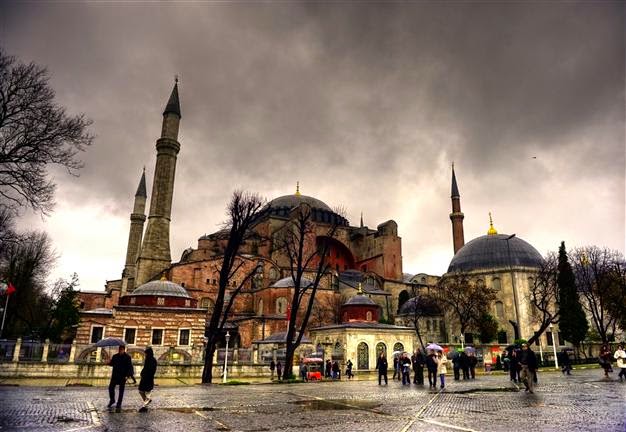
Qur’an read inside Hagia Sophia for the first time in 85 years

Islam is innately supremacist, seeking to re-conquer or wipe out the remnants of Christianity, and the Turkish Muslim desire to re-convert Hagia Sophia into a mosque has been gathering great momentum over the last decade. Indeed, nine other Hagia Sophia (former) churches have been reconverted into mosques in the last few years alone.

See all posts related to Hagia Sophia.


posted at Jihad Watch, April 11, 2015

It was once the grandest cathedral in the Christian world, surpassing anything in Rome or anywhere else — until the Muslim conquest of Constantinople on May 29, 1453. Then it was converted into a mosque. In the 1930s, the secular Turkish government made it into a museum. But now, with Turkish secularism breathing its dying breaths, it will soon be a mosque again.

Istanbul`s Hagia Sophia sees first Koran reading in 85 years
AFP, April 11, 2015:

Istanbul: A Muslim cleric has for the first time in 85 years recited the Koran in the Hagia Sophia, the world famous landmark of Istanbul which is now a museum after serving as a church and a mosque, reports said Saturday.

The Hagia Sophia was turned into a museum accessible to all by the secular founders of modern Turkey in the 1930s and secular Turks are wary of any moves to re-Islamise the building.

A passage from the Koran, the holy scripture of Islam, was recited late Friday at a ceremony in the Hagia Sophia to mark the opening of a new exhibition “Love of the Prophet.”

Sunday, April 12, 2015

CHRIST IS RISEN! TRULY HE IS RISEN!


Wishing all my readers a Radiant and Joyous Pascha!

Now all things are filled with light: heaven and earth, and the nethermost regions. So let all creation celebrate the Resurrection of Christ, whereby it is established.
~ The Paschal Canon


Saturday, April 11, 2015

The Mystery of Christ's Death and Burial: 'This is the Blessed Sabbath'


The whole creation was altered by Thy Passion: for all things suffered with Thee, knowing, O Word, that Thou holdest all in unity.

Friday, April 10, 2015

The King of Glory, Crucified


Today He who hung the earth upon the
waters is hung upon a tree. 
He who is King of
the Angels is arrayed in a crown of thorns. 
He who wraps the heavens in clouds is wrapped
in the purple of mockery. 
He who freed Adam
in the Jordan receives blows on the face. 
The Bridegroom of the Church is affixed to the
cross with nails. 
The Son of the Virgin is
pierced by a spear. 
We worship Your passion, O Christ. 
We worship Your passion, O Christ.
We worship Your passion, O Christ. 
Show us also Your glorious Resurrection.

~ Antiphon XV, Matins of Great and Holy Friday ~


Thursday, April 9, 2015

The Eschatological Nature of Holy Week & Pascha

"Do we understand that when the world rejected its Savior... 'normal life' came to its end and is no longer possible... By the death of Jesus the 'normal' world, and 'normal' life were irrevocably condemned. Or rather they revealed their true and abnormal inability to receive the Light, the terrible power of evil in them. 'Now is the Judgment of this world' (John 12:31). The Pascha of Jesus signified its end to 'this world' and it has been at its end since then."

by the Very Rev. Alexander Schmemann


MONDAY, TUESDAY, WEDNESDAY: THE END 

These three days, which the Church calls Great and Holy have within the liturgical development of the Holy Week a very definite purpose. They place all its celebrations in the perspective of End ; they remind us of the eschatological meaning of Pascha. 

So often Holy Week is considered one of the "beautiful traditions" or "customs," a self-evident "part" of our calendar. We take it for granted and enjoy it as a cherished annual event which we have "observed" since childhood, we admire the beauty of its services, the pageantry of its rites and, last but not least, we like the fuss about the paschal table. And then, when all this is done we resume our normal life. 

But do we understand that when the world rejected its Savior, when "Jesus began to be sorrowful and very heavy... and his soul was exceedingly sorrowful even unto death," when He died on the Cross, "normal life" came to its end and is no longer possible. For there were "normal" men who shouted "Crucify Him," who spat at Him and nailed Him to the Cross. And they hated and killed Him precisely because He was troubling their normal life. 

It was indeed a perfectly "normal" world which preferred darkness and death to light and life.... By the death of Jesus the "normal" world, and "normal" life were irrevocably condemned. Or rather they revealed their true and abnormal inability to receive the Light, the terrible power of evil in them. "Now is the Judgment of this world" (John 12:31). The Pascha of Jesus signified its end to "this world" and it has been at its end since then. This end can last for hundreds of centuries this does not alter the nature of time in which we live as the "last time." "The fashion of this world passeth away..." (I Cor. 7:31). 

Wednesday, April 8, 2015

Jesus' Words Backed by Archaeology: The Stones Are Crying Out

Holy Week is an ideal time to post examples of the many historical, archaeological and scientific confirmations of the Biblical witness to the Christian Faith, which itself is part of the Living Tradition of the Orthodox Church. This is especially important when it comes to the challenge posed by Islam, as the Koran claims that Jesus was not crucified:
In fact, they never killed him, they never crucified him — they were made to think that they did. All factions who are disputing in this matter are full of doubt concerning this issue. They possess no knowledge; they only conjecture. For certain, they never killed him. (Sura 4:157)

This patently false assertion in the supposedly divine Koran goes against not only the Gospel accounts, but even the historical witness of first century Roman and Jewish historians, as I note in my book, Facing Islam (p. 57):
...From a purely secular standpoint alone, Jesus the Christ is written of by numerous Roman and Jewish historians from the mid first-century onwards, including Thallus (who wrote circa 52 AD about Jesus’ crucifixion and the darkness over the land), Mara Bar-Serapion (writing ca. 70 AD), the renowned Jewish historian Josephus (ca. 93 AD), the Roman historian Tacitus (ca. 110-120 AD), and others.  As Orthodox Christians, we of course rely primarily on the integrity of the Apostolic witness, the Gospels, the Acts of the Apostles, the Epistles and the Holy Tradition of the Church for our knowledge and understanding of the life, ministry and Person of Jesus Christ.

For an excellent study of the validity of the Gospel accounts, I strongly recommend 'Jesus and the Eyewitnesses - The Gospels as Eyewitness Testimony', by Richard Bauckham. In the meantime, I hope you enjoy and share the below article as we journey with the Lord to His cross and resurrection.


Jesus' Words Backed by Archaeology: The Stones Are Crying Out
by Charles Colson, Charisma News via Pravoslavie
February 7, 2015


A few years ago, people exploring caves outside Jerusalem came across the find of a lifetime: an ancient burial cave containing the remains of a crucified man. This find is only one in a series of finds that overturns a century-old scholarly consensus.

That consensus held that the Gospels are almost entirely proclamation and contain little, if any, real history. The remains belonged to a man who had been executed in the first century A.D., that is, from the time of Jesus.

As Jeffrey Sheler writes in his book Is the Bible True? the skeleton confirms what the evangelists wrote about Jesus' death and burial in several important ways.

First, location—scholars had long doubted the biblical account of Jesus' burial. They believed that crucified criminals were tossed in a mass grave and then devoured by wild animals. But this man, a near contemporary of Jesus, was buried in the same way the Bible says Jesus was buried.

Then there's the physical evidence from the skeleton. The man's shinbones appeared to have been broken. This confirms what John wrote about the practice of Roman executioners. They would break the legs of the crucified to hasten death, something from which Jesus, already dead, was spared.

Tuesday, April 7, 2015

Bridegroom Matins of Great and Holy Tuesday: 'Work diligently with the talent given to you...'

May all who have received a talent from God,  now, with the help of Christ, increase according to the grace given by Him and sing: “Bless the Lord, O works of the Lord!” (from Ode 8 of the Canon)

Behold the Bridegroom...
The first half of Holy Week in the Orthodox Church directs us to repentance, fruitfulness and vigilance, in anticipation of the Lord's Second Coming.

As the enemy of our salvation stirs up persecutions against us and our brothers and sisters throughout the world, together with "wars and rumors of wars," and as he "prowls around like a roaring lion, seeking whom he may devour" (1 Pet 5:8), trying to lull us into laziness and love for the pleasures of this life, therefore we must rouse ourselves and contend for "the Faith once for all delivered to the saints" (Jude 3).

May these excerpts from the Bridegroom Matins of Holy Tuesday help inspire us to "Work diligently, therefore, with the talent given to us..." 
____

Tone 8 Troparion

Behold, the Bridegroom comes at midnight,
and blessed is the servant whom He shall find watching;
and again, unworthy is the servant whom He shall find heedless.
Beware, therefore, O my soul, do not be weighted down with sleep,
lest you be given up to death 
and lest you be shut out of the Kingdom!
But rouse yourself, crying: “Holy, holy, holy, are You, O our God!”
Through the Theotokos have mercy on us!


Tone 4* Kathisma Hymn (following Kathisma 9)

Let us love the Bridegroom, O brothers!
Let us keep our lamps aflame with virtues and true faith,
so that we, like the wise virgins of the Lord,
may be ready to enter with Him into the marriage feast!//

For the Bridegroom, as God, grants unto all an incorruptible crown.


Tone 2 Kontakion

You know that this is the last hour, O wretched soul,
and fear the cutting of the fig tree.
Work diligently, therefore, with the talent given to you.
Keep watch and cry://
“Let us not remain outside the bridal chamber of Christ!”

Monday, April 6, 2015

Metropolitan Hilarion: There is the genocide of Christians in the Middle East

This is a wide ranging interview, with much to commend it. However, there are also some jarring absurdities and blatantly false assertions made, which provide us with teachable moments. My comments are interspersed in brackets and italics.

Pravmir, April 4, 2015

On March 29, 2015, Metropolitan Hilarion of Volokolamsk, who hosts the Church and the World program on Russia-24 TV network, had as his guest the Russian Ministry of Foreign Affairs Commissioner For Human Rights, Democracy and Rule of Law, Constantine Dolgov.

Metropolitan Hilarion: Good afternoon, dear brothers and sisters! You are watching the Church and the World program. Today we will again discuss the Middle East and the situation of Christian minorities. My guest today is the Russian Foreign Ministry Commissioner for Human Rights, Democracy and Rule of Law, Constantine Dolgov. Good afternoon, Constantine Constantinovich.

C. Dolgov: Good afternoon, your Eminence.

This is a really pressing problem. Regrettably, the situation in the Middle East, in which once very numerous Christian communities have found themselves, raises the most serious concern. The region as a whole is going through a turbulent time and certain waves of internal instability raised by the so-called ‘Arab Spring’. Of course, there are still various conflicts, including old and unresolved. First of all, it is the Arab-Israeli conflict. The armed conflict continues in Syria. There is a threat of international terrorism. We all can see perfectly well the Islamic State militants overstepping the limits in various countries of the region. Not least of all their victims are precisely Christians. There are flagrant violations of human rights, first of all, the fundamental right to life.