Showing posts with label Holy Week. Show all posts

Thursday, May 2, 2019

The Miracle of the Holy Fire - God's Encouragement to Christians following the rise of Islam

"Miracles come when they are needed, and it seems that the Holy Fire first came when it was needed most — during the time of the Islamic oppression of the Church, when the Christians suffering under the yoke of Muhammad most needed confirmation that their faith in the crucified and risen Christ was true." — Fr. Lawrence Farley


Today, May 2, 2019, the Holy Fire arrived at a wonderful parish I am closely connected to, by circumstance and by the heart. Alas, I could not travel to be with them to greet and receive the Holy Fire, brought all the way from Jerusalem, but it did spur me on to read up on the annual Miracle of the Holy Fire.

In doing so, I came across a typically wonderful article by Fr Lawrence Farley. It is his quote at the top of this post, and his observation is no less true today than it was when the Sword of Islam cut its wide and bloody swath across the Christian world, decimating churches and slaughtering and subjugating Christians across the Middle East, North Africa, and Central Asia, and even into Western Europe, the Balkans, Italy, and Russia.

Today, 80% of the countries where Christians suffer the worst persecution are Muslim majority and/or an Islamic dictatorship. Muslim persecution of Christians worldwide jumped almost 15% from 2017 to 2018, also according to Open Doors' World Watch List.

Christians in the West and in the USA and Canada are being increasingly pressured to acquiesce to the secular agenda. While open persecution of Christians in America has recently been highlighted by lawfare against Christian bakers and florists, outbursts of demonic hatred against Christians is encountered everywhere. Just recently, the peaceful Abbot Tryphon of Vashon Island was assaulted by a tormented soul who saw his cross and could not hold back his venom, and truly like a serpent, struck a potentially deadly sucker punch without any warning.

So, the Holy Fire remains with us, a visible annual miracle, a gift from God to bolster the faith of Christians the world over.

More sucker punches — and Muslim jihad terror attacks — are surely coming. Just ask the persecuted Christians in Nigeria and elsewhere.

But for now, let us give thanks for this powerful miracle.

What Good is the Holy Fire?


May 15, 2017 · Fr. Lawrence Farley, No Other Foundation


The so-called “Holy Fire” is the name given to the fire that appears on ends of the candles of the Patriarch of Jerusalem and others every Holy Saturday. The Patriarch, accompanied by a church crammed filled with others, awaits for the annual miracle every Holy Saturday. On that day the Patriarch strips himself of his holy robes and enters the Tomb of Christ with a bundle of unlit tapers, says certain prayers, and then awaits for his tapers to be miraculously lit from heaven. He is not disappointed: his tapers are miraculously lit every year and he emerges from the Tomb with the flame to the tumultuous shouting of everyone in the Church of the Holy Sepulchre.

Friday, April 17, 2015

Celebrations of Holy Pascha in Pakistan

I am deeply moved by the quiet bravery and dedicated faith of Fr. Joseph Farooq and these congregations, who shine as Light in the midst of the darkness of the Islamic nation of Pakistan.  ~ CHRIST IS RISEN! ~

See also:


Celebrations of Holy Pascha in Pakistan
Pravoslavie — April 15, 2015


With the blessing of His Eminence Metropolitan HILARION, Archbishop of Eastern America and New York, First Hierarch of the Russian Orthodox Church Outside of Russia, on April 12, 2015, the ROCOR faithful in Pakistan joyfully participated in the Paschal Divine Liturgy. The congregation was given the chance to prepare themselves during the Holy week. The parishioners participated in the services starting from Palm Sunday; it is the most joyous feasts of the year, as we commemorate the Entrance of our Lord into Jerusalem and with full passion and true spirit the Orthodox faithful were taught well by Fr.Joseph Farooq how to follow the holy traditions of the Orthodox Church during the Passion Week. All the main services were well attended, with many parishioners receiving the sacrament of Confession and Holy Communion.

Saturday, April 11, 2015

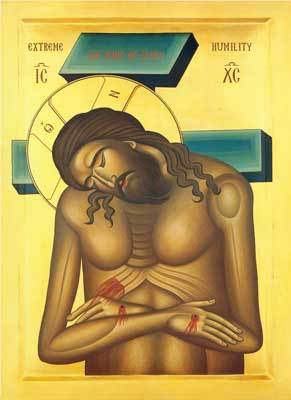
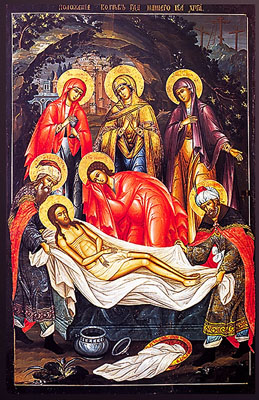
The Mystery of Christ's Death and Burial: 'This is the Blessed Sabbath'


The whole creation was altered by Thy Passion: for all things suffered with Thee, knowing, O Word, that Thou holdest all in unity.

Friday, April 10, 2015

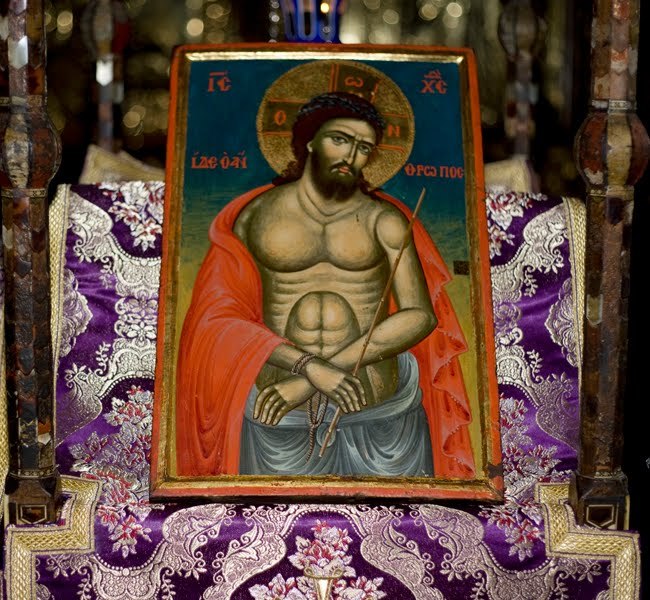
The King of Glory, Crucified


Today He who hung the earth upon the
waters is hung upon a tree. 
He who is King of
the Angels is arrayed in a crown of thorns. 
He who wraps the heavens in clouds is wrapped
in the purple of mockery. 
He who freed Adam
in the Jordan receives blows on the face. 
The Bridegroom of the Church is affixed to the
cross with nails. 
The Son of the Virgin is
pierced by a spear. 
We worship Your passion, O Christ. 
We worship Your passion, O Christ.
We worship Your passion, O Christ. 
Show us also Your glorious Resurrection.

~ Antiphon XV, Matins of Great and Holy Friday ~


Thursday, April 9, 2015

The Eschatological Nature of Holy Week & Pascha

"Do we understand that when the world rejected its Savior... 'normal life' came to its end and is no longer possible... By the death of Jesus the 'normal' world, and 'normal' life were irrevocably condemned. Or rather they revealed their true and abnormal inability to receive the Light, the terrible power of evil in them. 'Now is the Judgment of this world' (John 12:31). The Pascha of Jesus signified its end to 'this world' and it has been at its end since then."

by the Very Rev. Alexander Schmemann


MONDAY, TUESDAY, WEDNESDAY: THE END 

These three days, which the Church calls Great and Holy have within the liturgical development of the Holy Week a very definite purpose. They place all its celebrations in the perspective of End ; they remind us of the eschatological meaning of Pascha. 

So often Holy Week is considered one of the "beautiful traditions" or "customs," a self-evident "part" of our calendar. We take it for granted and enjoy it as a cherished annual event which we have "observed" since childhood, we admire the beauty of its services, the pageantry of its rites and, last but not least, we like the fuss about the paschal table. And then, when all this is done we resume our normal life. 

But do we understand that when the world rejected its Savior, when "Jesus began to be sorrowful and very heavy... and his soul was exceedingly sorrowful even unto death," when He died on the Cross, "normal life" came to its end and is no longer possible. For there were "normal" men who shouted "Crucify Him," who spat at Him and nailed Him to the Cross. And they hated and killed Him precisely because He was troubling their normal life. 

It was indeed a perfectly "normal" world which preferred darkness and death to light and life.... By the death of Jesus the "normal" world, and "normal" life were irrevocably condemned. Or rather they revealed their true and abnormal inability to receive the Light, the terrible power of evil in them. "Now is the Judgment of this world" (John 12:31). The Pascha of Jesus signified its end to "this world" and it has been at its end since then. This end can last for hundreds of centuries this does not alter the nature of time in which we live as the "last time." "The fashion of this world passeth away..." (I Cor. 7:31). 

Wednesday, April 8, 2015

Jesus' Words Backed by Archaeology: The Stones Are Crying Out

Holy Week is an ideal time to post examples of the many historical, archaeological and scientific confirmations of the Biblical witness to the Christian Faith, which itself is part of the Living Tradition of the Orthodox Church. This is especially important when it comes to the challenge posed by Islam, as the Koran claims that Jesus was not crucified:
In fact, they never killed him, they never crucified him — they were made to think that they did. All factions who are disputing in this matter are full of doubt concerning this issue. They possess no knowledge; they only conjecture. For certain, they never killed him. (Sura 4:157)

This patently false assertion in the supposedly divine Koran goes against not only the Gospel accounts, but even the historical witness of first century Roman and Jewish historians, as I note in my book, Facing Islam (p. 57):
...From a purely secular standpoint alone, Jesus the Christ is written of by numerous Roman and Jewish historians from the mid first-century onwards, including Thallus (who wrote circa 52 AD about Jesus’ crucifixion and the darkness over the land), Mara Bar-Serapion (writing ca. 70 AD), the renowned Jewish historian Josephus (ca. 93 AD), the Roman historian Tacitus (ca. 110-120 AD), and others.  As Orthodox Christians, we of course rely primarily on the integrity of the Apostolic witness, the Gospels, the Acts of the Apostles, the Epistles and the Holy Tradition of the Church for our knowledge and understanding of the life, ministry and Person of Jesus Christ.

For an excellent study of the validity of the Gospel accounts, I strongly recommend 'Jesus and the Eyewitnesses - The Gospels as Eyewitness Testimony', by Richard Bauckham. In the meantime, I hope you enjoy and share the below article as we journey with the Lord to His cross and resurrection.


Jesus' Words Backed by Archaeology: The Stones Are Crying Out
by Charles Colson, Charisma News via Pravoslavie
February 7, 2015


A few years ago, people exploring caves outside Jerusalem came across the find of a lifetime: an ancient burial cave containing the remains of a crucified man. This find is only one in a series of finds that overturns a century-old scholarly consensus.

That consensus held that the Gospels are almost entirely proclamation and contain little, if any, real history. The remains belonged to a man who had been executed in the first century A.D., that is, from the time of Jesus.

As Jeffrey Sheler writes in his book Is the Bible True? the skeleton confirms what the evangelists wrote about Jesus' death and burial in several important ways.

First, location—scholars had long doubted the biblical account of Jesus' burial. They believed that crucified criminals were tossed in a mass grave and then devoured by wild animals. But this man, a near contemporary of Jesus, was buried in the same way the Bible says Jesus was buried.

Then there's the physical evidence from the skeleton. The man's shinbones appeared to have been broken. This confirms what John wrote about the practice of Roman executioners. They would break the legs of the crucified to hasten death, something from which Jesus, already dead, was spared.

Tuesday, April 7, 2015

Bridegroom Matins of Great and Holy Tuesday: 'Work diligently with the talent given to you...'

May all who have received a talent from God,  now, with the help of Christ, increase according to the grace given by Him and sing: “Bless the Lord, O works of the Lord!” (from Ode 8 of the Canon)

Behold the Bridegroom...
The first half of Holy Week in the Orthodox Church directs us to repentance, fruitfulness and vigilance, in anticipation of the Lord's Second Coming.

As the enemy of our salvation stirs up persecutions against us and our brothers and sisters throughout the world, together with "wars and rumors of wars," and as he "prowls around like a roaring lion, seeking whom he may devour" (1 Pet 5:8), trying to lull us into laziness and love for the pleasures of this life, therefore we must rouse ourselves and contend for "the Faith once for all delivered to the saints" (Jude 3).

May these excerpts from the Bridegroom Matins of Holy Tuesday help inspire us to "Work diligently, therefore, with the talent given to us..." 
____

Tone 8 Troparion

Behold, the Bridegroom comes at midnight,
and blessed is the servant whom He shall find watching;
and again, unworthy is the servant whom He shall find heedless.
Beware, therefore, O my soul, do not be weighted down with sleep,
lest you be given up to death 
and lest you be shut out of the Kingdom!
But rouse yourself, crying: “Holy, holy, holy, are You, O our God!”
Through the Theotokos have mercy on us!


Tone 4* Kathisma Hymn (following Kathisma 9)

Let us love the Bridegroom, O brothers!
Let us keep our lamps aflame with virtues and true faith,
so that we, like the wise virgins of the Lord,
may be ready to enter with Him into the marriage feast!//

For the Bridegroom, as God, grants unto all an incorruptible crown.


Tone 2 Kontakion

You know that this is the last hour, O wretched soul,
and fear the cutting of the fig tree.
Work diligently, therefore, with the talent given to you.
Keep watch and cry://
“Let us not remain outside the bridal chamber of Christ!”

Tuesday, April 22, 2014

Fr Daniel Byantoro: Christ, Our True 'Qurban'

Pascha is the ideal time to post this powerful message from Fr Daniel, encapsulating the heart of the Gospel not only for Christians, but for Muslims whom the Lord is drawing to Himself:

"Holy Week and Pascha are when the mystery of the healing and restoration of our nature is manifested... Hence we are made near to God through the Sacrifice of Christ; Christ is our true Qurban."

by Fr Daniel Byantoro — Friends of Indonesia
Originally published January 13, 2012

In the Feast of Sacrifice pilgrimage, Muslims perform rituals at and around their holiest shrine, the Ka’ba, in Mecca. The ritual itself reminds them of what they believe to be the reenactment of Abraham’s near Sacrifice of his son (Ishmael not Isaac according to Muslims) which God replaced with an animal sacrifice. At the conclusion of their rituals, they slaughter animal sacrifices, called “Qurban,” to be distributed to the poor.

This word “Qurban” was also used by the Jews during the time of Christ to signify anything that is sacrificed to God, as it is said:” “But you say, `If a man says to his father or mother, “Whatever profit you might have received from me [is] Corban” (that is, a gift to God) (Mark 7:11).

This word is also used by the Syriac Orthodox Christians for the Divine Liturgy/Holy Communion in the form of “Holy Qurbana,” and is also used by the Coptic Orthodox Christians for the “prosphora” bread, which they simply called it as “Qurban”.

In itself the word “Corban/Qurban” is derived from the word “Qarab/Qarib” which means “to be near/to be close”. Therefore a Qurban is a sacrifice that makes the sacrificer closer to God; it is a way to unite with God.

Saturday, April 19, 2014

Holy Saturday - The Encounter with Death

by Fr Steven C, Kostoff, Orthodox Christian Meditations
Originally published May 8, 2013

I would like to share a particularly insightful passage from the writings of Fr. Alexander Schmemann from his over-all analysis of the Matins of Great and Holy Saturday (always served on Friday evening “in anticipation”).  This is one of the longest services of Holy Week, attended by many, and highlighted by our common vigil around the tomb of the crucified and buried Lord, and culminating in a procession that takes us outside and around the church. 

This procession with the Epitaphion (burial shroud) – actualizing the passage of Christ through the darkness of death and Hades – proclaims that nevertheless, Christ is the Holy Immortal One that death and Hades cannot hold in their respective grips.  There occurs here what Fr. Alexander calls “the encounter with death.”  And it is because of death that Fr. Alexander claims “the entire universe has become a cosmic cemetery … condemned to death and destruction.”  

Thus, this encounter between the Son of God and death has a truly cosmic and timeless meaning imparted to it. The “hour” of the Son of God has now arrived, and this “hour” is that of His death, actualized, commemorated and and made present through the liturgical services of the Church.

It is here that Fr. Schmemann has a wonderful paragraph that beautifully explains what happens when death must encounter the voluntary death of Christ:

“Now this hour has come and the Son of God enters into Death.  The Fathers usually describe this moment as a duel between Christ and Death, Christ and Satan.  For this death was to be either the last triumph of Satan, or his decisive defeat.  The duel develops in several stages.  At first, the forces of evil seem to triumph.  The Righteous One is crucified, abandoned by all, and endures a shameful death.  He also becomes the partaker of “Hades,” of this place of darkness and despair … but at this very moment, the real meaning of this death is revealed.  The One who dies on the Cross has Life in Himself, i.e., He has life not as a gift from outside, a gift which  therefore can be taken away from Him, but as His own essence.  For He is the Life and the Source of all life.  “In Him was Life and the Life was the light of man” (JN 1:4).  The man Jesus dies, but this Man is the Son of God.  As man, He can really die, but in Him, God Himself enters the realm of death, partakes of death. This is the unique, the incomparable meaning of Christ’s death.  In it, the man who dies is God, or to be more exact, the God-Man.  God is the Holy Immortal; and only in the unity “without confusion, without change, without division, without separation” of God and Man in Christ can human death be “assumed” by God and be overcome and destroyed from within, be “trampled down by death.”

This is the ultimate expression of the Church’s “Death of God” theology.  In the Person of the Son of God incarnate, God experiences death from within.  For the Son of God dies in the human nature that He has made His own once and for all.  This is more properly called the theopaschite formula; again, meaning that we can ascribe death to God – not in His divine nature for that nature remains eternally impassible - but in His human nature that suffers passion on our behalf.  There is therefore no human experience that Christ does not experience on our behalf – and that includes death itself.  Thus, in the “praises” we chant in front of the tomb of the Savior, we proclaim our faith in His life-giving death:


O Life, how canst Thou die?
How can Thou dwell in a tomb?
Yet by Thy death Thou hast destroyed
   the reign of death,
and raised all the dead from hell.


In a tomb they laid Thee,
O Christ the Life.
By Thy death Thou hast cast down the
  might of death
and become the font of life for all the world.


Holy Saturday is thus the “Blessed Sabbath” that “great Moses mystically foreshadowed” [as we sing in the great hymn on this day].  The Son of God “rests” in the tomb on this Sabbath, having completed His work of re-creation by dying and reigning on and from the Tree of Life – the wood of the Cross.  That is why Holy Saturday is imbued with a sense of profound expectation, in that we already know that the Lord will arise again, death having no dominion over Him.  Holy Saturday is the day of transition and transformation - from the Cross to the Empty Tomb.


Friday, April 18, 2014

We Behold The Lord of Glory Crucified for our Salvation


Today He who hung the earth upon the waters is hung upon a tree. 
He who is King of the Angels is arrayed in a crown of thorns. 
He who wraps the heavens in clouds is wrapped in the purple of mockery.
He who freed Adam in the Jordan receives a blow on the face.
The Bridegroom of the Church is affixed to the cross with nails. 
The Son of the Virgin is pierced by a spear. 
We worship Your passion, O Christ. 
Show us also Your glorious Resurrection.

(Antiphon XV from the Matins of Great and Holy Friday)


Wednesday, April 16, 2014

The Prayer of Gethsemane

by Fr. Gregory, Panagia Swift To Hear — April 14, 2014

The Prayer of Gethsemane

This is the title of a Chapter in the book, His Life is Mine by Archmandrite Sophrony...

Archmandrite Sophrony believes that the prayer of our Lord in Gethsemane was a prayer for the salvation of all mankind.  And this is something to think about as we approach Holy Friday: What should we pray for at that time?  Maybe we need to think how the world seems to have basically rejected our Lord Jesus Christ and pray for the salvation of all.  So now a quote from Father Sophrony’s book, His life is Mine:  

"Christ’s prayer in the garden of Gethsemane is the noblest of all prayers by its virtue and power for atone for the sins of the world.  Offered to the Eternal God the Father in a spirit of divine love it continues to shine, a light that cannot be extinguished, forever drawing to itself the souls that have preserved their likeness to God.  Christ included the whole human race in this prayer, from the first Adam to the last man to be born of woman.

"We lack existential knowledge of such love and so its permanent significance is hidden from us.  Victorious in eternity, Christ’s love on the earthly plane spells extreme suffering.  No one has ever known such suffering as Christ endured.  He descended into hell, into the most painful hell of all, the hell of love.  This is a sphere of existence which can only be apprehended through spiritual love—of love that has been granted us to know from on High.  It is vital to have experienced, if only once, the heavenly fire which Christ brought with him; to know with our entire being what it is to be even a little like Christ…

"When, as I have said, a shadow of a likeness to the Gethsemane prayer is granted him, man then transcends the boundaries of his own individuality and enters into a new form of being—personal being in the likeness of Christ.  By participating in the sufferings of his Divine love, we, too, in spirit can experience a little of his death and of the power of his resurrection.  'For if we have been planted together in the likeness of his death' (in deep prayer for the world and consuming desire for the salvation of all), 'we shall be also in the likeness of his resurrection' (Rom. 6.5).  When it is given to us from on high to enter this new sphere of Being, we arrive at 'the ends of the world' (I Cor. 10.11) and pass into the light of Divine Eternity.

"And every man on whom God has bestowed the rare and dread privilege of knowing to a minute degree the agony of Christ’s prayer in the garden of Gethsemane will stumble on, slowly and painfully, to a cogent awareness of the resurrection of his own soul and a perception of Christ’s undeniable, ineluctable victory.  He will know 'that Christ being raised from the dead dieth no more; death hath no more dominion over him' (Rom. 6.9)  And now, O Christ, by the gift of Thy love which passeth all understanding I, too, have crossed from death to life…

"Now—I am." 

(His Life is Mine, pp. 91, 95)


Source: panagiaquicktohear.com

Sunday, April 13, 2014

The Eschatological Nature of Holy Week & Pascha

Holy Monday, Tuesday and Wednesday:
The Bridegroom Matins
by THE VERY REV. ALEXANDER SCHMEMANN

MONDAY, TUESDAY, WEDNESDAY: THE END 

These three days, which the Church calls Great and Holy have within the liturgical development of the Holy Week a very definite purpose. They place all its celebrations in the perspective of End; they remind us of the eschatological meaning of Pascha.

So often Holy Week is considered one of the "beautiful traditions" or "customs," a self-evident "part" of our calendar. We take it for granted and enjoy it as a cherished annual event which we have "observed" since childhood, we admire the beauty of its services, the pageantry of its rites and, last but not least, we like the fuss about the paschal table. And then, when all this is done we resume our normal life.

But do we understand that when the world rejected its Savior, when "Jesus began to be sorrowful and very heavy... and his soul was exceedingly sorrowful even unto death," when He died on the Cross, "normal life" came to its end and is no longer possible?

For there were "normal" men who shouted "Crucify Him," who spat at Him and nailed Him to the Cross. And they hated and killed Him precisely because He was troubling their normal life. It was indeed a perfectly "normal" world which preferred darkness and death to light and life.... By the death of Jesus the "normal" world, and "normal" life were irrevocably condemned. Or rather they revealed their true and abnormal inability to receive the Light, the terrible power of evil in them. 

"Now is the Judgment of this world" (John 12:31). The Pascha of Jesus signified its end to "this world" and it has been at its end since then. This end can last for hundreds of centuries this does not alter the nature of time in which we live as the "last time." "The fashion of this world passeth away..." (I Cor. 7:31). 

Saturday, April 12, 2014

Fr. Seraphim Rose: At the End of Our Exile

This brief homily, dating from 1965 (from the small collection of Eugene Rose's early sermons, 'Heavenly Realm') was written for the Sunday of the Prodigal Son, the first Sunday of the Lenten Triodion. We have now completed our journey through the exile of Lent, so these words ought to stir in us a renewed desire to "prepare to meet the Rising Sun of the New Jerusalem, the Resurrection of our Lord Jesus Christ."

As Fr Seraphim says below, "There is still time... to remember our true home," and make ourselves "exiles from the world."

We have this sacred time of Holy Week to do just that.

_____

“By the rivers of Babylon, there we sat down, yea, we wept, when we remembered Zion.”

In these words of the Lenten Psalm, we Orthodox Christians, the New Israel, remember that we are in exile. For Orthodox Russians, banished from Holy Russia *, the Psalm has a special meaning; but all Orthodox Christians, too, live in exile in this world, longing to return to our true home, Heaven.

For us the Great Fast is a session of exile ordained for us by our Mother, the Church, to keep fresh in us the memory of Zion from which we have wandered so far. We have deserved our exile and we have great need of it because of our great sinfulness. Only through the chastisement of exile, which we remember in the fasting, prayer and repentance of this season.

Do we remain mindful of our Zion?

Friday, April 11, 2014

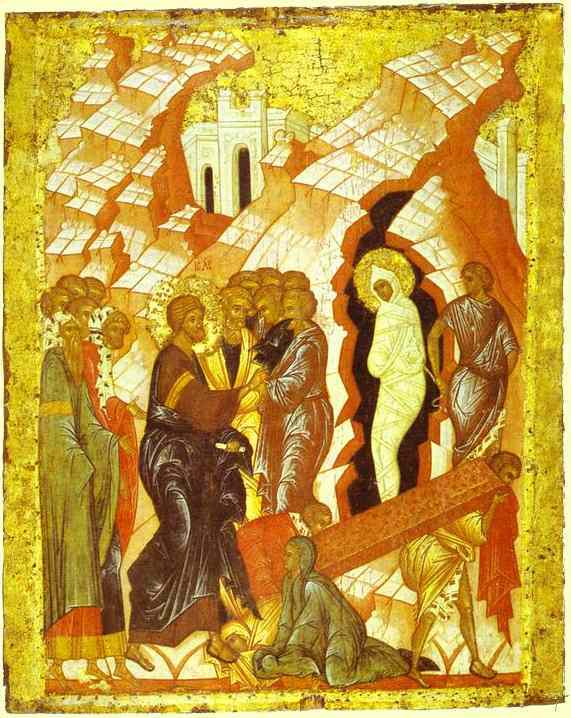
The Strange Case of Lazarus

By Fr Stephen Freeman, Glory to God for All Things — April 10, 2014

St. John’s Gospel records the story of Christ’s raising Lazarus from the dead as the last action of Christ before His entry into Jerusalem. That setting has given rise to the feast of Lazarus Saturday in the Orthodox Church – a small Pascha before Holy Week.

The three synoptic gospels make no mention of these events, to which I draw no historical conclusions. The gospels include and exclude events for many reasons, historical considerations seeming to be of the least importance. Which stories, and in what order, primarily serve deeper theological concerns.

For St. John, the story of Lazarus serves as the occasion for commentary and teaching on the resurrection of believers, much like the Feeding of the Five Thousand serves for commentary and teaching on the Eucharist.

“If you had been here, my brother would not have died,” (Martha’s words) echoes the universal voice of the Church in the face of Christ’s delayed Second Coming. It is the plaintive heart of believers who wonder why God allows suffering.

And some of them said, “Could not this Man, who opened the eyes of the blind, also have kept this man from dying?” (Jn 11:37)

It is an obvious question, repeated in various forms by believers as well as scoffers through the centuries. The story of Lazarus, which occurs before Christ’s suffering and death, specifically addresses the heart of the Church after Christ’s suffering and death. For though we rejoice in Christ’s death and resurrection, it is our dead brother (mother, father, sister, friend) who lies heavy on our hearts.

Turning towards Holy Week

Icon of the Wise and Foolish Virgins (Matthew 25:1-13)

These will be among my last posts before Orthodox Christian Holy Week begins, when we should turn aside from the maelstrom of the world and the cacophony of false religions of whatever stripe, and direct 100% of our attention — body, soul and spirit — to the Lord Jesus Christ and His voluntary and saving Passion, Crucifixion, Death, Burial and Resurrection.

For all our sakes, mine as well as yours, dear readers, I intend to post some favorite articles throughout the Lord's Passion Week, per the counsel of Fr. Steven Kostoff, who wrote this week on his blog:

+  One must first make a commitment to Holy Week and  make it the priority for your respective households, regardless of how often you actually make it to the services. This is a week of strict fasting, and no other activities should impinge upon that.  Your commitment to making Holy Week the center of your lives is synonymous with your commitment to Christ. 
+  Try and arrange your schedules so that you are able to attend the services as well as possible.  However, if you are not able to attend the services, it must not be because of something of "entertainment value;" or some other distraction that can wait for a more appropriate time.  Be especially aware of Great and Holy Friday and Saturday.  These are the days of the Lord's Death and Sabbath rest in the tomb.  These are days of fasting, silence and sobriety.  Respect that fact that you are participating in a great mystery - the mystery of redemption and salvation. 
+  Parents, you may think of taking your children out of school on Holy Friday and attending the Vespers service in the afternoon.  (This may already be solved for you in some school systems as we celebrate Pascha this year with Roman Catholics and Protestants and perhaps your school district allows for a taking Good Friday off). 
+  Reduce or eliminate TV and other viewings for the week.  Keep off the internet except for essential matters. [In other words, don't focus on Islam during the Lord's Passion Week!] 
+  Be regular in your prayers. 
+  Try not to gossip or speak poorly of other persons. 
+  Choose at least one of the Passion Narratives from the four Gospels - MK. 14-15; MATT. 25-26; LK. 22-23; JN. 18-19 - and read it carefully through the week.  There is also other good literature about Holy Week and Pascha that could be read. 
+  If you have access to any of the Holy Week service booklets, read and study the services carefully before coming to church.  This will deepen your understanding of that particular service's emphasis as Holy Week unfolds. 
+  If you come to the midnight Paschal Liturgy, do your best to stay for the entire service, prepared to receive the Eucharist.  You may or may not choose to stay for the meal to follow, but what matters is the Liturgy.


Much more in the full meditation here.

So, with the Raising of Lazarus and Palm Sunday already at hand, let us together join with the Lord Jesus Christ as He goes up to Jerusalem!