Showing posts sorted by relevance for query Mark Durie. Sort by date Show all posts

Monday, February 12, 2018

Reconnecting with Mark Durie

New Institute and blog series catches up with one of Christianity's most significant voices regarding the challenge of Islam.

I was updating the Facing Islam blog last week, and noticed (again) that Mark Durie had not posted anything on his blog for many months now (late June 2017, to be exact). This concerned me, as I consider him to be one of the most important Christian writers on Islam, so I ventured over to his site to see if I could find out the reason for this apparent absence.

I found it, in an unassuming blog post from June 20, 2017, in which Rev. Dr. Durie announces a new organization and platform designed to provide resources to help people "understand global religious currents and their impact on areas such as public policy, human rights, security and conflict." The full description sets forth the Interface Institute's purpose:


Introducing The Interface Institute 
Readers of markdurie.com blog posts may wish to connect with the resources of the Interface Institute
The Interface Institute is a new resource which provides the public with resources to understand the nexus between society and religion, particularly in relation to monotheistic religions.

After a phase in western history when a dominant assumption was that spiritual influences were in decline, we find ourselves launched into what Richard John Neuhaus already in 1997 called ‘the approaching century of religion’. 
It is becoming increasingly clear that multiple social and political challenges are being brought on by profound global shifts in religious identity and allegiance, yet many feel ill-equipped to respond to these challenges. The Interface Institute assists people to understand global religious currents and their impact on areas such as public policy, human rights, security and conflict. 
The Interface Institute curates a diverse range of published resources, both from Muslim-majority contexts, and also from nations of the Muslim diaspora, including the West. It also welcomes original written contributions Potential contributions can be sent to contact@interfaceinstitute.org 
Readers can connect with the Interface Institute’s resources at:
Web: http://interfaceinstitute.org/Facebook: https://www.facebook.com/interfaceinstitute/ 
From Mark Durie

Upon exploring the Interface Institute's website, I found several new examples, including some video, of Mark Durie's most recent writings, interviews, and lectures, which are, as always, extremely thoughtful, informative, and persuasive.

I am adding the Interface Institute to the left hand banner here which provides current articles from important websites on Islam and jihad. I will also be posting a selection of Mark Durie's most significant recent posts at Interface Institute, which help illumine a dark and troubling subject, and provide helpful resources. Watch for more posts soon in this series, and do visit the Interface Institute.

You can also find links to Mark Durie's books in the right hand column here, or explore them on his website.

Thursday, February 22, 2018

Mark Durie: 'The Abrahamic Fallacy: Why Abraham is not a point of unity for Islam, Judaism, and Christianity' (VIDEO)

Dr Mark Durie unpacks why the phrase ‘Abrahamic religion’ is a fallacy.

Continuing our series, 'Reconnecting with Mark Durie'.


The Abrahamic Fallacy: Why Abraham is not a point of unity for Islam, Judaism, and Christianity'

Scroll down for video...
by Mark Durie, Interface Institute, August 19, 2017:

The phrase ‘Abrahamic religion’ or ‘faith of Abraham’ was first promoted in ecumenical circles during the 1950’s and 1960’s by Lebanese Maronite priest, Youakim Moubarak, whose theological vision was political, of an ‘egalitarian Palestine in which Jews, Christians and Muslims demonstrate together its abrahamic and ecumenical vocation’.

In reality, however, Abraham is a divisive figure: in Judaism he is the Torah-observant father of the Jewish nation; for Christians he is the apostle of salvation by faith alone; for Muslims he is the proto-typical Muslim, a forerunner and validator of Muhammad.

Moubarak took the phrase ‘religion of Abraham’ from the Koran and his promotion of it is a manifestation of dhimmi theology, a worldview constrained by existential fear, psychological accommodation and denial. In fact the ‘Abrahamic vocation’ inspired by the Koran leads to Islamization and sharia implementation. The current state of the Middle East offers eloquent testimony to the hollowness of this vision.


______________

Dr. Mark Durie is an academic, human rights activist, Anglican pastor, a Shillman-Ginsburg Writing Fellow at the Middle East Forum, and Adjunct Research Fellow of the Arthur Jeffery Centre for the Study of Islam at Melbourne School of Theology.


Monday, February 12, 2018

Mark Durie: 'Muhammad killed many, Jesus none' (video)

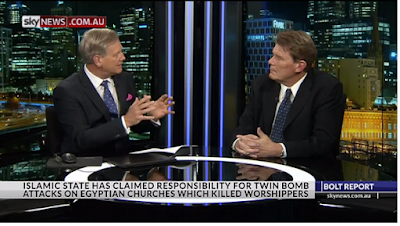
Dr Mark Durie interviewed by Andrew Bolt, Monday 17 April 2017.  “Anglican Pastor Mark Durie questions people’s ability to recognise that religion has shaped culture…”

https://interfaceinstitute.org/2017/04/18/muhammad-killed-many-jesus-none-pastor/
Click to watch the interview on the Interface Institute website...

This wide ranging interview lets Mark Durie explore how religion does influence culture, and how that is critical when considering Muslim culture and issues like FGM, abuse of women, and of course jihad and terrorism.

Unfortunately, I could not embed the video code, so do click over to the Interface Institute to watch this excellent interview.


Dr. Mark Durie is an author, academic, human rights activist, Anglican pastor, a Shillman-Ginsburg Writing Fellow at the Middle East Forum, and Adjunct Research Fellow of the Arthur Jeffery Centre for the Study of Islam at Melbourne School of Theology.

Sunday, June 21, 2020

(VIDEO) Mark Durie - The Hidden History of the Qur’an

How the text of the Qur’an tells a ‘hidden’ story about its own origins.

In his recent book, The Qur’an and its Biblical Reflexes, and in this video (from the June 11, 2020 live webinar), Mark Durie explores how the text of the Qur’an tells a ‘hidden’ story about its own origins, one which is different from the conventional account.

The Qur’an is a difficult book to read and understand. Within the religion of Islam, its text has always been read, explained and understood through the lens of the biography of Muhammad, which was itself based on later, sources committed to writing more than a century after the Qur’an came into existence.

This is a story about a small religious community, not located in Mecca, but somewhere else, enjoying a more moderate climate suited to agriculture but vulnerable to earthquakes, which found itself facing an existential theological crisis. Tune into this webinar to hear Mark Durie tell the story of how this crisis was resolved, and the momentous consequences which continue to influence the lives of billions, right down to the present day.


Tuesday, May 8, 2018

The Church and Islam: 'Dangerous Illusions' can have Eternal Consequences

While preparing to post William Kilpatrick's article,  'The Church and Islam: Dangerous Illusions',  I ended up with quite a long introduction which, I felt, took away from Mr. Kilpatrick's presentation. Therefore, I decided to hold back that introduction and use it to create this follow-up post to further address the 'Dangerous Illusions' which plague those Christians who praise Islam and refuse to see it for what it is.


For an Orthodox Christian to praise and affirm Islam and the Qur'an is akin to spitting on the holy icons of Christ and His Most Pure Mother. When the Muslims invaded Tbilisi, Georgia in 1227, they set icons of Christ and the Theotokos in the middle of the bridge, and promised to spare all those who spit on the icons, denied Christ and converted to Islam. 100,000 Georgian Orthodox Christians chose martyrdom rather than deny Jesus Christ. Let us honor their memory by confessing Jesus Christ to our dying breath! (Source)

William Kilpatrick warned in his article about the threat Islam poses to non-Muslims everywhere, depending on how seriously Muslims take the commands in the Qur'an to wage jihad against the unbelievers. We have seen Islamic jihad attacks climb dramatically in the years since 9/11/2001, with over 33,000 deadly terror attacks since then. This is undeniable evidence that there is something dark and violent at the heart at Islam.

However, in addition to the deadly threat Islam poses in this age, there exists also a grave spiritual danger for Christians who praise and affirm Islam, or who even affirm that Muslims worship the 'Same God' as we do.

Consider:
  • the Qur'an explicitly and vehemently denies Jesus Christ to be the Son of God, [1]
  • presents Jesus as an apostle and prophet only,
  • denies the Holy Trinity, 
  • denies that Christ was crucified, 
  • curses Christians, 
  • and commands Muslims to attack, persecute and kill Christians until they embrace Islam or pay the jizya. [2]

Therefore, whether they realize it or not, a Christian who praises and affirms Islam, Muhammad and/or the Qur'an is praising and affirming a false and militant religion which forcefully denies Jesus Christ and persecutes those who follow Him.

Sunday, March 4, 2018

Mark Durie: 'The threat is not extremism, but Islam'

"Mark Durie warns a cognitive dissonance is stopping many of us from understanding Islamist violence. No, we are not facing the threat of 'extremism' but of Islam."


Another in our series, 'Reconnecting with Mark Durie'. 

Thanks to Andrew Bolt in the Herald Sun for the lede above, and for spreading this excellent analysis more widely. This is a good article to share with friends and family members who insist that there is no connection between Islam and terrorism, or that there are as many dangerous Christian extremists as Muslim ones, or that there is no difference between Islam and Christianity (a variant of the 'Same God' heresy), or ... "What about the Crusades?!"

Excuse me, but your cognitive dissonance is showing

by Mark Durie, June 19, 2017

Herald Sun issue on the June 2017 Islamic jihad
terror attack in Brighton, Melbourne, Australia.

On June 5 in Brighton, Melbourne, at a spot I have driven past countless times, there was a terrorist incident. An armed Muslim, Yacqub Khayre, crying out support for the Islamic State and Al-Qaeda, took a hostage, killed a hotel worker, and engaged police in a shootout, until he was shot dead. It is hard to imagine a less likely place for jihadist violence than affluent, Anglo Brighton, with its tidily quiet tree-lined streets of multi-million dollar homes. If it could happen in Brighton, it could happen anywhere.

Islamic terrorism has been a shock to the secular soul of the West. We have tried to address the security challenge, but are not across the intellectual challenge. Recently in the Australian, Jonathan Cole exploded three myths that hamper efforts to counter terrorism: the essentialist claim that Islam is a religion of peace; the idea that jihadists are political actors exploiting religion; and the idea that jihadists are deranged psychopaths. In response, Cole argued that the terrorism debate needs to engage with Islamic theology.

There is a fourth myth not canvassed by Cole, the ‘myth of the extremist’. This is the idea that the jihadist’s condition is a case of ‘extremism’, a state which transcends any particular religion, and which therefore has nothing particular to do with Islam. The myth is that the problem is not what jihadists believe, but the way they believe; not the content of their faith, but the blindness with which they pursue it. This was the view of Charles Wooley’s recent article ‘Blind faith breeds barbarity in Islam as it did in Christianity’.

Saturday, June 22, 2019

Mark Durie: 'The Qur’an’s Turn To Violence'

"A careful reading of the Qur’an’s text reveals a movement which was faltering under the weight of the non-arrival of a prophesied doomsday scenario. This movement was then saved – and transformed – by a shocking and epoch-making announcement that the swords of believers were to be considered an act of God."


This landmark article by Dr. Mark Durie, based on his groundbreaking new book on the Qur'an, upends the standard approach to understanding the shift of Islam from a relatively benign religious movement (in its so-called "Meccan Period") to an aggressive and militaristic religio-political ideology (typically identified as beginning with the "Medinan Period"), which expanded rapidly through the sword and bloodshed to conquer and subjugate huge swaths of the ancient Christian World lasting over a millennium — vast areas of North Africa, the Middle East, Central Asia, and parts of Europe — and which is directly responsible today for the new era of global martyrdom of Christians in the 21st century, the relaunch of Islam's 1400-year-old jihad against the followers of Jesus Christ.

Dr. Durie's enormous contribution to Quranic studies reveals the desperate and opportunistic theological motives behind Muhammad's — and Islam's — embrace of outright hatred and bloody jihad against non-Muslims. The false prophet and forerunner of Antichrist now stands clearly revealed as the maniacal tool of a bloodthirsty "god," justifying the waging of divine wrath on those who reject Allah and his messenger.


The Qur’an’s Turn to Violence

by Mark Durie, June 7, 2019


The Problem Of Peace Vs. Violence


It is widely recognized that, on the topic of violence, the Qur’an speaks with more than one voice. Some verses speak for peace, and others for war. The conventional explanation is that the difference hinges on the migration of the early Muslim community from Mecca to Medina: in Mecca Muslims were persecuted while Muhammad and the Qur’an preached non-violence and tolerance, but in Medina an Islamic state was established, and Muhammad gathered an army, leading it to triumph in battle against non-believers.

A Conventional Explanation


A conventional Islamic theological interpretation is that in Mecca Muhammad and his community were weak, vulnerable and persecuted, so Allah wisely commended patience and forbearance. However when their power was established in Medina the Muslims were commanded to fight for the cause of Allah, ushering in the triumphant advance of the religion.

It is indisputable that there is a progression from peace to violence in the Qur’an. But is the conventional explanation for that shift supported by the text of the Qur’an itself? Does this explanation make the best sense of the Qur’an?


"If we read the Qur’an with an ear for changes in its theology around the transition between the (so-called) ‘Meccan’ and ‘Medinan’ verses, a different story emerges."


A Different Story To Be Told


In my recently published book, The Qur’an and its Biblical Reflexes, I argue that the traditional explanation is based on a misreading. Setting aside the whole Mecca-Medina narrative (for a whole host of reasons), I argue that if we read the Qur’an with an ear for changes in its theology around the transition between the (so-called) ‘Meccan’ and ‘Medinan’ verses, a different story emerges. This is a story about a crisis of faith and how it was successfully resolved.

Monday, September 29, 2014

Mark Durie: Fear and the rhetoric of 'unprecedented' barbarity

Context and analysis from one of the foremost Christian writers on Islam.

By Mark Durie, September 26, 2014

Many leaders have been stating that the Islamic State’s actions are ‘unprecedented’, ‘extreme’, ‘unique’, or even ‘eccentric’.  Western leaders who are intervening in the Syria-Iraq conflict justify their actions by declaring the Islamic State to be uniquely evil.  In announcing military action and increased security measures, Australian Prime Ministry Tony Abbottsaid of the Islamic State that “To do such evil — and to revel in doing such evil — is simply unprecedented”. David Cameron stated that “ISIL is a terrorist organisation unlike those we have dealt with before.”  Barack Obama claimed “these terrorists are unique in their brutality.”

The actions of Islamic State’s adherents are morally repugnant in the extreme, but only by applying historical amnesia and selective vision could one claim that their evil is unique or unprecedented.

In recent decades, not dissimilar horrors have regularly been reported from around the world, for example the abuses of the ‘Lord’s Resistance Army’, or the genocide pursued by the government of  Sudan against the Christians and traditional believers in the Nuba mountains and  the Blue Nile region, and before that against tribal Muslims in the Dafur region.  Indeed for decades the Sudanese government has unleashed jihad – with all the atrocities of the Islamic State – against its own (black African) citizens, often assisted by jihadis from all over the Arabic world, just like in Syria and Iraq today. 

The Islamic State's actions are also not unique in history.  Quite apart from the horrors of Nazism and Communism, Andrew Bostom has rightly pointed out that the atrocities of the Ottoman Caliphate in exterminating Christians under their rule were greater in magnitude than what is currently being experienced in Syria and Iraq. He writes:
“Notwithstanding the recent horrific spate of atrocities committed against the Christian communities of northern Iraq by the Islamic State (IS/IL) jihadists, the Ottoman jihad ravages were equally barbaric, depraved, and far more extensive. Occurring, primarily between 1915-16 (although continuing through at least 1919), some one million Armenian, and 250,000 Assyro-Chaldean and Syrian Orthodox Christians were brutally slaughtered, or starved to death during forced deportations through desert wastelands. The identical gruesome means used by IS/IL to humiliate and massacre its hapless Christian victims, were employed on a scale that was an order of magnitude greater by the Ottoman Muslim Turks, often abetted by local Muslim collaborators (the latter being another phenomenon which also happenedduring the IS/IL jihad campaign against Iraq’s Christians).”
Bostom also points out that the Yazidi’s recent sufferings at the hands of the IS are nothing new, but are consistent with a pattern of genocidal assaults against them which stretches back to Ottoman times.

What is so disturbing to Western people about the Islamic State is not the extremity of the barbarity, which is far from unprecedented, but the fact that so many Western citizens have been signing up with IS, and the psychological warfare being directed by IS against the outside world, including the West, manifested, for example, in the videos of beheadings, and the way some enslaved, raped women have been forced to phone their families to tell them about their abuse, even while it is going on. 

What is unique for us in the West is the way the fear is now upon our doorstep: this is the fear that what is happening there will come back home to haunt us.

The challenge facing the West now is not simply stopping the Islamic State – as important as that is – but what to do about the fear.

Dropping bombs on the Islamic State will not do it.


Mark Durie is the pastor of an Anglican church, a Shillman-Ginsburg Writing Fellow at the Middle East Forum, and Founder of the Institute for Spiritual Awareness.  His book The Third Choice explains the implications for Christians of living under Islamic rule.

Originally posted at: http://blog.markdurie.com/2014/09/fear-and-rhetoric-of-unprecedented.html


Tuesday, November 17, 2015

Mark Durie: 'Paris attacks were not 'nihilism' but sacred strategy'

One of the most important Christian writers on Islam and the global Muslim persecution of Christians, Anglican pastor and theologian Mark Durie, weighs in on the struggle to accurately render the meta-narrative concerning the Paris Jihad Attacks.

For a variety of reasons, there are a great many policymakers, media analysts, elected officials, Christian leaders, and ordinary citizens who are having an extremely difficult time understanding what is happening. Mark Durie offers a practical corrective to the West's epistemological blindness.


Paris attacks were not 'nihilism' but sacred strategy
by Mark Durie, November 17, 2015

LEADING commentator Janet Daley's article in Saturday's TelegraphThe West is at war with a death cult’ stands for everything that is woeful about European elites’ response to Islamic jihad.


It is a triumph of religious illiteracy.

The jihadist enemy, she asserts, is utterly unintelligible, so beyond encompassing in ‘coherent, systematic thought’ that no vocabulary can describe it: ‘This is just insanity’, she writes. Because the enemy is ‘hysterical’, lacking 'rational demands', 'negotiable limits,’ or ‘intelligible objectives’ Daley claims it is pointless to subject its actions to any form of historical, social or theological analysis, for no-one should attempt to ‘impose logic on behaviour that is pathological’.

Despite this, Daley then ventures to offer analysis of and explanations for ISIS’ actions, but in doing so she relies upon her own conceptual categories, not those of ISIS.

Her explanations therefore fall wide of the mark.


‘Civilians’

Daley writes: ‘We face a violent and highly contagious madness that believes the killing of civilians is a moral act.’  Here she appeals to Western concepts of war, reflected, for example, in the Geneva Convention, which provides detailed principles for the ‘protection of civilian persons’.

Yet the first step in understanding a cultural system alien to one’s own, is to describe it in its own terms.

ISIS does not subscribe to the Geneva Convention.  Its actions and strategies are based upon medieval Islamic laws of jihad, which make no use of the modern Western concept of 'civilian’.

They do, however, refer to the category of disbelievers (mushrik or kafir).

ISIS believes that killing disbelievers is a moral act, in accordance, for example, with Sura 9:5 of the Qur’an, which states :‘Fight and kill the idolators (mushrik) wherever you find them'.


Not nihilism

Daley writes: ‘The enemy has stated explicitly that it does not revere life at all’ and ‘Civilians are not collateral damage in this campaign: their deaths are the whole point.’  She goes on to lament that the latest French attacks lack any purpose, but are ‘carried out for the sheer nihilistic thrill of it’.

The claim that ISIS does not ‘revere life’ seems to refer to any number of statements by Islamic radicals, including an ISIS militant who vowed to ‘fill the streets of Paris with dead bodies’, and boasted that ISIS ‘loves death like you love life’ (see here).  This is a theological reference to a series of verses in the Qur’an in which Jews are criticised for desiring life (Sura 2:94-96, 62:6-8).

According to the Qur’an, loving life is a characteristic of infidels (Sura 3:14; 14:3; 75:20; 76:27) because it causes them to disregard the importance of the next life.  The taunt much used by jihadis, ‘We love death like you love life’,  implies that jihadis are bound for paradise while their enemies are hell-bound.

The point of these statements is that Muslims are willing to fight to the death, while their infidel enemies will turn back in battle. This is not about reverence for life, but about who has the will to win. This has nothing to do with nihilism, which is a belief that there are no values, nothing to be loyal to, and no purpose in living. In fact ISIS fighters have strong and clear loyalties and values, alien though they may be to those of Europe.

Wednesday, December 16, 2015

Mark Durie: Anyone Using The Phrase ‘Islam Is A Religion Of Peace’ Needs To Read This

"One may well ask how ‘the religion of peace’ became a brand of Islam, for the phrase cannot be found in the Qur’an, nor in the teachings of Muhammad."

by Mark DurieIndependent JournalDecember 17, 2015


Days after the ISIS-inspired terrorist attack in San Bernardino, President Obama’s address to the nation concerning the threat of ISIS missed the mark. In fact, President Obama seemed at times to be more concerned with Americans ostracizing Muslim communities through “suspicion and hate,” than he was with protecting innocent American civilians from murder in the name of radical Islam.

It is high time for western political leaders to stop responding to terrorism by naming Islam as ‘the religion of peace’. It is time to have a hard conversation about Islam.

The West is in the throes of acute cognitive dissonance over Islam, whose brands are at war with each other. On the one hand we are told that Islam is the Religion of Peace. On the other hand we are confronted with an unending sequence of acts of terror committed in the name of the faith.

There is a depressing connection between the two brands: the louder one brand becomes, the more the volume is turned up on the other.

Saturday, January 25, 2014

MUST READ: Dr Mark Durie speaks about his book, 'The Third Choice'


This excellent discussion with Mark Durie about Islam, dhimmitude, and his landmark book, The Third Choice, dates from 2010. This book should be required reading for anyone seeking to understand Islam and the threat it poses. It is an engaging read, and is a great educational tool, equipping us with not just historical and theological facts about Islam, but also an understanding of the ideological system of Islam, and what that means for non-muslims.

If you don't have The Third Choice, buy it today. If you do have it, you know how important it is. — Buy copies as gifts for your friends and family and/or recommend it to them.


The Third Choice
Article and Interview by Mark Tapson, September 20, 2010
FrontPage

Before it was innocuously renamed Park 51, the Ground Zero mosque development had been known as the Cordoba House, which proponents claimed referred to a supposed golden age of multi-faith tolerance under Islamic rule. What they neglect to mention is that historically, non-Muslims under Muslim rule have been presented with three choices: conversion to Islam, death, or the subservient status known as dhimmitude.

A new book sheds light on that little-understood condition and its contemporary relevance. The Third Choice: Islam, Dhimmitude and Freedom by Dr. Mark Durie was released in February (2010) by Deror Books and short-listed for Australian Christian Book of the Year. A former linguistics scholar, Durie is now the Vicar of St. Mary’s Anglican Church, Caulfield in Melbourne, Australia. He writes and speaks extensively in Australia and internationally about Islam, interfaith dialogue, religious conflict, and the persecution of religious minorities, especially Christians living under Sharia law.

I caught up with the author just prior to his recent arrival in Los Angeles to promote the book.

MT: Dr. Durie, I’d like to begin talking about The Third Choice by asking what inspired you, as an Anglican priest, to write a study of Islam and dhimmitude?

MD: I first became interested in Islam when doing linguistic field work in Aceh, Indonesia, in the early 1980’s. The Acehnese people are proud of their Islamic identity, but despite enjoying countless discussions about religion with them, I made no attempt to study Islam formally; my whole focus was on linguistic research. But I couldn’t escape learning about jihad, because it played such a large role in the historical consciousness of the people. An amazingly large number of works of Acehnese literature are jihad epics. Another aspect of my experience was contact with local Christians; this is how I came to know of the difficult circumstances of non-Muslims living in an Islamic society.

When I left academia to become an Anglican minister, around 1998, I thought I was leaving Islamic jihad well behind me. I had no idea of the depth and breadth of the global Islamic movement. Then as I watched the burning World Trade Center towers collapse in the New York morning sunshine, I knew there was no ideology on this earth other than Islamic jihad which could have inspired such an attack. It was no surprise when verses from the Koran reportedly found in the backpacks of the terrorists were exactly the same verses which had figured so prominently in Acehnese jihad epic poems from over a century ago.

At that point I knew I had to try to understand Islam properly. So I read the hadiths, the Koran, and Ibn Ishaq’s biography of Muhammad in the months after 9/11, with the eye of a theologian – I was constantly asking how this material would form people’s spiritual identity. This exploration made me deeply troubled. The persona of Muhammad which arose before me from Islam’s primary sources shocked me to my core. I thought, “If this man’s life is supposed to be the best example, we are all in deep trouble.” 

Tuesday, March 6, 2012

Speaking of Iconoclasm and the Breaking of Crosses...

Dr Mark Durie has written a solid and measured piece on the recent desecration of Christian (and Jewish) WWII war graves in Libya by a Muslim group. Contrary to assertions in the media that this act was in retaliation for the burning of Koran's in Afghanistan, Durie uses this incident to trace the history and continuity of Islam's hatred of the cross directly back to Muhammad, and to a prophecy of his in a hadith where he claims Jesus will return to "break the crosses," i.e., destroy Christianity. 'Breaking the Crosses' has always been a central tenet of Islam.

This is a must read as we continue to educate ourselves on orthodox Islam's traditional, canonical position vis a vis Orthodox Christianity.

Desecrating Christian and Jewish Graves in Libya
Mark Durie
March 5, 2012

Many commentators have expressed outrage at the recent destruction of British and Canadian war graves in Benghazi, Libya (in this YouTube Video).

I watched the video and saw, not just the desecration of graves, but attacks on crosses.  The radical Muslims in the video who are kicking over and smashing headstones marked with crosses (and one with a Star of David), also take pains to demolish a tall 'Cross of Sacrifice' standing at the edge of the cemetery.  This is no 'furious mob' on a 'rampage' as a Daily Mail report put it, a distorted report which beggars belief.  Nor is there any evidence in what the men are recorded as saying that they are angry or reacting to Koran burning by the US military.  They are methodically, deliberately, and in an organized fashion, going about destroying crosses and objects marked with crosses.  Their mood seems happy, even celebratory.  Every now and again a cry Allahu Akbar rings out.  Or a chuckle of joy.  They pass comments on the graves as they kick them over:  "Break the cross that belongs to those dogs",  "This is the grave of a Christian', and "This tomb has a cross on it, a kaffir [disbeliever]".


An Australian government minister, Craig Emerson, whose father served in Libya in World War II, commented "There is nothing in Islam that would warrant this sort of behavior."

But is this true?  Or just wishful thinking?

Certainly many Libyans and Muslims of other nationalities have expressed their abhorrence of these acts.  It would be completely wrong to attribute sympathy for such an attack to Muslims as whole.

But all the same, was this attack on war graves truly senseless and without foundation or precedent in Islam?  Regrettably, the answer must be 'No'.

The phenomenon of cross-destruction goes back to the life and example of Muhammad.  A tradition reported by al-Waqidi said that if ever Muhammad found an object in his house with the mark of a cross on it, he would destroy it. (W. Muir, The Life of Muhammad. Volume 3, p.61, note 47.)

In the YouTube video, when one of the men says 'Break the cross that belongs to those dogs', he uses the same classical Arabic phrase 'break the cross' (the Arabic root is k.s.r 'break') which is found in a famous hadith (tradition) about Jesus — understood in Islam to be a Muslim prophet — who will return to the earth as a cross-destroying sharia enforcer:

Narrated Abu Huraira:
Allah’s Apostle said, ‘By Him in Whose Hands my soul is, surely [Jesus,] the son of Mary will soon descend amongst you and will judge mankind justly [as a Just Ruler]; he will break the cross and kill the pigs and there will be no jizya [i.e. no taxation taken from non Muslims: because they will all be forced to convert to Islam]. …’ (Sahih al-BukhariThe Book of the Stories of the Prophets. 4:60:3448.)
This phrase 'break the cross' is religious and ritualistic in its overtones, invoking as it does the canon of Islam.  It is like a Christian saying 'forgive us our trespasses' or 'deliver us from evil'.  This is a clear reference to the words of Muhammad, and invokes his authority for the deed being performed.

To pious Muslims, Muhammad is regarded as the 'best example' for Muslims to follow, so it is hardly surprising if his enmity to the cross is shared by at least some Muslims today, and they recite his words while emulating his deeds.  The following are just some of many examples of cross destruction which can be culled from media reports of recent years:

  • Two days before Christmas in 1998, a Catholic church in Faisalabad, Pakistan had its crucifix pulled down by a Muslim leader.
  • On March 18, 2004, an Albanian mob attacked and desecrated the church of St Andrew in Podujevo, Kosovo. Photographs distributed to the international media show Muslims, who had climbed up onto the roof, breaking off the prominent metal crosses attached there. There have also been many instances of Muslim mobs smashing crosses in Christian graveyards acrossKosovo.
  • In April 2007, in the Al-Doura Christian area of Baghdad, Muslim militants instructed Christians to remove visible crosses from atop their churches, and issued a fatwa forbidding Christians from wearing crosses.
  • When Hamas took control of Gaza in 2007, some of its militias went on a cross-destroying rampage. The Rosary Sisters convent and school in Gaza was ransacked and looted by masked men and crosses were specifically targeted for destruction. A Christian resident of Gaza also reported having a crucifix ripped from his neck by someone from the Hamas Executive Force, who said ‘That is forbidden.’
  • On Monday 29 October 2007, in the Malaysian Parliament, a parliamentarian, Tuan Syed Hood bin Syed Edros complained about the ‘display of religious symbols’ in front of church schools: ‘I, as a responsible person to my religion, race, and country, I state my views that … these crosses need to be destroyed …’
  •  Michael Yon has reported on an poster found in Afghanistan ("Destroying the cross is an Islamic obligation") which instructs Muslims to destroy objects with crosses on them.
Antipathy to the cross among Muslims is not limited to Islamic societies.  In November 2004, Belmarsh Prison in England was reported to have plans to spend £1.6 million on a mosque. The facility already maintains a multi-denominational chapel, but this has been rejected for use by the Muslim inmates, some of whom had been convicted on terrorism charges, because the chapel contains crosses which have to be covered up when the Muslims say their prayers.
    No less a figure than the former Archbishop of Canterbury George Carey was compelled to remove his pectoral cross when he had to make a forced stop in Saudi Arabia in 1995. The incident is described by David Skidmore in the Episcopal News Service:
    Carey’s flight out of Cairo for Sudan was forced to make an intermediary stop in Saudi Arabia. On the approach to the Red Sea coastal city of Jidda, Saudi Arabia, Carey was told to remove all religious insignia, including his clerical collar and pectoral cross.
    There is another pattern at work here, which is the destruction of non-Muslim (infidel) graves and religious heritage.  The Taliban's destruction of ancient Buddhist monuments in Afghanistan is a well known example, as was the deliberate destruction of around 38,000 Jewish graves on the Mount of Olives, some of which were over 1,000 years old, during Jordan's occupation of Jerusalem from 1948 to 1967.

    It must also be acknowledged that radical Sunni Muslims have a long history of destroying even Muslim graves, if they have become sites of pilgrimage and veneration.  The Wahhabis of Saudi Arabia have been known for more than one hundred years for destroying venerated grave sites, including those of some of Muhammad's own relatives (see a Shi'ite lament here).  In Libya Salafists have also been busy destroying graves of Sufi saints.  Likewise, in Somalia the al-Shabab movement has been destroying Sufi graves (as well as war graves of Christians: see here).

    In the light of all these parallels, the destruction of this cemetery cannot be regarded as simply a senseless act done by a 'rampaging mob'.  It was a thoughtful, deliberate act, a ritualistic act which conforms to a widely attested pattern, namely the destruction of crosses, support for which can be found in canonical Islamic sources and the teaching of Muhammad.  It also conforms to a pattern of destruction of grave sites, of both non-Muslims and Muslims, by Muslims.

    This event had little if anything to do with Koran-burning by the US military.


    Source.

    Sunday, August 17, 2014

    Mark Durie - ‘Three Choices’ and the bitter harvest of denial

    How dissimulation about Islam is fueling genocide in the Middle East

    What follows are key excerpts from a lengthy (4000+ words) article by Dr. Mark Durie, whose books Which God? and The Third Choice should be required reading for all Christians, especially for Orthodox Christian hierarchs, pastors and teachers. An orthodox Anglican with practical experience in Christian-Muslim relations in Australia, Dr. Mark Durie is a trusted voice to heed in these dark times.

    I strongly recommend reading carefully and absorbing the full article, as well as Dr. Durie's books. For a shorter summary of the article with comment by Jenny Taylor see here.

    =======

    ‘Three Choices’ and the bitter harvest of denial: How dissimulation about Islam is fueling genocide in the Middle East

    In northern Iraq religious genocide is reaching end-game stage.  Islamic State (IS) soldiers, reinforced with military equipment originally supplied by the US, are driving back Kurdish defenders who had been protecting Christians and other religious minorities.  While hundreds of thousands of refugees have been fleeing into Kurdistan, around 40,000 Yazidis and some Christians are trapped on Mount Sinjar, surrounded by IS jihadis.  (Yazidis are Kurdish people whose pre-Christian faith derives from ancient Iranian religious traditions, with overlays and influences from other religions.)...

    The IS jihadis are killing the men they capture.  In one recent incident 1500 men were executed in front of their wives and families.  In another incident 13 Yazidi men who refused to convert to Islam had their eyes plucked out, were doused with gasoline and burned alive.  When the men are killed, captured women and children are enslaved to be used for sex, deployed as human shields in battle zones, or sold to be used and abused as their new owners see fit.

    The United States has ironically called for greater cooperation.  UN Ambassador, Samantha Power, urged ‘all parties to the conflict’ to allow access to UN relief agencies. She called on Iraqis to ‘come together’ so that Iraq will ‘get back on the path to a peaceful future’ and ‘prevent ISIL from obliterating Iraq’s vibrant diversity’.

    Of course it is not ‘vibrant diversity’ which is being wiped out in Iraq, but men, women and children by their tens of thousands.  This is not about the failure of coexistence, and the problem is not ‘conflict’. This is not about people who have trouble getting on and who need to somehow make up and ‘come together’. It is about a well-articulated and well-documented theological worldview hell-bent on dominating ‘infidels’, if necessary wiping them off the face of the earth, in order to establish the power and grandeur of a radical vision of Islam.  

    [...]

    These events ought to be sobering to the West, not least because thousands of the IS jihadis were raised and bred in the mosques of Europe, North America and Australia, not to mention the madrassas of nations such as Malaysia, Bangladesh and Indonesia.  Having been formed by the theology of radical Islam in their home societies, would-be jihadis are flocking to Syria and Iraq where they seek victory or martyrdom, killing and raping as they go.

    Why is this so?  How did the Arab Spring, hailed by so many armchair western commentators as the next best thing for the Middle East, blossom bright red into a torrent of blood?

    Part of the answer is that the West is in the grip of theological illiteracy.  It has stubbornly refused to grasp the implications of a global Islamic revival which has been gaining steam for the best part of a century.  The Islamic Movement looks back to the glory days of conquest as Islam’s finest hour, and seeks to revive Islamic supremacy through jihad and sacrifice.  It longs for a truly Islamic state – the caliphate reborn – and considers jihad to be the God-given means to usher it in.

    Tuesday, February 19, 2013

    Could Islam be 'Reformed'?


    This is a very significant article (originally published in 2010) by one of the most insightful writers on Islam today, Dr. Mark Durie of Australia, author of Revelation: Do We Worship the Same God?, and The Third Choice: Islam, Dhimmitude, and Freedom. As with most things related to Islam, when discussing the idea of 'reforming' it, we must be very clear about our terms and what precisely we mean. This Dr. Durie does, with a patient pedagogy that permeates all his writings.


    "They ARE the Reformation"

    By Mark Durie

    On December 1, 2009, Wafa Sultan and Daniel Pipes debated whether and to what extent a 'moderate' Islam is possible.  Although both are opponents of Islamic radicalism, on this question they did not agree.

    Wafa Sultan argued that Islam is Islam, pure and simple, and there can never be such a thing as 'moderate Islam'. On the other hand, Daniel Pipes argued that the answer to radical Islam must be moderate Islam: Islam can be moderated, and the effort to support Muslim moderates is both necessary and worthwhile.

    The two participants in the debate are as contrasting a pair as one could imagine.  The ex-Muslim Wafa Sultan is undoubtedly a powerful voice in her native Arabic, and even in English she is impassioned and speaks with a memorable turn of phrase.  In contrast, Daniel Pipes is measured and softly spoken, carefully and persistently making his case.  He challenged her to explain what practical solutions she could offer to the challenge of radical Islam.  She challenged him to show the results produced by his promotion of moderate Islam.

    I commend the debate to readers, not because one party won the day, but because the speakers were addressing important questions, which will exercise many minds for years - perhaps generations - to come.

    My concern here however is to focus on an important comparison between medieval Christianity and present-day Islam, which was raised by someone in the audience, who asked:

    "I will suggest that this [radical Islam] is not that different from Christianity at the time of the crusades, which was a very belligerent religion compared to what it is today.  So look at that in terms of the evolution of a religious doctrine, and how long does that take?"

    The questioner went on to speculate whether the acceleration of change, which we see in the world around us, could allow a reformation of Islam to happen more rapidly than happened with Christianity.

    On countless occasions over the years I have heard this comparison: Christianity has undergone its reformation, so why not Islam? The European reformation took centuries: why wouldn't an Islamic reformation also take time?  Isn't it all a matter of time.

    This line of thinking arises from a world view which looks at ideologies through the lens of 'progress' or 'evolution', shaped by a kind of Darwinism.  The underlying presupposition is that human societies evolve as time passes, progressing and becoming more humane and more advanced.  

    Clearly not everyone in the West works from this assumption, but many do.  As recently as the 1960's, it was even fashionable among Western secularists to believe that religion had had its day altogether. Many announced that God was, at last, 'dead'.  The death of God was widely  regarded as one of the positive benefits of progress.

    The idea of progress is not simply a concept - it has become part of the warp and woof of our everyday language.  We speak of ideas, policies and practices as 'backward' or 'regressive', 'progressive' or 'advanced'.  Time has become a yardstick to measure the ever-improving character of human social order.  It is the embedding of the idea of progress into our everyday language which gives credibility to the question "Can Islam not undergo its own reformation too?"

    But do societies really tend to evolve, becoming more and more advanced?  Do social institutions inevitably improve with time?  Is progress more than just an idea - is it a law which governs the history of religions?

    I find it very difficult, looking back over the ethical wreckage of the 20th century, to subscribe to the presupposition of progress. The worst atrocities of the past 100 years were perpetrated by regimes which held up an ideal of social evolution, and which were motivated by a vision of human progress.  One recalls, for example of the careers of Hitler, Stalin, Mao Zedong and Pol Pot.  Such shameful monuments to 'progress' as National Socialism and Communism do not inspire confidence that human societies and ideologies can and must improve with time.

    There is another problem with comparing today's Islam with pre-Reformation Christianity, and this has to do with the meaning of 'reformation' itself.  It has become accepted by many thinking people today that 'reformation' means some kind of softening, a 'moderating' process.  Indeed a manifestation of 'progress'.  This is far from the truth.

    Throughout the whole medieval period the idea of reformation (reformatio) was prestigious, and many reform movements chased after this ideal.   Reformation meant going back to one's roots, and just about everyone agreed that this was a Good Thing.  For medieval Christians, a reformed Christianity meant being more Christ-like, more apostolic, and more Pauline.  Wealthy St Francis read Jesus' words about giving away one's possessions to feed the poor, so he followed this teaching, and many flocked to join him.  Thus the Franciscans were founded as a reform movement.  

    St Francis was a radical reformer. He was not inspired by a vision of making Christianity more moderate and progressive.  What moved him was a desire to follow the Jesus of Gospels.  

    Likewise Luther recalled the words of St Paul about freedom in the letter to the Galatians - 'for freedom Christ has set us free' - to exort the German Nobles to claim their own freedom from ecclesiastical authority.

    The European Reformation - so often invoked in comparisons with Islam today - was driven by a desire to re-form Christianity a second time,  taking it back to its roots.  It sought to move ahead by going backwards.  Its inner logic had nothing to do with the modern idea of progress or the Darwinian concept of 'evolution'.  The Reformation was not a 'progressive' movement in the modern sense, but one which sought to 'regress', renewing the example of Christ and his apostles.  

    This is why Luther and other reformers encouraged believers to read their Bibles for themselves, in their own native tongue.  Luther regarded it as the duty of every Christian to be constantly renewing their own faith from the original sources.  LIke St Francis, Luther was a Christian radical.

    It is true that some changes brought in by the European Reformation had a moderating effect on Western intellectual life. There developed a greater emphasis on freedom and individual responsibility, for example. The Protestant work ethic was one bi-product of this emphasis. Yet these developments did not take place out of a desire to develop a more moderate form of Christianity, but because they they were regarded as conforming more to the  Bible.

    Therefore, according to the core meaning of 'reformation' - a return to one's roots - reforming Islam  would mean making it more Muhammadan.  An Islamic reformation would produce a religion which is closer to the Koran, and above all, closer to the example and teaching of its founder.  

    The hankering of some Westerners after an Islamic reformation begs the question of what would it mean to be follow Muhammad's example more closely?

    As it happens, such a movement has been underway for more than 100 years, and is in full swing today.  It is what we know today as Islamic radicalism. The ideal of an Islamic reformation has produced, among many other results, the global jihad movement, the push for sharia revival and reimplementation of the Caliphate. This is what a desire to revive the example and teaching of Muhammad has led to.

    There are two two main reasons why renewing the example of Muhammad leads to Islamic radicalism. 

    One is that Muhammad combined within himself the offices of king, judge, general and religious leader, thus unifying politics, law, the military and religion.  To follow his example means creating a theocratic political order, where the laws of the land are controlled by Islamic theology.  In contrast Christian tradition has always distinguished the secular from the ecclesiastical, based on the older Hebrew religious distinction between priests and kings.  This feature of medieval Christianity - the distinction between religion and politics - was severely criticised by famous Muslim scholar Ibn Khaldun.  Muslim thinkers had always regarded it as one of the key weaknesses of Christianity.

    The second reason why renewing Islam leads to radicalism is that many of the harsher elements of Islamic law - such death for apostates, stoning adulterers, cutting off the hands of thieves, enslaving one's enemies, and killing non-believers - are firmly grounded in Muhammad's example.

    Australian Muslim Waleed Aly was entirely correct when he said Islam has already had its Reformation, and the outcome has been Islamic radicalism:  

    "Still, Western calls for an Islamic Reformation grow predictably and irrepressibly stronger, while those familiar with the Islamic tradition easily observe that radical and terrorist groups such as al-Qa'ida and the Taliban, cannot be cured by Reformation for the very simple fact that they are the Reformation." [People like us: how arrogance is dividing Islam and the West, p.xv].

    For those today whose world view is shaped by the ideal of progress, and look out upon Islam peering through the frame of Western assumptions about 'backwardness', 'progress' and 'evolution', Waleed Aly's insight can be difficult to grasp.  Yet it is essential that it be understood and appreciated.  

    In today's world, if what is needed is more moderate manifestation of Islam, then the very last thing that could ever accomplish this would be an Islamic Reformation.


    Wednesday, October 7, 2015

    Islamic Indoctrination Taking Place in Georgia Public Schools

    Georgia Public Schools are teaching key components of Islamic dawah: “schools are reportedly forcing students to learn the Five Pillars of Islam—the creed one must learn to convert—and teaching students that Allah is the same God worshipped by Christians.” 

    So far, unlike in Tennessee, they haven’t [yet] forced the students to actually recite the Shahada, the Muslim confession of faith.

    Further, homework assignments are designed to indoctrinate students into accepting this assertion as fact, when it is a strongly contested point which many Orthodox and traditional Christians flatly reject, and with compelling reason.  In addition, the volume of Georgia school materials on Islam outnumber those on Christianity by up to 10 to 1, further highlighting the preferential treatment accorded Islam “in a way that could violate the U.S. Constitution.”

    The “Same God” assertion is indeed a primary plank of Islamic dawah (proselytizing), and together with Islam’s claim to be an “Abrahamic Faith” is one of the main tools used by Muslim apologists to advance their agenda within unsuspecting Christian and Jewish communities.

    Besides the theological issues with the “Same God” claim itself, Mark Durie explains some of the many dangers this and the “Abrahamic Faith” assertion conceals:

    Tuesday, April 1, 2014

    'Jesus Is Muslim' and 'Mohammad is in the Bible' Billboards appear in Ohio


    Will Christians do more than merely protest, and use this as a 'Teachable Moment'? (Story reported at Christian Post.)
    _______

    Order the book.
    This is exactly the sort of false Islamic teaching I refute in my book, Facing Islam: What the Ancient Church has to say about the Religion of Muhammad.

    No Christian, least of all an Orthodox Christian, should be swayed or confused by such claims, which are easily proven to be both theologically and historically false. So let's explore the claims of these billboards.

    Here is an excerpt from the conclusion of my chapter, 'Do Muslims and Christians Worship the Same God?', which features an extensive quote from Dr Mark Durie's book, Revelation - Do We Worship the Same God? (now revised and re-published under the title Which God? Jesus, Holy Spirit, God in Christianity and Islam):

    Sunday, February 19, 2012

    Crash Course on the Muslim Brotherhood

    Since the beginning of the 'Arab Spring' revolutions a year ago, the Muslim Brotherhood has been lauded by the Obama Administration as a "largely secular" organization. The Brotherhood (or Ikhwan) was able to position themselves as "moderates" in the political upheaval after the overthrow of Egyptian dictator Hosni Mubarak thanks to the rise of an (even more) extremist Salafist group. In the Parliamentarian elections last Fall, the Ikhwan and the Salafist groups won a combined 65% of the vote, decisively sending Egypt on the path towards becoming an Islamist state where the constitution is fully based on the Shariah. The Obama Administration has chosen from the outset to partner with the Ikhwan, not the secular, liberal reformists in Egyptian society.

    For background and context, watch the 4 minute video below, which ably condenses Andrew McCarthy's significant book, The Grand Jihad.  (Read an interview with McCarthy about the book here.  Order the book here.)

    Then scroll down for an alarming article by Dr Mark Durie which elaborates the issues at play.

    And as the political power drama plays itself out in Egypt (and in the United States), the Copts are ever more aggressively persecuted, not just by Muslim mobs, but by government forces...


    Saboteurs for the Islamic Movement?
    Dr Mark Durie
    February 17, 2012

    For years now I have been visiting the US regularly, and usually make my way to Washington DC, where I have had many opportunities to meet with journalists, politicians, lobbyists and other experts who are paying attention to the course of Islam in the US.  These conversations, and a whole host of reports from a wide variety of sources, including White House official statements, have made it obvious to me that there is increasing trend for US government agencies to align with and empower radical Muslim agendas. At the same time, American elites are being cowed into silence.  If anything, they seem less capable of critiquing radical Islam than they were a decade ago.  An Orwellian veil of silence through control of public discourse is being pulled over eyes of many in the Land of the Free.

    To put it bluntly, the government of the United States has become an ally of the radical Islamic Movement, under the careful guidance of Muslim Brotherhood agents in the US.  The first victims of this alliance are secular and liberal activists all across the Middle East, whose bodies are being broken and voices silenced because of official American engagement with and support for the cause of radical Islam.

    I was discussing this observation with friends who had made their way to Australia from the former Soviet Union decades ago.  Their comment was:  "In Russia we just called people like that saboteurs."  They were referring to the present US admnistration.  This view may seem absurd, but the evidence is clear enough.  

    In the light of these troubling thoughts, I was startled to come across the following recent article by Essam Abdallah, a prominent Egyptian liberal intellectual.  He claims that radical Islam is winning in the Middle East because of carefully targetted support for the Islamic Movement by the US.

    Interested readers may also wish to follow the commentary - and follow upcoming discussion of this issue - at the 
    Investigative Project.

    ======


    Islamist Lobbies’ Washington War on Arab and Muslim Liberals

    The most dramatic oppression of the region’s civil societies and the Arab Spring is not by means of weapons, or in the Middle East. It is not led by Gaddafi, Mubarak, Bin Ali, Saleh, or Assad. It is led by the powerful Islamist lobbies in Washington DC. People may find my words curious if not provocative. But my arguments are sharp and well understood by many Arab and middle eastern liberals and freedom fighters. Indeed, we in the region, who are struggling for real democracy, not for the one time election type of democracy have been asking ourselves since January 2011 as the winds of Arab spring started blowing, why isn’t the West in general and the United States Administration in particular clearly and forcefully supporting our civil societies and particularly the secular democrats of the region? Why were the bureaucracies in Washington and in Brussels partnering with Islamists in the region and not with their natural allies the democracy promoting political forces?

    Months into the Arab Spring, we realized that the Western powers, and the Obama Administration have put their support behind the new authoritarians, those who are claiming they will be brought to power via the votes of the people. Well, it is not quite so.

    The Muslim Brotherhood, the Islamic Nahda of Tunisia, the Justice Party of Morocco and the Islamist militias in Libya’s Transitional National Council have been systematically supported by Washington at the expense of real liberal and secular forces. We saw day by day how the White House guided carefully the statements and the actions of the US and the State Department followed through to give all the chances to the Islamists and almost no chances to the secular and revolutionary youth. We will come back to detail these diplomatic and financial maneuvers which are giving victory to the fundamentalists while the seculars and progressives are going to be smashed by the forthcoming regimes.

    In the US, there are interests that determine foreign policy. And there are lobbies that put pressure to get their objectives met in foreign policy. One of the most powerful lobbies in America under the Obama Administration is the Muslim Brotherhood greater lobby, which has been in action for many years. This lobby has secured many operatives inside the Administration and has been successful in directing US policy towards the Arab world. Among leading advisors sympathetic to the Ikhwan is Daliah Mogahed (Mujahid) and her associate, Georgetown Professor John Esposito. Just as shocking, there is also a pro-Iranian lobby that has been influencing US policy towards Iran and Hezbollah in the region.

    One of the most important activities of the Islamist lobby in the US is the waging of political and media wars on the liberal Arabs and Middle Eastern figures and groups in America. This battlefield is among the most important in influencing Washington’s policies in the Arab world. If you strike at the liberal and democratic Middle Eastern groups in Washington who are trying to gain support for civil societies in the region, you actually win a major battle. You will be able to influence the resources of the US Government to support the Islamists in the Middle East and not the weak democrats. This huge war waged by the Islamist lobbies in America started at the end of the Cold war and continued all the way till the Arab spring. The two main forces of this lobby are the Muslim Brotherhood fronts and the Iranian fronts. According to research available in the US, the Ikhwan fronts such as CAIR (Council on American Islamic Relations), led by Hamas supporter Nihad Awad, as well as the Muslim Public Affairs Council, the Islamic Society of North America, and others waged their political war to block the representatives of Arab liberals and Muslim moderates from making their case to the American public. The Iranian lobby, exemplified by the National Iranian American Committee (NIAC), led by Trita Parsi, has been hitting at Iranian exiles.

    Since the 1990s CAIR and its allies have attacked Copts, Southern Sudanese, Lebanese, Syrian reformers, Assyrians and Chaldeans, and Muslim dissidents in the United States. The Ikhwan of America demonized any publication, book, article, or interview in the national media or local press raising the issue of secular freedoms in the Middle East. The Islamists wanted to eliminate the liberal cause in the Arab world and replace it with the cause of the Islamists. What is also shocking is that CAIR and its allies stood by the oppressive regimes and visited them, claiming they speak on behalf of the peoples. CAIR and the Brotherhood fronts in America destroyed systematically every project that would have defended the seculars and liberals originating from the Middle East. The notorious and well-funded Islamists of the US allowed no book, documentary, or show on the liberals in Arab civil societies to see the light.

    Thanks to this powerful lobbying campaign, the American public was not given a chance to learn about the deep feelings on the youth in the region. Americans were led to believe that all Muslims, all Arabs and all Middle Easterners were a strange species of humans who cannot appreciate freedom. Instead, the American Islamists, helped by apologists on the petrodollars payrolls, convinced the mainstream media that the Arab world has authoritarians and Islamists only.

    Dr Shawki Karas, president of the American Coptic Association, told me in the late 1990s how he was harassed by Islamist activists for speaking up against the Mubarak regime and the Muslim Brotherhood in America. He was threatened with losing his job at the college where he taught. Reverend Keith Roderick, who has assembled a coalition of more than 50 group rights from the Muslim world, was severely attacked by the Islamists and was threatened to be removed from his church position. Muslim American leaders who are conservative and secular, such as Dr Zuhdi Jasser, were crucified by CAIR and the Brotherhood for daring to challenge the Party line of the Isl.amists in America and claiming that the Jihadists are the problem in the region. Muslim liberal dissidents such as Somali Ayan Hirsi Ali, Saudi Ali al Yammi, Syrian Farid Ghadri, Iranian Manda Ervin, and many others were trashed by the Islamist lobbies to block them from defending the causes of secular liberty in the US. Egyptian liberals as well as seculars and democracy activists from Iraq, Sudan, Syria, and other countries have been attacked by CAIR and allies. The pro-Iranian lobby targeted most Iranian-American groups and tried to discredit them, particularly with the rise of the Green Revolution in Iran. By smearing the Muslim liberal exiles, the Islamists were trying to destroy their causes in the mother countries. In the 1990s and the years that followed 9/11 the region’s dictators supported the efforts by Islamist lobbies to crush the liberal exiles. The Mubarak, Bashir, Gaddafi, Assad, and Khomeinist regimes fully supported the so-called Islamophobia campaign waged by CAIR and its Iranian counterpart NIAC against dissidents for calling for secular democracy in the region. The dissidents were accused of being pro-Western by both the Islamists and the dictators.

    The Islamist lobbies also severely attacked members of the US Congress such as Democrats Tom Lantos, who has since passed away, Eliot Engel, Howard Berman, Gary Ackerman, and Joe Lieberman as well as Republicans Frank Wolfe, Chris Smith, Trent Franks, John McCain, Rick Santorum, and Sam Brownback for their efforts in passing legislative acts in support for democracy and liberty in the Middle East. CAIR and NIAC heavily savaged President Bush’s speeches on Freedom Forward in the Middle East, deploying all the resources they had to block US support to liberal democrats in the region. Islamist lobbies in Washington are directly responsible for killing any initiative in the US Government to support Darfur, southern Sudan, Lebanon, the Kurds, liberal women in the Muslim world, and true democrats in the Arab world and Muslim Africa.

    In the think tank world, CAIR and its allies aggressively attacked scholars who raised the issue of persecution against seculars or minorities in the Arab world and Iran. Among those attacked were Nina Shea and Paul Marshal from the Hudson Institute and the founder of an anti-slavery group, Dr Charles Jacobs, who was exposing the Sudan regime for its atrocities. Last but not least is the Islamists’ relentless campaign to stirke at top scholars who advise Government and appear in the media to push for democratic liberation in the region. The vast and vicious attacks leveled against Professor Walid Phares—initially by CAIR’s Nihad Awad and then widened by pro-Hezbollah and Muslim Brotherhood operatives online—has revealed to Arab and Middle Eastern liberal and seculars how ferocious is the battle for the Middle East in the US. Phares’s books, particularly the latest one, The Coming Revolution: Struggle for Freedom in the Middle East (2010), hit the Islamist agenda hard by predicting the civil society revolts in the Middle East and then predicting how the Islamists would try to control them. Phares was attacked by an army of Jihadist militia online like no author since Samuel Huntington in the 1990s. As a freedom activist from the Middle East, Mustafa Geha, wrote, Phares is a hero to Muslim liberals. Along with dissidents, lawmakers, experts, and human rights activists, Phares is a force driving for a strategic change in US foreign policy towards supporting secular democracies in the region. This explains why the Islamists of America are fighting the battle for the forthcoming regimes with all the means they have.


    Dr. Essam Abdallah is an Egyptian liberal intellectual who teaches at Ain Shams University and writes for the leading Arab liberal publication Elaph.