Friday, June 14, 2013

Former Taliban Muslim Baptized at Mt Athos

Ahmed was born and raised in a village in Afghanistan in the middle of war. His childhood memories are dust, poverty, and compulsory Islamic education in the holy writings and war.

"I do not remember anymore who fought whom, however there was constant warfare."

For years he worked for the Taliban doing various things. He was a fanatical Muslim who belonged to so-called radical Islam. At some point he could no longer bear this sort of life - misery, poverty, violence, pain, and death which he saw everywhere.

At 23 he journeyed through the impassable mountains into Pakistan and then to Iran. His only "passport" was the common language of Farsi.

He worked for two years there "without documents" and eventually arrived at the coast of Asia Minor in Turkey, which for him was the gate to the paradise of the West.

One winter evening nine years ago, with an inflatable that children play with on the beaches, two oars and four to five bottles of water, he along with a friend jumped into the sea across from Lesvos, which seemed so close.

In his own words:

"The sea was pitch black, it was a moonless night in the winter and very windy. We did not know how to swim. The waves looked like mountains to us. Somewhere in the distance a red light was flashing. The boat was like a nutshell in the waves. I soon realized that the journey to paradise was neither near nor easy. After about ten hours we came to the steep coast with rocks. We were in despair because we did not know if we would be able to climb it, it was so sharp. Eventually we climbed and came to an unpaved road. Before long we came to an elderly woman in black with a head-covering - we thought she was a Muslim - and with a child. My friend spoke a little English, but she nothing. With hand signals she showed us the way to a paved road and gave us a few coins, which we knew was all she had, in order to take the bus into the city. We arrived at the port and took the first ferry to Piraeus. At the door they caught us. After three months in a small reception center for immigrants that had many people like us, they gave us a map and we drove to Athens. I learned Greek and worked various jobs until I found a regular job with a company that placed solar panels. They payed me well, they wrote me up with the Social Insurance Institute, and I did my papers to receive political asylum. I worked for the same company in Athens for six years. All these years after work I would go to the outside of the churches in the beginning - something was pulling me there - and afterwards I began to enter within. I would become calm. As my Greek was getting better, I wanted to know more about Christ. I found a New Testament, however it was in a language I did not understand [Koine Greek]. Eventually I found a blue one in the Greek I had learned. I began to read it. I decided that I wanted to become a Christian. I left Athens when the company closed and went to the provinces to find various rural jobs. Eventually I found a small basement apartment in the city nearby. It had a beach. I like the beaches very much in Greece. Shortly before Pascha in 2013, I decided to ask to become a Christian."

On Wednesday June 5th, in the evening, on Mid-Pentecost according to the Old Calendar, on the balcony of the Athonite Cell of Marouda over Karyes, looking towards the Skete of Saint Andrew and the endless blue Aegean, the same sea he crossed one night from the opposite direction, under a beautiful sky and brilliant sun, Ahmed became a Christian.


He took the name Alexander.

Source: (including more photos) Mystagogy

Christians face being driven from the Middle East

Orthodox priest Fr. Peter-Michael Preble is featured in this good overview:

Christians face being driven from the Middle East
by Simon Kent - Toronto Sun

This could be the greatest story never told.

The Arab Spring has turned to bitter mid-winter for Christians across the Middle East.
Members of orthodox faiths are being driven from their biblical heartlands by hard line Muslim governments with no toleration of religious diversity.

All behind the increasingly opaque veil of chaos and civil war as the rest of the world looks the other way.

The exodus comes just 24-months into the biggest political upheaval in a generation, according to Father Peter-Michael Preble, an Orthodox priest with the Romanian Orthodox Archdiocese in the Americas.

He says Christians are the single most persecuted minority in countries including Egypt, Syria, Saudi Arabia, Tunisia, Algeria Iraq, Iran and the Lebanon.

The Southbridge, Mass. priest points to the recent kidnapping of two prominent Orthodox bishops by rebel Syrian fighters as evidence of the bind Christians find themselves in.

“Syriac Orthodox Archbishop Yohanna Ibrahim and Greek Orthodox Metropolitan Boulos Yaziji were both taken after they were tried to negotiate the release of two other Orthodox priests being held for ransom,” Preble told the Toronto Sun.

“Sadly, they were also outspoken in highlighting the threat to religious tolerance from the conflict engulfing their country. “They were warning against a Christian holocaust.

“Look across the entire Middle East and you see flames and war with radical Islamists fighting either governments or each other with Christians in the crossfire.

“At the political level it is the Muslim Brotherhood making life very difficult for the faithful. Christians have made their lives in those countries for millennia yet now face the prospect of either being murdered or banished forever.”

Preble says the entire Judeo-Christian heritage that once underpinned the region is threatened with collapse.

A century ago, more than 20% of the region’s population was Christian and as recently as the 1980s, places like Lebanon had a Christian majority. Now, with Christian numbers fading, it’s split between brawling Shia Hezbollah and Sunni fanatics.

Estimates put the Christian population in the Middle East at under 5% and sinking rapidly — and the figure only remains that high because of the Coptic Christians who remain, for now, in strife-torn Egypt.

All are part of the largest and most widely spread faith in the world.

Christianity has an estimated 2.2 billion followers or 32% of the world population, according to a report by the Washington-based Pew Forum on Religion and Public Life.

Despite these numbers, Christianity faces restrictions and hostility in 111 countries around the world, ahead of the 90 countries limiting or harassing the second-largest faith, Islam, another Pew report reveals. Father Preble laments the plight of followers caught up in war-torn states has been little remarked in the west’s mainstream media.

“It seems to be very much out of sight, out of mind,” Preble said. “Followers have to tolerate a host of restrictions in many countries that include — but are not limited to — laws prohibiting conversion to Christianity under penalty of death, state destruction of churches even when they have been approved, torture of Christian dissidents and often socially sanctioned vigilante violence.

“The latter has been most widely seen in Egypt where Coptic Christians have been targeted by gangs eager to drive them from a land they have lived for almost 2,000 years.”

In an effort to raise public awareness of the plight of the faithful, Father Preble has written to U.S. Secretary of State John Kerry and asked him to work for the release of the captive priests.

So far he has heard no response but warns the fate of Christians in the Syrian city of Homs may be one that awaits all followers in the area.

“Opposition fighters have driven out 80,000 Christians from the Homs region alone and they know they can never return,” Preble said. “Their churches have been destroyed, businesses taken and their future denied. What if this pattern is repeated across all of Syria and the persecution of the Copts in Egypt goes on?


“These are the very places that gave birth to Christianity and sheltered Jesus when His family was on the run. Now they are a killing field for Christians.”


Wednesday, June 12, 2013

Neo Martyr St Ephraim of Nea Makri

Updated March 10, 2014 with new icons of St Ephraim's Life and Martyrdom

St Ephraim was martyred by the Muslim Turks over six-hundred years ago, but like the newly-appeared Martyrs Raphael, Nicholas and Irene, his story was concealed by God's providence, only to be revealed in our days.

The lives of these newly-revealed Neo-Martyrs are a sign and call to us to persevere in Christian faith, godliness and holiness, and to be strengthened to defend our faith in the Lord Jesus Christ even unto death. They ought also to be a great encouragement to those who struggle and persevere in isolation and obscurity, for God preserves and rewards the righteous, and reveals them in His time.


Saint Ephraim the Newly-Revealed Wonderworker of Nea Makri
Whose Martyrdom Occurred On May 5th And Relics Were Discovered On January 3

The holy New Martyr and wonderworker Ephraim was born in Greece on September 14, 1384. His father died when the saint was young, and his pious mother was left to care for seven children by herself.

When Ephraim reached the age of fourteen, the all-good God directed his steps to a monastery on the mountain of Amoman near Nea Makri in Attica. The monastery was dedicated to the Annunciation and also to St Paraskeva. Here he took on his shoulders the Cross of Christ, which all His followers must bear (Matt. 16:24).

Being enflamed with love for God, St Ephraim eagerly placed himself under the monastic discipline. For nearly twenty-seven years he imitated the life of the great Fathers and ascetics of the desert. With divine zeal, he followed Christ and turned away from the attractions of this world. By the grace of God, he purified himself from soul-destroying passions and became an abode of the All-Holy Spirit. He was also found worthy to receive the grace of the priesthood, and served at the altar with great reverence and compunction.

On September 14, 1425, the barbarous Turks launched an invasion by sea, destroying the monastery and and looting the surrounding area. St Ephraim was one of the victims of their frenzied hatred. Many of the monks had been tortured and beheaded, but St Ephraim remained calm. This infuriated the Turks, so they imprisoned him in order to torture him and force him to deny Christ.

Tuesday, June 11, 2013

The Holy New Martyr Zafeirios of Halkidiki


With the Revolution of Halkidiki in 1821 many families, men and women, fled the area and went to Mount Athos in order to escape the slaughter and capture by the Turks. There were cases where the Halkidonians, who refused to change their Orthodox Faith, accepted the wreath of martyrdom, and among them was the young Zafeirios. As a teenager he was the only one of the young children taken from Mount Athos and brought to Thessaloniki that remained faithful to Christ. His exact place of origin is unknown, but certainly he was from one of the villages of Halkidiki. His Service (here) was composed by Athanasios Simonopetritis in 2011 and he is commemorated on June 11th.

Codex 743 (6250) of the Russian Monastery of Saint Panteleimon notes the following:

"On the Most-Holy Mountain of Athos around 1821, 1822, 1823, when Revolution erupted in Greece, Pasha Abu Bout of Thessaloniki came and captured the Mountain and much suffering occurred. Thereupon he sent his own men to the Mountain, gathered the found children, 70 in number, and brought them to Thessaloniki to make them Turks. Only one stood firm in the faith and was martyred, named Zafeirios."


According to Monk Moses the Athonite, his memory, unknown in the Synaxaria, is honored with the Synaxis of the Athonite Fathers.

Source: Mystagogy

Monday, June 10, 2013

Report recommends changes for translator that altered Bible to appease Muslims

This is a very significant story, as it points to the danger of Christians being so concerned about not offending Muslims that they wind up teaching false theology:


Report recommends changes for translator that altered Bible to appease Muslims
h/t Creeping Sharia, original in World Magazine


After a year’s work, a World Evangelical Alliance (WEA) panel has released its report on the Muslim-context translation practices of Wycliffe Bible Translators and its partner SIL International. Wycliffe requested the audit of its policies after controversy erupted last year over the world’s premier translator supporting translations that altered the phrases “Son of God” and “God the Father” in Muslim contexts.
Western mission agencies have been concerned about literal translations of “God the Father” and “Son of God” in Muslim contexts because the terms imply God had sexual relations with Mary. One SIL-supported translation of Matthew in Turkey rendered “God the Father” something along the lines of “the great protector,” according to locals. (See “The battle for accurate Bible translation in Asia” from the Feb. 25, 2012 issue of WORLD Magazine.)

Both the Assemblies of God and the Presbyterian Church in America threatened to withdraw support from Wycliffe over the issue. Western mission agencies have also felt backlash from local believers in Muslim contexts who felt the agencies were changing the terms out of impatience over church growth. Frontiers, a missions agency that funds translation work, has also supported translations that alter the divine familial terms, but unlike Wycliffe it has not publicly submitted to an audit of its practices or policies. The WEA report may set the standard for Frontiers whether it officially adopts the recommendations or not.

The report never overtly rebukes Wycliffe/SIL, but it does draw clearer lines for the organizations’ translation practices. (Download a PDF of the report.)

Wycliffe’s earlier standards said translators should use a literal translation of the divine familial terms in a “majority” of cases, but left open the possibility of using an “alternative term with equivalent meaning” when the literal translation might “communicate wrong meaning.”

The new report is clearer. “The WEA Panel (hereafter referred to as ‘Panel’) recommends that when the words for ‘father’ and ‘son’ refer to God the Father and to the Son of God, these words always be translated with the most directly equivalent familial words within the given linguistic and cultural context of the recipients,” the report says.

The panel says where the familial words had a sexual implication, the translators should add qualifying adjectives to the familial word rather than change the word itself, using terms like “anointed Son of God” or “heavenly Father.” They also recommend that translators use “paratext” (footnotes or commentary) to explain the terms rather than alter the text itself.

[Let the Scriptures be translated accurately!  Qualifying adjectives like "anointed Son of God" are in danger of presenting a false Christology like that of Paul of Samosata or adoptionism, rejected by the early Church Fathers. - zosimas]

The report notes “the centrality of the word for “son” in the biblical presentation of salvation,” and says the centrality “demands that translators render the word with the most direct equivalent possible.”

The report also recommends standards for local involvement in translations and urged Wycliffe to set up a process for handling controversies over the familial terms. The panel says Wycliffe should be transparent about the translation decisions it makes.

Wycliffe had suspended the controversial translations while the review moved forward. A Wycliffe spokesman said that all the suspended translations (and all future translations) would meet these new standards prior to publication.


Critics of Wycliffe’s translation practices were cautious about embracing the report until they had studied it more fully.

Pakistan: hundreds accused of taking part in anti-Christian rampage released

Collective punishment of an entire Christian neighborhood, by an entire Muslim neighborhood, because one Christian man is accused of insulting Muhammad.


Pakistan: hundreds accused of taking part in anti-Christian rampage released
Pravmir

Three months after a mob of 3,000 Muslims attacked a Christian neighborhood in Lahore, Pakistan’s second-largest city, few of the perpetrators are in prison.

Hundreds of those detained immediately after the incident were released; of the 83 who were arrested, 31 have been released on bail.

“Most of the people who were stopped after the attack were declared innocent by the police and immediately released, for corruption or political pressure,” said Naeem Shakir, a Christian lawyer.


Meanwhile, the Christian whose arrest on blasphemy charges was the occasion for the rampage has gone on trial. Sawan Masih denies that he insulted Muhammad.

Related:

Sunday, June 9, 2013

Russia Deals Properly with Jihad: 300 Muslims detained at prayer room following crackdown by Putin

I feel badly for the Putins regarding their unfortunate divorce, but President Vladimir Putin's handling of the danger of Islamic jihad is spot on.


300 Muslims detained at prayer room following crackdown by Putin
by Jessica Chasmar - The Washington Times

Russian authorities detained 300 Muslims, including 170 foreigners, on Friday after President Vladimir Putin ordered a crackdown on radical Islamists ahead of next year’s Winter Olympics, Fox News reported.

The Muslims were held at a prayer room in Moscow, and Islamist literature was confiscated, police said, according to Radio Free Europe.

It is the third time this year such a raid has been ordered, targeting Muslim places of worship, Reuters reported.

Mr. Putin told a meeting of security force officers on Friday that the “fight against corruption, crime and the insurgency has to be carried out harshly and consistently.”

He said “the situation in the North Caucasus should be kept under particular control,” Radio Free Europe reported.

The NEH 'Muslim Journeys' Project: Washington Openly Propagandizing for Islam in Local Libraries

This is nothing short of a cultural jihad on unsuspecting Americans, combining revisionist history with Islamic dawah (preaching/proselytizing) to aggressively promote the false religion of Muhammad through nearly 1000 libraries nationwide.

Stacking Library Shelves: How Washington is pushing Islamic propaganda into local communities. Where's the ACLU when we need it?
Marvin Olasky - World Magazine

Libraries in America, like schools, have a long tradition of local control. In 2009 Minnesota librarian Barbara Fisher told Library Journal readers how she chose books: “I know my community, and I know what their interests are.” Wisconsin librarian Abigail Goben wrote about choosing books based on reviews, patron requests, and librarian blogs: “We’re a chatty bunch and love recommending things to each other.”

The National Endowment for the Humanities has a different process. Earlier this year NEH, as part of a “Muslim Journeys” project, shipped to 953 local libraries and humanities groups 25 books chosen by five “national project scholars” known for their positive appraisals of Islam. We’ll go book-by-book through some of the choices, but four critics of Islam who reviewed for WORLD the 25-book collection all said it was one-sided. 

Alvin Schmidt, author of The Great Divide, said the selection “conveys the message that Islam is a peaceful religion,” which is “the biggest, unmitigated lie in circulation today.” Andrew Bostom, author of Sharia versus Freedom, said the books “whitewash” Islam and “amount to ‘dawa’—Islamic proselytization.” Jihad Watch director Robert Spencer said, “This is an egregiously propagandistic selection of books, designed not to give readers a balanced view of jihad, but solely a positive one.”


Read the full article at worldmag.com

This follow-up article shows this initiative, which involves our government actively promoting Islam by using the National Endowment for the Humanities, is partnering with other organizations to get the (Islamic) word out:
Muslim Journeys: Let's talk about it... again - American Library Association (ALA) offers grant funding to expand penetration of NEH 'Muslim Journeys' propaganda initiative. 
World magazine, however, has run a series of articles discussing the NEH push, and offering titles on Islam which portray a more accurate picture. I own or am familiar with many of the books referenced in the following three articles, and encourage you to expand your library based on these trustworthy recommendations:
Good Reading on Islam - Some suggested titles to counter the NEH propaganda list, recommended by Dr Daniel Pipes.
More Good Reading on Islam - This list comes from Professor Alvin Schmidt, author of The Great Divide: The Failure of Islam and the Triumph of the West (Regina Orthodox Press), and The American Muhammad: Joseph Smith, Founder of Mormonism (Concordia Press).
More Books to Read on Islam - Marvin Olasky, World magazine correspondent and author of this entire series on books about Islam, and himself a professor of Islamic studies at the University of Texas, gives his own suggested reading list, with comments. Again, many of these are quite familiar to me, and in my personal library.

Syria: "We have a persecution equivalent to the massacre of Diocletian"

And as Dr. Mark Durie relates, this is due to the jihadists zealously applying the terms of the dhimma, as done by Muhammad, and by the caliph Umar when he conquered Syria in the 7th century.


The Persecution of Christians in Syria
By Metropolitan Hierotheos of Nafpaktos

We are following whatever comes to light from the war occurring in Syria. Whatever is going on there is presented as a civil war, but in actuality other external powers are involved, that want to have influence in the region. On one side is Turkey, Saudi Arabia and Qatar, and on the other side is Russia, Iran and China. Clearly we have here a geopolitical crisis, because Syria is in a critical area where many nations have interests.

However, that which escapes the attention of many is that in Syria there is a massacre of the Christian population. Recently there came to light the disclosure of the fact of the abduction of the Orthodox Metropolitan Paul and the Syro-Jacobite Metropolitan John-Ibrahim. It is a sad fact that shows the savage face of war in the region and its consequences. Yet, the problems are even worse for Christians.

Stathis Efstathiades ("To Vima tis Kyriakis" 05/19/2013) gives us important information and I will quote it below:

From a bulletin of the Commission of the EU on April 16 we are informed that the number of Christians that have been killed, murdered or are missing "it is believed to have surpassed 1,220". A Syro-Orthodox Clergyman of Amman (Monophysite) told the Arabic CNN that "we have a persecution equivalent to the massacre of Diocletian". He continued: "Those who did not manage to leave will have the fate of our fellow Orthodox in Iraq".

And because there is mention of the Christians in Iraq, we should record the statements of Nina Sia who is the spokeswoman for the American Commission on Human Rights, according to whom that during the two-year period of 2012-2013 in Iraq "a total 2,310 Iraqis, members of religious minorities of which Christians are the majority, were murdered, strangled and disappeared". Also, on Christmas in 2012 "there was not one church to liturgize", since they had been burned and destroyed, while most of the Clergy fled Iraq or went into hiding "because they are and remain the main target of Islamists". And these things are happening in Iraq after May of 2005, when the war "officially" ended. It seems that "there has begun an organized, systematic persecution of Iraqi Christians".

This year, which is 1700 years since the Edict of Milan (313 A.D.), which established freedom of religion in the Roman Empire, there are occurring terrible persecutions against Christians (Orthodox, Monophysite), who are being decapitated and killed, religious freedoms are being overturned and violence and inhumanity have returned.

Whatever is happening in Syria, in Iraq and in the eastern Nations, unfortunately is being done with the assistance, tolerance and participation of western Christian Nations, because above all there are economic factors.


And what are we Orthodox Christians to do? How do we react? Are we moved by the plight of our brethren? Does their drama concern us? Are we praying for them? Pained?

Saturday, June 8, 2013

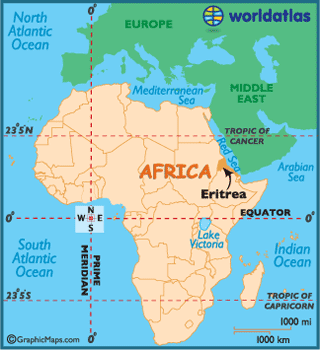
In Eritrea, ‘Persecution greater than ever and getting worse’

Patriarch Abune Antonios,
Detained since 2007

Religious persecution in Eritrea is at its “highest level ever and getting worse”, an Eritrean Christian leader, who cannot be named for security reasons, has told the Christian charity Open Doors International.

Thirty-seven Christian students from the College of Arts and Social Sciences in the town of Adi Kihe, and five men from the Church of the Living God in Asmara, were arrested last week, taking the total number of Christians known to have been arrested this year to 191.

Open Doors, a ministry to Christians who live under pressure because of their faith, estimates around 1,200 Christians are now incarcerated in Eritrea. However, some estimates claim the figure to be as high as 3,000.

Churches in Eritrea have been monitored closely since May 2002, when the government closed all Protestant and Pentecostal churches which did not apply for registration with the department of Religious affairs.

Eleven years later, there is evidence of widespread human rights abuses by the Eritrean government, according to human rights organisation, Amnesty International.

“Twenty years on from the euphoric celebrations of independence, Eritrea is one of the most repressive, secretive and inaccessible countries in the world,” Amnesty International’s Eritrea Researcher, Claire Beston, told the BBC.

In its latest report this month, Amnesty International reported evidence of “arbitrary arrest and detention without trial on a vast scale to crush all actual and suspected opposition, to silence government critics and to punish anyone who refuses to comply with the restrictions on human rights imposed by the government”.

The government of Eritrea rejected the report as “wild accusations” and “totally unsubstantiated”.
However, Selam Kidane, an Eritrean expatriate and Director of Release Eritrea, a UK-based human rights organisation, told World Watch Monitor there had been an “intensification” of religious persecution since January.

“We can’t pin it down to anything that has happened, or triggered it, but there have been lots of arrests,” she said.

Kidane said the Eritrean government is following the leaders of illegal underground churches to gather information and make arrests.

And while religious persecution in Eritrea is not limited to Christians, Kidane said the underground Christian church has suffered most.

“Any religion that’s not willing to come under the control of the government is being persecuted,” she said. “It’s not just confined to Christians. But in terms of being completely banned, it’s the minority churches that have suffered the most – the Pentecostal Church, the Evangelical Church – they are ones that have been stigmatised and been accused of all sorts of things by their communities and by other faith groups.”


Almost half the population of Eritrea is Christian. Nearly nine out of 10 Christians belong to the Orthodox Church, while almost all the rest are Catholic or Protestant.

Eritrea is ranked 10th on the World Watch List, which ranks the 50 countries in which Christians are most under pressure for their faith.


“When Christians [in Eritrea] are discovered, they are arrested and held in shipping containers in military camps. At least 105 Christians were arrested in 2012, and 31 Christians were reported to have died in prison,” the World Watch List reports.