Showing posts with label Kosovo. Show all posts

Tuesday, June 25, 2019

Raymond Ibrahim: 'Field of Blackbirds’: The 630 Year-Old Reason Eastern Europeans Dislike Islam

This essential historical summary by Raymond Ibrahim — one of the leading scholars on Islam's 1400-year continuing jihad against Christianity — offers compelling reasons for Eastern Europeans' distrust of Islam. 

They remember, "those years—1541 to 1699, when the Islamic Ottoman Empire occupied Hungary—are replete with the massacre, enslavement, and rape of Hungarians."

The United States should learn from the abhorrent experience of our Eastern European brethren under the sword of Islam, and adopt their sane policy of prudent refusal to allow unbridled and unvetted Muslim immigration to America. 


Battle of Kosovo painting by Peter Radicevic, 1987


'Field of Blackbirds’: The 630 Year-Old Reason Eastern Europeans Dislike Islam

by Raymond Ibrahim, June 15, 2019


Why Eastern Europeans are much more reluctant to accept Muslim migrants than their Western counterparts can be traced back to circumstances surrounding a pivotal battle, that of Kosovo, which took place on June 15, 1389, exactly 630 years ago today. It pitted Muslim invaders against Eastern European defenders, or the ancestors of those many Eastern Europeans today who are resistant to Islam.

Because the jihad is as old as Islam, it has been championed by diverse peoples throughout the centuries (Arabs in the Middle East, Moors (Berbers and Africans) in Spain and Western Europe, etc.). Islam’s successful entry into Eastern Europe was spearheaded by the Turks, specifically that tribe centered in westernmost Anatolia (or Asia Minor) and thus nearest to Europe, the Ottoman Turks, so-named after their founder Osman Bey. As he lay dying in 1323, his parting words to his son and successor, Orhan, were for him “to propagate Islam by your arms.”

This his son certainly did; the traveler Ibn Batutua, who once met Orhan in Bursa, observed that, although the jihadi had captured some one hundred Byzantine fortresses, “he had never stayed for a whole month in any one town,” because he “fights with the infidels continually and keeps them under siege.” Christian cities fell like dominos: Smyrna in 1329, Nicaea in 1331, and Nicomedia in 1337. By 1340, the whole of northwest Anatolia was under Turkic control. By now and to quote a European contemporary, “the foes of the cross, and the killers of the Christian people, that is, the Turks, [were] separated from Constantinople by a channel of three or four miles.”

Thursday, April 14, 2016

SPECIAL APPEAL: Help support our Orthodox brothers and sisters in Kosovo!


This is an appeal for a joint fundraising project of the Decani Monastery Relief Fund and the ROCOR Fund for Assistance. Please consider giving to help meet their April 21 fundraising goal!


The Kosovo diet: cabbage Monday through Saturday...

With your help, our Serbian brothers and sisters can get the help they need.

Thanks to your incredible support, we have collected over $10,000 for our Orthodox brothers and sisters in Kosovo!

But the humanitarian crisis is not over for the Orthodox Serbs.

Saturday, November 7, 2015

VOTE NO to Kosovo's Membership in UNESCO before November 9

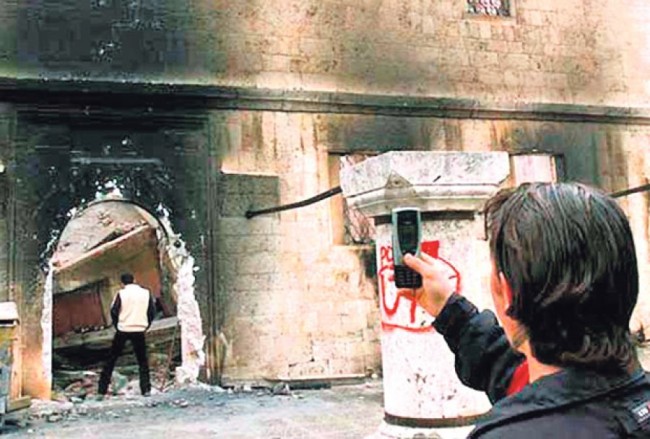
“Greater Albania” advocates the destruction of the remnants of Serbian culture and attempts to create a Kosovo culture which would appropriate everything on its territory. Over 100 Serbian Orthodox churches were destroyed in Kosovo between 1999 and 2004 alone, while the breakaway territory was administered by the United Nations.

Members of the UN cultural body UNESCO are expected to vote on Kosovo's entry into the organization on November 9.

There is an online petition enabling you to “VOTE NO to Kosovo's Membership in UNESCO.”

PLEASE FOLLOW THE LINK TO THE PETITION AND VOTE IMMEDIATELY. SHARE ON FACEBOOK, EMAIL AND OTHER FORUMS AS WELL...

Photos and video below the break...
Instagram Deletes Account for Revealing Destroyed Serb Churches in Kosovo
Sputnik via Pravoslavie, November 7, 2015


Hoping to foil Kosovo's attempt to become a member of UNESCO, ethnically Serbian student activists in the self-proclaimed state created a page on Instagram called “No to Kosovo's Membership in UNESCO.” There they posted photos of numerous Orthodox Christian places of worship and significance, including monasteries, churches and cemeteries, which were demolished in the years after ethnic Albanian Muslims gained de facto independence with the help of a deadly NATO bombing campaign and EU endorsement. Instagram responded by blocking the account for its “disturbing content.”

“We have been told that we are posting disturbing images, and we simply posted the truth -- the burning of Serb churches and monasteries, the holy places, the destruction of monuments, tombs, and so on,” Nemanja Bisevac, one of the account’s administrators, told journalists.

Jovan Aleksic, another administrator of the account and an activist with the protest group Students for Truth (Studenti za Istinu), told Sputnik Serbia he believes the Instagram page was suspended after a complaint from “those who are pushing the so-called Kosovo state forward to UNESCO.” pointing at the Albanian administration of the breakaway region.

The account was a part of a broader campaign dubbed “No to Kosovo's Membership in UNESCO.” led by Kosovan Serbian students, which hopes to deny Kosovo UNESCO membership.

“We have sent letters with photos and videos attached that speak for the destruction of the Serbian cultural heritage in Kosovo … to representatives of all 195 UNESCO member states. We’ve held a large protest in [the north Kosovan Serb town of] Sremska Mitrovica against so-called Kosovo becoming a member of UNESCO,” Aleksic said.

Also, Students for Truth have produced videos in Serbian, English and Arabic, showing the almost total annihilation of Kosovo's Serbian religious and cultural heritage.

Sunday, April 27, 2014

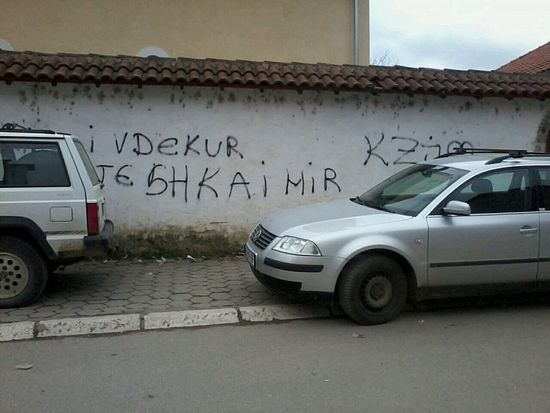
KLA graffiti appear on gate of Serbian Orthodox monastery

GRAČANICA -- A graffiti reading "UCK" - Albanian for "KLA", the so-called Kosovo Liberation Army - appeared on the gate of the Visoki Dečani Monastery early on Friday.

Pravmir — April 27, 2014

This is according to a statement issued by the Eparchy of Raška and Prizren of the Serbian Orthodox Church (SPC).

The 14th century Serbian monastery is located in western Kosovo and is on UNESCO’s World Heritage List.

“This is the latest in a series of similar provocations by Albanian extremists who previously wrote messages containing hate speech on the church wall in Đakovica, after which similar writings appeared on the facades of Serb houses in Orahovac,” the Eparchy said.

This time, extremists wrote on the very gate of the Visoki Dečani Monastery, only a dozen metres from the KFOR’s Italian checkpoint, according to the statement.

The Eparchy of Raška and Prizren noted that this act constitutes an open threat to the Visoki Dečani Monastery and its brotherhood.

Thursday, April 10, 2014

Metropolitan Amfilohije’s book on Kosovo presented in USA

"Western media played the key role in the intentional misinterpretation of events in the field and the portrayal of Serbia and Serbs as the side responsible for most – if not all – crimes committed during the clashes."

Pravmir — April 10, 2014

CHICAGO/BELGRADE – The book authored by Metropolitan Amfilohije of Montenegro and the Littoral entitled ‘Letopis novog kosovskog raspeca’ (Chronicles of the renewed crucifixion of Kosovo) in the English language was presented in Chicago and the first copies will be sent to a number of US officials so that they could find out about the Serbian account of the events.

The book promotion was held in the Church of the Holy Resurrection. The book comprises diary entries of Serbian Orthodox Metropolitan Amfilohije since 1999 to the end of 2000 noted down in the Patriarchate of Pec after the withdrawal of the Yugoslav Army and the signing of the Kumanovo Military Technical Agreement Agreement.

Archpriest Radomir Nikcevic as the director of the Svetigora publishing house told Tanjug that 500 copies of the book would be sent to the U.S. president, congressmen, senators and prominent institutions and individuals so that the truth about Kosovo could finally be revealed in the American continent.

Friday, April 4, 2014

Unlawful Seizure of Monastic Lands in Kosovo and Metohija Continues

Pravoslavie — April 3, 2014

Orahovac, Kosovo and Metodija — According to a report of the brethren of the Serbian Monastery of Sts Cosmas and Damian in Zociste, a local Albanian individual has recently seized a parcel of land, belonging to the monastery.

The brethren have discovered that one of local Albanians unlawfully ploughed up and farmed the piece of land, situated not far from the monastery, reports the Kosovo Diary portal. At the same time, the monastery possesses all necessary documentation for this land. 

Furthermore, since the beginning of the construction work on the restoration of the monastery complex, there have been ongoing verbal provocations against the brethren and workers. 

Sts Cosmas and Damian Monastery is situated close to the settlement of Orahovac in Metohija and is famous for its numerous miracles of healing from the saints' relics. In spite of its nationwide popularity, the monastery was completely destroyed in 1999 by Albanian militants and the church was blown up. The Serbian population was virtually driven away from the immediate vicinity of the monastery. 

At the present time a small community of monks, headed by Archimandrite Stephen, is living in the monastery. It remains the center of spiritual life, first of all for the Serbians from neighboring Orahovac and Velika Hoca.

© Православние.Ru

Thursday, March 6, 2014

Hate-filled Grafitti on walls of Serbian Orthodox Convent in Kosovo

Increased pressure from Muslims to eradicate Christianity from Kosovo. Thus is specifically anti-Christian, religiously-motivated, persecution.

"This incident is just one of a large number of indications that the situation of the four Serbian women, nuns of the convent, is worsening. These elderly women, who live as a monastic community, are all what remains of the Serbian population of Djakovica."

via
Insulting Grafitti on the Walls of Serbian Convent in Kosovo
Pravoslavie — Djakovica, March 1, 2014

The events of last two months indicate the ongoing persecutions of the Serbian population of Kosovo and Metohija.


According to a report of the website of the Diocese of Rasko-Prizren, on the wall of the Dormition Convent in Djakovica in the morning on February 23, graffiti appeared in Albanian: "The only good Serb is a dead Serb."

The day before, on the Saturday of the Reposed, the Kosovo police did not allow a group of Serbs to visit the convent and graves of their relatives at a local cemetery.

According to the diocese's report, the insulting graffiti was removed on February 24. However, Church representatives believe that, "The atmosphere of intolerance towards this shrine and Serbian refugees indicate that the level of their security has become much lower, and the Serbs who come here to visit the convent and the cemetery are not welcome."

This incident is just one of a large number of indications that the situation of the four Serbian women, nuns of the convent, is worsening. These elderly women, who live as a monastic community, are all what remains of the Serbian population of Djakovica.

This year on the eve of the Nativity of Christ, Albanians organized mass rallies in front of the walls of the convent, during which two coaches with Serbian pilgrims were pelted with stones. The Serbs were forbidden to visit the convent. On the next day—the very feast of Nativity—the sisters of the convent were unable to attend a Divine Liturgy because of the rallies.

Wednesday, February 5, 2014

Two thirds of Kosovo-Metohija Serbs still in exile

"Albanian [Muslim] terrorists in Kosovo-Metohija have destroyed around 150 temples and monasteries, [but] even after such violent acts, no one can diminish the significance of the Serbian spiritual and cultural heritage in Kosovo-Metohija."

InSerbia via OCP Media — February 3, 2014

BELGRADE – The Serbian Orthodox Church (SPC) in Kosovo-Metohija remains the mainstay of Serbian identity, although it is difficult to speak of normal church life with two thirds of SPC believers from the province still in exile, Bishop Teodosije of Raska-Prizren and Kosovo-Metohija has said.

“Thanks to God, our holy sites are as safe as they can be at this moment, and we will do everything to ensure their long-term survival,” Bishop Teodosije told the Christmas issue of Vecernje novosti.

Saturday, January 4, 2014

Serbs In Kosovo-Metohija Are Not Forgotten – Patriarch Irinej

InSerbia via OCP — 1/4/2014

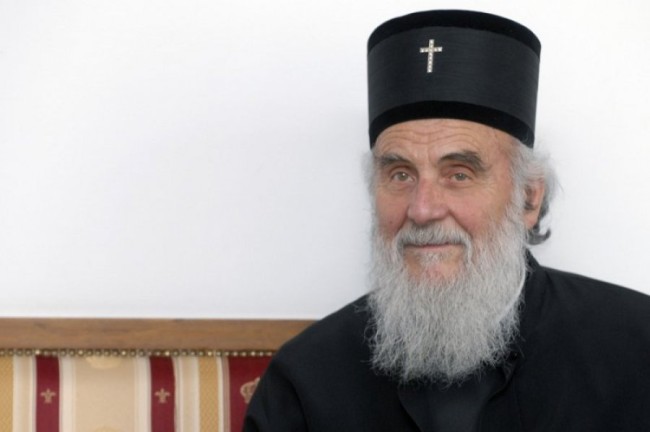
Patriarch Irinej of the Serbian Orthodox Church
Photo from: www.novosti.rs
BELGRADE – Patriarch of the Serbian Orthodox Church (SPC) Irinej addressed his traditional Christmas epistle to Orthodox believers in Serbia who celebrate the holiday according to the Julian calendar, with special emphasis on the position of Serbs in Kosovo-Metohija (KiM) where suffering and injustice persist.

“Unrest and violence rule in Kosovo-Metohija. For decades and centuries, they have been robbing us of that province, of the historical Old Serbia,” said Patriarch Irinej in the epistle read at the Patriarchate, which he addressed on behalf of all bishops of the Serbian Orthodox Church.

“To our brothers and sisters in Kosovo-Metohija we say: be aware that you are not alone and forgotten, the entire Serbian nation and the justice-loving people of the world are with you,” Patriarch Irinej said, calling on the Serbs in KiM to live in peace, harmony and love, both with each other and everyone else.

For more on Kosovo and Serbia, see my previous posts:


Friday, December 27, 2013

Orthodox Church in Kosovo turned into public toilet and garbage dump

As much as the Albanian and Bosnian Muslims would like to destroy the Orthodox Christian faith, and especially the very site where St. Tsar-Martyr Lazar of Serbia and his army attended Liturgy and received holy communion before the Battle of Kosovo, we know from the Lord's promise that the gates of hell will not prevail against the His Church.

Regarding the Battle of Kosovo, I wrote this in my book, Facing Islam:

The Great-Martyr Tsar Lazar of Serbia, inspired by a vision, sacrificed himself and his army in the epic Battle of Kosovo on June 15, 1389. At the Divine Liturgy, before going out to battle, they chanted “For the glorious Cross and golden freedom!” and the stirring motto of St Sava of Serbia, “Give up everything for Christ, but Christ for nothing!” The battle waged by Tsar-Martyr Lazar and his army at Kosovo weakened the Muslim invaders enough so as to prevent them from conquering Western Europe.
Make no mistake, the repeated Muslim desecrations of the Church of the Beheading of St John the Baptist are specifically targeting this Serbian Orthodox National Shrine, which holds immense symbolic importance for the Serbs, all of Europe, and free people everywhere. Albanian Muslim attacks on this church are an attack on us all, and a new chapter in Islam's very old war against Christianity.


Orthodox Church in Kosovo turned into public toilet and garbage dump
InSerbia via Pravmir — 12/25/2013


Orthodox church dedicated to the Beheading of St. John the Baptist in the village of Samodreza near Vucitrn, was desecrated and turned into a garbage dump. The altar of this Serbian shrine, built on the place where Prince Lazar received communion with the army before the Battle of Kosovo, Albanian children turned into a public toilet, writes “Kurir”.

Photo: Kurir

All attempts to stop the desecration of the Orthodox church were unsuccessful because the Albanian population is against its renewal. The church was burned, vandalized and desecrated for the first time in 1999 after international forces arrived in Kosovo, writes the daily.

Monday, November 11, 2013

If Kosovo Is The Price, Than We Say 'Thank You But No Thank You' To EU – Patriarch Irinej

Patriarch Irenej is adding his voice to help preserve Serbia's Orthodox Christian spiritual and historical legacy, against the efforts of Albanian Muslims, Islamic supremacists, and their accomplices in the European Union, who seek to complete Islam's endless jihad against the Serbs. 

For more on the history of Kosovo and its honored and beloved status as the "cradle of Serbian culture and spirituality," visit Kosovo.net.

If Kosovo Is The Price, Than We Say 'Thank You But No Thank You' To EU – Patriarch Irinej
InSerbia via Pravmir — 11/9/2013


The head of the Serbian Orthodox Church, Patriarch Irinej, said that Serbia can not give up on Kosovo, and if the price for the entry into Europe is losing Kosovo, then, he said, we would rather be out of Europe.


“If the price of entry to Europe is to secede Kosovo then we have to say ‘thank you but no thank you’ to Europe. We prefer to stay alone without Europe, if it must be, but with our Kosovo,” said the Patriarch Irinej receiving, at the Patriarchate, the participants of international Pan-European conference on human and religious rights.

Tuesday, October 8, 2013

Russian Patriarch praises Orthodox Kosovo Serbs for courage

His Holiness Patriarch Kirill conveys so much, without having to mention the specifics of which we are all aware.

Voice of Russia via Pravmir — 10/7/2013

Patriarch Kirill of Moscow and All Russia has praised the Orthodox Serbs of Kosovo for their courage.

“The suffering that has befallen our Serb brothers in Kosovo and Metochia fills the hearts of the Russian Orthodox believers with pain and grief. The Orthodox population of this territory is demonstrating enormous courage as they remain, amid threats and insults, devoted to the land bestowed by prayers of their righteous ancestors, whose memory lives in numerous churches and monasteries,” the Russian patriarch said at an official reception in Belgrade on behalf of the Serb president, Tomislav Nikolic.

Saturday, September 14, 2013

The Orthodox Christian Holocaust: 1894 to the Present

Synaxis of Martyrs of Asia Minor in the 20th c.
Includes summaries of genocide against 3.6 million Armenians and Greeks by Turkish Muslims from 1894-1923.  
(Originally posted Sept. 14, 2013; Updated March 16, 2015)

The common thread of the below article is that "history repeats itself." The West (including the "exceptional" United States) does little to nothing to protect indigenous Orthodox and Eastern Christians in the Muslim world, and under President Obama actively supports Muslim extremist groups like the Muslim Brotherhood who are committed to genocidal cleansing of Christians from Egypt, Syria, Iraq and the entire Islamic world. In the 1990s, under President Clinton, the United States and NATO openly sided with Muslim extremists in Bosnia and waged open warfare against the Serbian Orthodox peoples. 

I debated whether to repost only the portions dealing with the Orthodox Genocide conducted by the Muslim Turks from 1894-1923, but there is so much information concerning the deplorable response (and even active collaboration) of the United States to persecution of Eastern Christians, that I decided to reprint the entire article. 
 
Please take the time to read this, and share it widely. There is no finer summary of the Orthodox Christian Holocaust. 
 
"This calls for the patient endurance of the saints..." —Rev. 13:10, 14:12.


In Memory Of The 50 Million Victims Of The Orthodox Christian Holocaust

Compiled by Rev. Archimandrite Nektarios Serfes
Boise, Idaho, U.S.A. — October 1999
Written by Reverend Father Raphael Moore
(Reprinted from Holy Transfiguration Greek Orthodox Church Sioux Falls, SD., Protopresbtyer Benjamin Henderson, Priest) 

History Of Asia Minor: 1894-1923

During 1894-1923 the Ottoman Empire conducted a policy of Genocide of the Christian population living within its extensive territory.  The Sultan, Abdul Hamid, first put forth an official governmental policy of genocide against the Armenians of the Ottoman Empire in 1894.


Systematic massacres took place in 1894-1896 when Abdul savagely killed 300,000 Armenians throughout the provinces.  Massacres recurred, and in 1909 government troops killed, in the towns of Adana alone, over 20,000 Christian Armenians.

When WW1 broke out the The Ottoman Empire was ruled by the "Young Turk" dictatorship which allied itself with Germany.  Turkish government decided to eliminate the whole of the Christian population of Greeks, Armenians, Syrians and Nestorians.  The government slogan, "Turkey for the Turks", served to encourage Turkish civilians on a policy of ethnic cleansing.

The next step of the Armenian Genocide began on 24 April 1915 with the mass arrest, and ultimate murder, of religious, political and intellectual leaders in Constantinople and elsewhere in the empire.  Then, in every Armenian community, a carefully planned Genocide unfolded:  Arrest of clergy and other prominent persons, disarmament of the population and Armenian soldiers serving in the Ottoman army, segregation and public execution of leaders and able-bodied men, and the deportation to the deserts of the remaining Armenian women, children and elderly.  Renowned historian Arnold Toynbee wrote that "the crime was concerted very systematically for there is evidence of identical procedure from over fifty places."

Still from the film 'Ravished Armenia', based on a survivor's eyewitness account.

The Genocide started from the border districts and seacoasts, and worked inland to the most remote hamlets.  Over 1.5 million Armenian Christians, including over 4,000 bishops and priests, were killed in this step of the Genocide.

The Greek Christians, particularly in the Black Sea area known as Pontus, who had been suffering from Turkish persecutions and murders all the while, saw the Turks turn more fiercely on them as WW1 came to a close.  The Allied Powers, at a peace conference in Paris in 1919, rewarded Greece for her support by inviting Prime Minister Venizelos to occupy the city of Smyrna with its rich hinterlands, and they placed the province under Greek control.  This action greatly angered the Turks.  The Greek occupation was a peaceful one but drew immediate fire from Turkish forces in the outlying areas.  When the Greek army farmed out to protect its people, a full-fledged war broke out between Greece and Turkey (the Greco-Turkish war).

The Treaty of Sevres, signed in 1920 to end WW1 and which provided for an independent Armenia, was never ratified.  The treaty's terms changed not long after the ink dried as England, France and Italy each began secretly bargaining with Mustafa Kemel (Ataturk) in order to gain the right to exploit oil fields in the Mozul (now Iraq).  Betrayed by the Allied Powers, the Greek military front, after 40 long months of war, collapsed and retreated as the Turks began again to occupy Asia Minor.

September 1922 signaled the end of the Greek and Armenian presence in the city of Smyrna.  On 9 September 1922, the Turks entered Smyrna; and after systematically murdering the Armenians in their own homes, the forces of Ataturk turned on the Greeks whose numbers had swelled, with the addition of refugees who had fled their villages in Turkey's interior, to upwards of 400,000 men, women and children.

The conquering Turks went from house to house, looting, pillaging, raping and murdering the population.  Finally, when the wind had turned so that it was blowing toward the sea so that the small Turkish quarter at the rear of the city was not in danger, Turkish forces, led by their officers, poured kerosene on the buildings and homes of the Greek and Armenian sectors and set them afire.  Thus, any remaining live inhabitants of the city were flushed out to be caught between a wall of fire and the sea.  The pier of Smyrna became a scene of final desperation as the approaching flames forced many thousands to jump to their death or to be consumed by fire.

The Allied warships and shore patrol of the French, British and American military were eyewitnesses to the events.  George Horton, the American Consul in Smyrna, likened the finale at Smyrna to the Roman destruction of Carthage.  He is quoted in Smyrna (1922, written by Marjorie Dobkin) as saying:  Yet there was not fleet of Christian battleships at Carthage looking on a situation for which their governments were responsible."  This horrible act unleashed the last phase of the genocide against the Christians of Turkish Asia Minor.

Wednesday, July 31, 2013

Patriarch Irenej: Serbia Must Not Renounce Its Spirituality

A lament for formerly Christian Europe, and a glimpse into the fond closeness of Serbia and Russia, hinting at Russia's protection of Serbia and the Orthodox Serbs in Kosovo.

Pravoslavie.ru — 7/29/2013


Serbian Orthodox Church (SPC) Patriarch Irinej said at the end of his visit to St. Petersburg and Moscow that Serbia is not running away from Europe, but cannot join Europe as it is now under the conditions that are being imposed on it.

"We do not have the right to renounce our spirituality, our culture, everything that makes us a nation. This is why I hope the people will consciously gather around the Church and thank God for giving us a chance to preserve the apostolic faith," the Patriarch said in an interview for the Voice of Russia, expressing hope Serbia will become stronger over time, both in the spiritual and the political sense.

Asked if Serbia can keep its Orthodox roots once it joins the EU, Patriarch Irinej said "the present spiritual state of Europe is pathetic."

"Like Nietzsche said 'God is dead' there. Still, a few little islands of church life remain," he said.

Tuesday, July 30, 2013

Patriarch Irinej Voiced Expectation That Russia Will Help Resolve Kosovo Issue

Yet more confirmation of Russia's role as protector and defender of Orthodox Christians, especially those being persecuted by Muslim extremists.

PRAVMIR — 7/25/2013

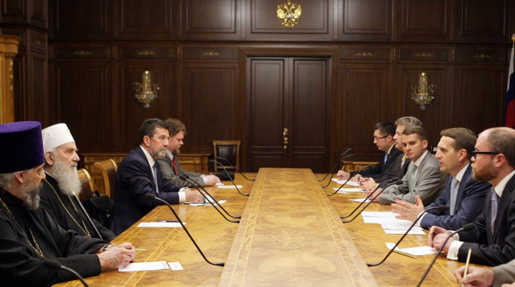
MOSCOW – Patriarch of the Serbian Orthodox Church (SPC) Irinej has voiced expectation in Moscow that Russia, as the major Slavic power, will help resolve the Kosovo issue in a fair way, reported Tanjug.

We pin our hopes on Russia that it will help settle the Kosovo issue, Patriarch Irinej said on Tuesday in talks with Sergei Naryshkin, speaker of the State Duma which is the lower chamber of the Russian parliament.

The Serbian Patriarch said that Serbia is going through a difficult period, pointing to the suffering of the Serb people in Kosovo-Metohija (KiM).

Everything is at risk in Kosovo, Patriarch Irinej said, voicing hope that Russia has a clear picture about real developments in Kosovo, the Russian news agency reported.

Patriarch Irinej is on his first official visit to Russia since assuming duties. With the delegation, he will tour Russian churches and monasteries, and Orthodox holy sites in Ukraine and Belarus during the two-week visit.

Together with other patriarchs of autocephalous Orthodox churches, he will take part in the celebrations of 1025th anniversary of Russia’s christening.


The Orthodox patriarchs will be received by presidents of Russia, Ukraine and Belarus.

Monday, July 1, 2013

Albanian extremists attack children’s buses in Kosovo

The Albanian "extremists" in this story are almost certainly Muslims, and very likely consider this attack a legitimate act of jihad according to the Koran and teachings of Islam.


Albanian extremists’ attack on children’s’ buses in Kosovo
Pravmir


Statement of the Communication Service of the Moscow Patriarchate Department for External Church Relations.

According to PTC news agency, on June 28, 2013, a group of Albanian extremists committed an organized attack on a column of school buses taking Serbian children home from the celebrations on the occasion of the national holiday ‘Vidovdan’, the Day of the Kosovo Battle against the Ottoman Empire.

 The helpless children were hit by a flow of stones. Three young pilgrims were seriously injured. The Kosovo police failed to apprehend the attackers.

We regret to state that similar incidents happen in Kosovo and Metohija almost annually. Thus, in 2012, over 50 young people, who came from Serbia for Vidovdan, were injured during an attack in which petrol bombs were used and some of them were hospitalized with gunshot wounds.

The extremists seek to mark Vidovdan with violence against Orthodox Serbs to intimidate and make them reject their own history linked with the Kosovo region. The attack against Serbian schoolchildren should be resolutely condemned by the international community.


This incident is evidence raising again the doubt that the Kosovo authorities are capable of overcoming ethnic tension and give real guarantees of safety to the Orthodox Serbian population of the region.

Sunday, June 30, 2013

For Kosovo Serbs, Pentecost on the Ruins


Pravoslavie.ru

For Serbs from around Suva Reka, Pentecost is a very special day, when they have the modest opportunity to see if only briefly their homeland, their native villages and homes--or rather, what is left of them.

This day, is the patronal feast day, or Slava as the Serbs call it, of their ancient holy shrine, the Holy Trinity Monastery, now in ruins for over a decade. The monastery had its beginnings in the fourteenth century--the height of the Nemanjić dynasty, when Kosovo and Metochia were the very heart of Serbia and the cradle of Serbian culture, history, and faith.

In 1999, before the very beginning of the war, eight nuns lived and prayed to God in the monastery of the Holy Trinity. The head of the convent was Abbess Katarina. On June 12, 1999, the sisters of the monastery and the entire Serbian population of the nearby village of Mušutište were forced to abandon their native regions to save themselves from the Albanian terror. The KLA soon burned down all the villages, along with the ancient church of the Hodigitria Mother of God (1315), and then destroyed the Holy Trinity Monastery.

Serbs have not returned since that time, but the memory of their homeland and sacred places lives on in the hearts of those “resettled” and “relocated” persons, as those who forced them out now call them.

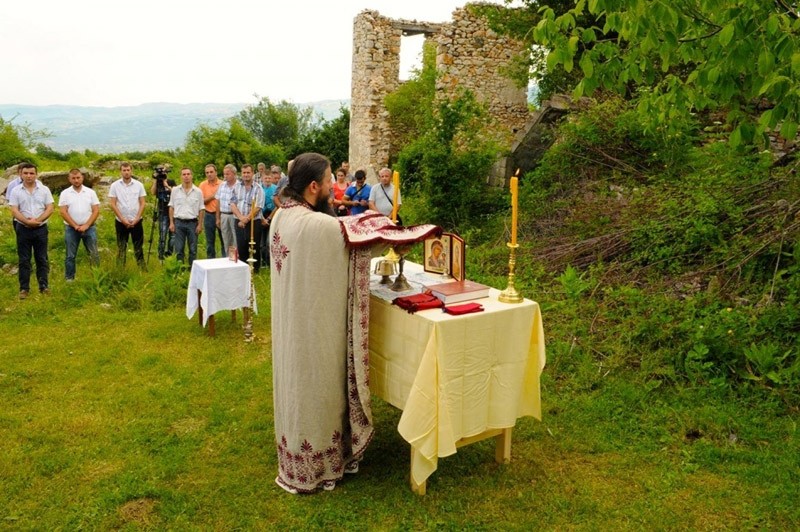
With the blessing of Bishop Teodosije of Raska-Prizren, the brothers of Visoki Dečani Monastery have been coming here for the past few years on the day of Pentecost to cut the overgrowth of grasses and serve the Divine Liturgy under the open skies. Serbs who used to live in this region also come to pray, along with other guests.

This year, Hieromonk Petr (Rojevich) served, and Nuns Iezekieka and Jeremiah attended. After Communion and a modest repast, those who came took advantage of the opportunity to visit their forebear’s graves, and the corners and grounds so dear to their hearts.

Full photo gallery here.

Friday, June 7, 2013

Serbs' Sufferings in Kosovo Continue

"After the destruction and desecration of Orthodox churches and monasteries, expulsion of hundreds of thousands of Serbs, human organ trafficking and similar crimes in Kosovo-Metohija, the Serbs are now being subjected to... barbarian destruction of gravestones, killings, attacks on properties and everyday threats."


Serbian Orthodox Assembly: Serbs’ suffering in Kosovo-Metohija continues
Maja Radojcic - Pravmir.com  

The Serbian Orthodox Church (SPC) Holy Assembly of Bishops announced on Tuesday that the suffering of Serbs in Kosovo-Metohija (KiM) continues, that the latest negotiating process in Brussels did not yield a solution for the problem, and that the SPC will continue to offer support to the Serbian government and parliament in preserving churches and monasteries and Serbia’s integrity in that province.

“The Assembly notes with regret that the international protectorate, presence of NATO forces in KiM and the latest top-level negotiations in Brussels did not bring about justice or a solution for the problem,” the Assembly said in a release after its regular session.

After the destruction and desecration of Orthodox churches and monasteries, expulsion of hundreds of thousands of Serbs, human organ trafficking and similar crimes in Kosovo-Metohija, the Serbs are now being subjected to a somewhat softer violence – barbarian destruction of gravestones, killings, attacks on properties and everyday threats.

In order to learn more about the efforts of the government and other state bodies, the Assembly asked First Deputy Prime Minister Aleksandar Vucic to visit the Assembly session, says the release.

During the visit, it was agreed that despite differences in approach to certain issues, there is unity and consensus when it comes to the commitment to the future of the Serb people in Kosovo, the preservation of churches and monasteries and the integrity of Serbia, which means a refusal to either directly or indirectly recognize the phantom statehood of Kosovo outside of Serbia, reads the release.

The Assembly assured Vucic that the government and parliament can count on the Church’s full support, within its competences and capabilities, reads the release.

Vucic attended the Assembly session on Friday.

The regular spring session of the Assembly of Bishops, the SPC legislative and judicial body, took place at the Patriarchate in Belgrade and Nis from May 21 to June 3.