Showing posts with label truth. Show all posts

Tuesday, May 9, 2017

Sign of the Times: US Catholic Church punishing priests for speaking truth about Islam and jihad

In our age of worldliness and ever-spreading Christian apostasy, the US Conference of Catholic Bishops and Rome itself is siding with Islam against Catholic priests (and even against Catholic saints!) who speak forthrightly about Islam, Muhammad, and jihad.

Robert Spencer writes:
"The highly dubious proposition that Islam is a religion of peace has become a kind of superdogma that the U.S. bishops enforce with a stringency (and even ruthlessness) that they never display regarding actual Church teaching."


Will this Catholic Apologia for Islam — and its attendant persecution of faithful priests who serve as conscience to Rome's pan-ecumenist dreams — manifest itself in a dogmatic declaration of solidarity with Islam, a doctrinal embrace of the 'Same God Heresy', and a final shameful denial of Jesus Christ by formally affirming Muhammad as a prophet?

Time will tell, but this deeply disturbing trend in Roman Catholicism points only to one end: the Great Apostasy and the Religion of the Future, warned against by Blessed Hieromonk Seraphim Rose some forty years ago.

Our task? Be faithful unto the end, enduring criticism, mocking and persecution, willing to confess Jesus Christ even unto death, as the Lord Himself said:

"He who endures to the end shall be saved." (MT 10:22) 
"Whoever is ashamed of Me and My words in this adulterous and sinful generation, of him the Son of Man also will be ashamed when He comes in the glory of His Father with the holy angels." (MK 8:38)


Another Day, Another Apology to Muslims
by Susan D. Harris, American Thinker, May 2, 2017 (via Creeping Sharia):

“Don’t listen to liberals, because the Muslims will cut your heads off.” That’s the comment that warranted the KRQE headline, “Parents accuse Belen priest of making discriminatory comments against Muslims.”

Apparently no one had a problem with the “don’t listen to liberals” part. Instead, being well trained in political correctness, it was the moment Fr. Jonas Romea, a priest in Belen, New Mexico, told a group of pre-K to eighth grade Catholic kids that there were Muslims terrorists that caused the problem.

Specifically mentioning Muslims cutting “heads off” was when parents became terribly offended on behalf of Islam. The next thing you know, a reporter at KOAT Action News was asking Fr. Romea if he didn’t think his remarks were “Islamophobia?” Fr. Romea said that he denied that label, and strengthened his point by saying:

“Recent reports out of the Middle East show that Catholics around the world are under attack. The news pieces that we get… from there tell us that actually, Christians are being slaughtered.”

KRQE reported that after receiving complaints about Fr. Romea’s remarks (made during a homily to students at Our Lady of Belen Church,) the “Archdiocese of Santa Fe sent out a letter to parents saying the homily didn’t fully embrace the message of Jesus Christ.”

Saturday, September 24, 2016

Raymond Ibrahim: Is Obama Waging a “Narrative Battle” against ISIS or Reality?

"Acknowledging that untold millions of Muslims are engaged in similar behavior [to ISIS] leads to a much more troubling narrative with vast implications."

by Raymond Ibrahim, September 22, 2016


According to White House press secretary Josh Earnest, “When it comes to ISIL, we are in a fight—a narrative fight with them. A narrative battle.”  Earnest said this the day after two separate bombings occurred in New York, and an ISIS-linked Muslim went on a stabbing spree in Minnesota.  Obama’ spokesman later elaborated:

… remember ISIL is trying to assert a narrative, that they represent the religion of Islam in a war against the west and in a war against the United States. That is mythology. That is falsehood. That is not true. That is bankrupt ideology they are trying to wrap in the cloak of Islam.

This, of course, is a straw man argument: the real question isn’t whether ISIS “represents” Islam, but whether ISIS is a byproduct of Islam.  And this question can easily be answered by looking not to ISIS but Islam. One can point to Islamic doctrines that unequivocally justify ISIS behavior; one can point to the whole of Islamic history, nearly 14 centuries of ISIS precedents.

Or, if these two options are deemed too abstract, one can simply point to the fact that everyday Muslims all around the world are behaving just like ISIS.

For instance, Muslims—of all races, nationalities, languages, and socio-political and economic circumstances, in Arab, African, Central and East Asian nations—claim the lions’ share of Christian persecution; 41 of the 50 worst nations to be Christian in are Islamic.  In these countries, Muslim individuals, mobs, clerics, politicians, police, soldiers, judges, even family members—none of whom are affiliated with ISIS (other than by religion)—abuse and sometimes slaughter Christians, abduct, enslave and rape their women and children, ban or bomb churches, and kill blasphemers and apostates.

Thursday, October 8, 2015

Fr. Stephen Freeman: 'Church Scandals Must Come'

As I saw this title in my feed for Pravmir this morning, I had a sense about it, and knew I had to read it right away. Please bear with my introductory remarks.

As I absorbed Fr Stephen's thoughts on scandal, it took me back to one of the most scandalous things I had ever encountered in my life in the Orthodox Church. It was the day in the summer of 2008 that I opened up a thin booklet by an Orthodox priest and professor, written to be "a guide for Orthodox Christians encountering Muslims," and read this:

"Muslims and Christians worship the same God."

The shock of reading such a statement, written by an Orthodox Christian priest, one who celebrates the Divine Liturgy, the Eucharist, and who is charged with defending the Church and the Holies with his very life, left me reeling. It was a scandalon — σκάνδαλα — as devastating and unbelievable as any I had encountered. And it started me on the path which would lead to me writing the book, Facing Islam, and then launching this blog.

That scandal set me on this path to refute the lie that says the God of Islam is the True God, for that is what one is saying, when one makes the above assertion.

That scandal compelled me to bear witness to the Way, the Truth, and the Life, the Lord Jesus Christ, the Word of God, Second Person of the Holy Triune Godhead, who became man for our sake, to restore us to the Father, to our divine calling as children of God.

The irony of that initial scandal is that while I recall vividly the reaction it provoked within me, and the torrent of righteous fervor it unleashed, over the years since, I have come to see my inner reaction to the many scandals caused by Islam and those who defend it — especially those Orthodox Christians who are so confused in their theology, ecclesiology and their notion of love as to affirm Islam itself — to become progressively more pensive, pained, sorrowful, and less angry, defensive, polemical.

Christ calls us to love our enemies, to forgive seventy times seven. This means, in the most stark and challenging context, to love and forgive the Muslim jihadist who is sawing our head off with a serrated knife. We have examples of Holy New Martyrs in our very day (and of their grieving families in the aftermath) doing exactly that.

But when one knows and is filled with the Truth, one cannot forgive the lie, only the liar. One cannot forgive the deception, only the deceived, the lost, precisely because "they know not what they do."

I have often quoted the words of Yuri Maximov (now Priest George) regarding the towering, prophetic example of New Priest-Martyr Daniil Sysoev of Moscow (†2009), and will do so again and again, for his words are perhaps the best summation of what my book, blog and mission are all about:

Among those who call themselves Orthodox, I have met such strange people who say that Fr. Daniel should not preach to Muslims, that one must respect their religion, and that there is no benefit from his preaching. But Fr. Daniel thought, as did the Lord, the Apostles, and all the saints, that one must respect mistaken people but not their mistakes. Truth is one, that which contradicts and negates truth is a lie, and respect for a lie is contempt for the truth. (Source)

Scandals must come, but it is often scandals which prove and test us, and most sharply delineate Truth from falsehood, Light from darkness, the True Way from the way to perdition.

Brothers and sisters, let us confess Jesus Christ and labor to be found in Him, that we may rejoice at His Coming, and not be ashamed. This is the True Faith. Amen.


Church Scandals Must Come
by Fr. Stephen Freeman, Glory to God for All Things, October 20, 2012

Scandals must come (Matt. 18:7).

Judas betrays Jesus with a kiss.

These are the words of Christ. He tells us that scandals are not only likely to happen – but that they will happen. They are necessary (ἀνάγκη).

Most readers will marvel that this is a quote from Jesus. The reason is simple: the Greek (ἀνάγκη γάρ ἐστιν ἐλθεῖν τὰ σκάνδαλα) is rarely translated in such a manner. “Stumbling blocks,” or “offenses,” is the more common way to render the word skandala (σκάνδαλα). But the Greek has a very simple cognate in English: scandal.

Why would Christ tell his disciples that scandals must come? It is a description of the nature of things in this world. The entrance of the Kingdom of God and its dwelling among men is not such that men will cease to be broken or evil. Christ warned His disciples that he himself would be betrayed – not by strangers – but by one of them!

Thursday, September 24, 2015

St Silouan: On Love for One's Enemies

Icon of St Silouan (Sept 24)
by Fr Andrew Tregubov 
Today is the feast of St Silouan, who came to love and pray for the whole world, and whose teachings on loving our enemies present us with a great challenge.

The world does not understand what love is. But the saints, because they are united to Christ, do grasp the mystery of love. Even love for one's enemies.

We must love our brother, our neighbor, our enemy. Yet one cannot love evil itself, one cannot love falsehood, for to do so would be to affirm it, to say "Amen" to it, and thus to wrongly and mistakenly give it validity, power, enthronement in the hierarchy of values.

The saints understand this, the difference between loving my neighbor, the person right in front of me, and honoring what he stands for. I must love my neighbor, even if he is my enemy, even if he has dressed me in an orange jumpsuit and is sawing my head off with a serrated blade because of my love for Jesus Christ. "Father forgive him, for he knows not what he does!"

I must forgive him because what he does to me is evil. I cannot say that the evil is not evil. I cannot honor the evil, for by doing so I dishonor the good. I cannot honor the lie without dishonoring the Truth. But I can and must love and forgive the person himself.

The saints understand that we must stand for Truth. It was his confession of the Truth for which Jesus was condemned and crucified.

And the high priest stood up in the midst and asked Jesus, saying, “Do You answer nothing? What is it these men testify against You?” But He kept silent and answered nothing.
Again the high priest asked Him, saying to Him, “Are You the Christ, the Son of the Blessed?”
Jesus said, “I am. And you will see the Son of Man sitting at the right hand of the Power, and coming with the clouds of heaven.”
Then the high priest tore his clothes and said, “What further need do we have of witnesses? You have heard the blasphemy! What do you think?”
And they all condemned Him to be deserving of death.
— Mark 14:60-64 

Jesus said, "I AM." Ego Eimi, in this simplest statement, equating himself with "He Who Is." Jesus speaks the Truth for He is the Truth, and He cannot deny the Truth, for then He would be a liar. John presents this confession of Jesus in a different context, in Jesus' discussion with the Jews.

Sunday, September 20, 2015

Time to tell the Truth about Islam

"Islamic radicals have a very good case that their version of Islam is truer to the original than the moderate version. The proper way to undermine their ideology/theology is not to cast doubts on their interpretation of Islam, but to cast doubts about the truth of Islam itself."

by William Kilpatrick, The Turning Point Project — August 30, 2015


The important thing about a religion, said C.S. Lewis, is not whether it makes one feel good, but whether it is true. This observation came to mind while reading a recent piece by Rev. James Schall, S.J., titled “Speaking Honestly about Islam.”

Schall suggests that we haven’t been telling the truth about Islam because to do so violates the feel-good principle that currently rules Western societies. According to the feel-good principle, self-esteem is the highest value. And therefore every person, culture, and religion has an inalienable right to feel good about oneself/itself.

People hew to the Islam-is-peace line because they don’t want to give offense and also because they don’t want to be accused of a hate crime. It’s a well-founded fear. In many Western societies, numerous individuals—and some of them very prominent individuals—have been put on trial for the crime of criticizing Islam: Mark Steyn and Ezra Levant in Canada, Geert Wilders in the Netherlands, Lars Hedegaard in Denmark, and Elisabeth Sabaditsch-Wolff in Austria, to name a few. In several cases, the defendants were informed that truth was no defense. The accuracy of their criticism, they were told, was beside the point (the point being that they had said hurtful things).

Honesty is the best policy, according to the old maxim, but many Western governments have adopted a deliberate policy of prevarication in regard to Islam. Hardly a day goes by when some Western leader or other isn’t explaining away the latest jihad attack as having nothing to do with Islam.

Saturday, January 25, 2014

Huffington Post: “Muhammad’s beliefs on how to treat religious minorities make him a universal champion of human rights”

The timing of this HuffPo article and Robert Spencer's devastating critique of it couldn't be better. Having just posted a 2010 interview with Mark Durie about his peerless book on Islam, The Third Choice, Durie's words were still fresh in my mind, specifically his assessment of Muhammad:

[After 9/11] I knew I had to try to understand Islam properly. So I read the hadiths, the Koran, and Ibn Ishaq’s biography of Muhammad in the months after 9/11, with the eye of a theologian – I was constantly asking how this material would form people’s spiritual identity. This exploration made me deeply troubled. The persona of Muhammad which arose before me from Islam’s primary sources shocked me to my core. I thought, “If this man’s life is supposed to be the best example, we are all in deep trouble.”

Durie's response to examining Islam's primary sources is the proper, healthy response. Distorting or concealing the truth about Muhammad and Islam is to advance a lie. Christians, by virtue of their desire to forgive their enemies and think the best of others, are especially susceptible to the temptation to paint a halo around Muhammad and think of Islam as a nearly compatible religion. It cannot be emphasized enough that no saint of the Church has ever been soft on Islam or Muhammad. See St John of Damascus and St Gregory Palamas as two prime examples. And consider the words of Righteous New-Martyr Fr Daniil Sysoev:

One must respect mistaken people but not their mistakes. Truth is one, that which contradicts and negates truth is a lie, and respect for a lie is contempt for the truth.

Education is essential when it comes to Islam, and refuting the clueless and deceptive paeans praising Muhammad as a paragon for modern, pluralistic society, or as a prototypical defender, protector and guarantor of rights and safety to Christians and other religious minorities, is the duty of those who value and uphold truth, freedom and human dignity.


Huffington Post: “Muhammad’s beliefs on how to treat religious minorities make him a universal champion of human rights”
by Robert Spencer, Jihad Watch — January 24, 2014

This article is as risible as Karen Armstrong’s likening Muhammad to Gandhi, and is as gracefully written as a seventh grader’s book report. But for the Huffington Post, accuracy and quality are of no import: if it downplays the grim reality of Islamic jihad terror, then it’s good enough for them.

The author of this piece is Craig Considine, who has likened Muhammad to George Washington and claimed that Christianity has a concept of jihad just like Islam’s. He pulls off these feats of legerdemain by employing a very simple method: ignoring what doesn’t fit his thesis, as he does here.

“What Studying Muhammad Taught Me About Islam,” by Craig Considine in the Huffington Post, January 21:
Muslims worldwide have recently joined together to celebrate Mawlid al-Nabi, the birthday of the Prophet Muhammad. This day is an opportunity for Muslims and non-Muslims, such as myself – a Catholic – to reflect upon the life and legacy of the prophet of Islam. In this short essay, I want to share with you what I have learned about Muhammad and how his legacy informs my understanding of Islam. 
Muhammad’s beliefs on how to treat religious minorities make him a universal champion of human rights, particularly as it pertains to freedom of conscience, freedom of worship, and the right for minorities to have protection during times of strife. 
Muhammad initiated many legal covenants with Christians and Jews after establishing his Muslim community. For example, in one covenant with the Christian monks at Mount Sinai, Egypt, Muhammad called on Muslims to respect Christian judges and churches, and for no Muslim to fight against his Christian brother or sister. Through this agreement, Muhammad made it clear that Islam, as a political and philosophical way of life, respected and protected Christians.

[Regarding this spurious document, also called the 'Charter of Privileges', see also my post here.]

This document, the Achtiname, is of even more doubtful authenticity than everything else about Muhammad’s life. Muhammad is supposed to have died in 632; the Muslims conquered Egypt between 639 and 641. The document says of the Christians, “No one shall bear arms against them.” So were the conquerors transgressing against Muhammad’s command for, as Considine puts it, “no Muslim to fight against his Christian brother or sister”? Did Muhammad draw up this document because he foresaw the Muslim invasion of Egypt? There is no mention of this document in any remotely contemporary Islamic sources; among other anomalies, it bears a drawing of a mosque with a minaret, although minarets weren’t put on mosques until long after the time Muhammad is supposed to have lived, which is why Muslim hardliners consider them unacceptable innovation (bid’a).

The document exempts the monks of St. Catherine’s monastery from paying the jizya. While it is conceivable that Muhammad, believing he bore the authority of Allah, would exempt them from an obligation specified by Allah himself in the Qur’an (9:29), the Achtiname specifies that Christians of Egypt are to pay a jizya only of twelve drachmas. Yet according to the seventh-century Coptic bishop John of Nikiou, Christians in Egypt “came to the point of offering their children in exchange for the enormous sums that they had to pay each month.” The Achtiname, in short, bears all the earmarks of being an early medieval Christian forgery, perhaps developed by the monks themselves in order to protect the monastery and Egyptian Christians from the depredations of zealous Muslims.

Wednesday, December 25, 2013

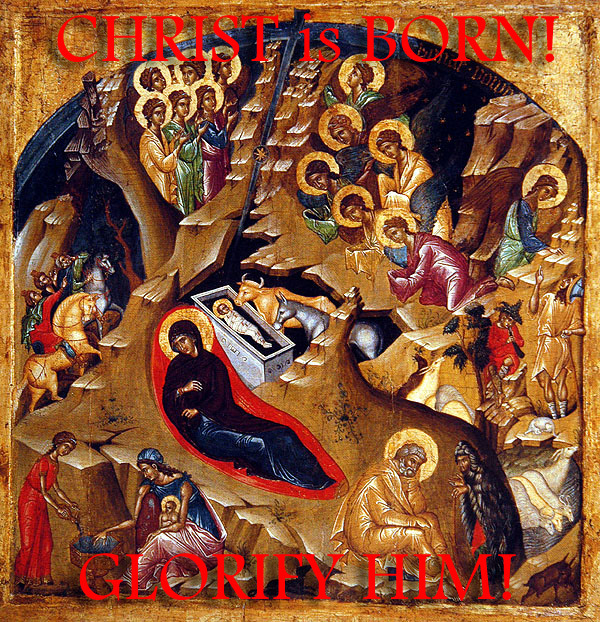
CHRIST is BORN! GLORIFY HIM!


Troparion (Tone 4)

Thy Nativity, O Christ our God,
Has shown to the world the light of wisdom,
For by it those who worshiped the stars
were taught by a star to adore Thee,
The Sun of Righteousness,
And to know Thee, the Orient from on High,
O Lord, Glory to Thee!


Kontakion (Tone 3)

Today the Virgin gives birth to the Transcendent One,
And the earth offers a cave to the Unapproachable One!
Angels with shepherds glorify Him,
The Wise Men journey with a star!
Since for our sake the Eternal God was born
As a little child!


Hymn To The Theotokos (Birthgiver of God):

Magnify, O my soul, the most-pure Virgin Theotokos, 
More honorable and more glorious than the heavenly hosts.
I behold a strange, most glorious mystery: 
Heaven—the cave; 
The cherubic throne—the Virgin; 
The manger—the place where Christ lay—
The Uncontainable God, Whom we magnify in song!


For an excellent collection of resources, including patristic texts, suggested books, videos, icons, and more, go here.


Friday, November 29, 2013

Divine Liturgy and the Great Thanksgiving

There is no need to preface this article with any "comparative theology." The beauty, truth, grace and love of God for us, and our loving response in thanksgiving, is quite fully expressed by Gabe Martini here. 

Ultimately, there can be no comparison of Orthodox Christianity with the religions of the nations, for they lack the Truth. The Truth is a person. Jesus Christ is the Way, He is the Truth, He is the Life. 

"This is the True God and Eternal Life. Little children, keep yourselves from idols. Amen." (1 JN 5:21)

The Divine Liturgy. Photo: M.Rodionov / Expo.Pravoslavie.Ru

by Gabe Martini, via Pravoslavie — 11/28/2013

Some of the most profound words of the Divine Liturgy are rarely heard.

Standing at the south corner of the altar, the deacon quietly utters to the presiding priest: “It is time for the Lord to act.”

This phrase sets the tone for everything in our worship. We are not performing some sort of magical act that assuages the deity in our favor, but are rather joining in with the liturgy of eternity; the liturgy of his own actions in our favor; the liturgy which has, and is, and ever shall be taking place; the liturgy which is the great thanksgiving—the great Eucharist—of God.

Thursday, September 5, 2013

A Prophetic Minority: What American Christians Can Learn from Jeremiah

This is a stirring article, which should resonate strongly for us Orthodox Christians. We have always been a minority in North America, and until recently, tens of millions of our brothers and sisters were under extreme persecution under the Soviet regime. According to our finest theologians and pastors, our Divine Liturgy is the perfect embodiment of the Kingdom of God on Earth, as well as being an Eschatological Sign of the End of the World.

If anyone has a prophetic word to offer, if anyone is equipped to speak truth to power, it is the living and vital Orthodox Church! But are we living and vital, or are we merely trying to 'fit in', make a living, not rock the boat, and get on with day to day life?

This is, by the way, why I have been posting so much material related to Father Seraphim Rose this week following the anniversary of his repose on September 2. If there was ever a prophetic voice in the contemporary Orthodox Church, it was his. Here is an appropriate 'word' from Father Seraphim to introduce this article:

Christian compromise in thought and word and negligence in deed have opened the way to the triumph of the forces of the absurd, of Satan, of Antichrist. The present age of absurdity is the just reward of Christians who have failed to be Christians.

It is futile, in fact it is precisely absurd, to speak of reforming society, of changing the path of history, of emerging into an age beyond ab- surdity, if we have not Christ in our hearts; and if we do have Christ in our hearts, nothing else matters.

Now one cannot be a half-hearted Christian, but only entirely or not at all.

~ Hieromonk Seraphim Rose (†1982)


A PROPHETIC MINORITY: WHAT AMERICAN CHRISTIANS CAN LEARN FROM JEREMIAH

By: Tom Gilson — Breakpoint via Pravoslavie.ru — 9/5/2013

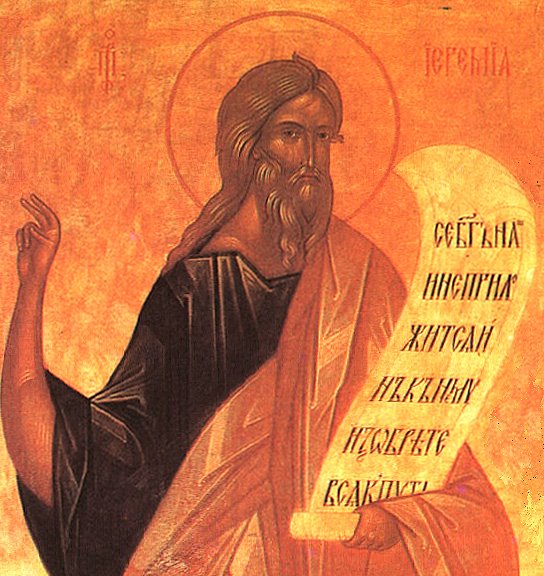
Prophet Jeremiah
Russell Moore, incoming president of the Southern Baptist Convention’s Ethics and Religious Liberty Commission, says that Christians’ place in America is no longer about a being moral majority but a prophetic minority. He’s right. Not long ago I wrote about three reasons religious freedom matters: freedom of conscience, dethroning the state, and at the point where these two intersect, speaking truth to power. This voice of truth is the Church’s prophetic ministry.

We have been accustomed to being something like a moral majority; we must discover now what it means to be a prophetic minority. There may be no better teacher for us than Jeremiah. I’ve been spending much time with Jeremiah lately, though I must admit I’ve had difficulty getting past the first several chapters. They sound too familiar; too much like the world we live in; and therefore too troubling to hurry through.

Wednesday, September 4, 2013

Seeker of the Truth: In Memory of Hieromonk Seraphim (Rose)

* September 2 is the anniversary of the repose of Hieromonk Seraphim Rose. I plan to post extensively on Father Seraphim throughout this week.

Pravoslavie.ru — Originally published 9/2/2012

“Christ’s call is still reaching to us; let us begin to listen to it.” These words of Father Seraphim (Rose)—ascetic, theologian, and preacher—are relevant today more than ever. His books helped many to hear this call. Written in the 1970s and ‘80s for his contemporaries lost in the intellectual wastelands, his works are today even more relevant, because today’s “intellectuals” are wandering lost in even more dangerous deserts of spiritual morbidity.

Fr. Seraphim in the St. Elias Skete, Noble Ridge, near the St. Herman
of Alaska Monastery in Platina, Cal. In the background is Mt. St. Herman.

Father Seraphim departed to the Lord on September 2, 1982—30 years ago. In honor of this day, Pravoslavie.ru has asked several pastors of the Russian Orthodox Church to talk about what Father Seraphim means to them.
_______

Archpriest Vladimir Vigilyansky:

Books by Father Seraphim (Rose) played a very important role during the period of my life when I was coming into the Church. When I read during the early 1980s in samizdat Orthodoxy and the Religion of the Future and Signs of the End Times, I was stunned by his ability to connect and place into Christian context the scattered and multi-faceted phenomena of modern times. He taught me that that the history of mankind, indeed the very life of every person is filled with meaning. 

Father Seraphim has remained a unique example of a missionary in whom were combined a powerful mind and asceticism, and the ability to speak with fervent faith to his readers in their own language. His path to Orthodoxy was thorny, but through his personal experience and choice by both the mind and the heart, he brought and will continue to bring a multitude of people to the Church.
_______

Archpriest Andrei Tkachev:

This man’s name and information about him entered into my life during the time when the song, “Good-bye America, o-o-o” was a fresh hit. Secretly raised on a love for a country of “forbidden fruits” and its culture, many of us truly viewed America as a country “where I will never be” and where “you can find everything”, but you won’t find Orthodoxy, and probably never will. In our country during that period, whole generations were discovering the Orthodox faith like a kind of “Atlantis”, and we were greatly surprised to learn that a similar discovery was taking place in other countries by people of other cultures, including in the States.

Thursday, July 25, 2013

'The Fruit of Tribulation' - A Sermon on Holy Hieromartyr Hilarion (Troitsky)

This sermon is a prophetic and sobering word for our generation, as we face as yet unimaginable sufferings.   I found great consolation in this. I pray you do also.  Let us keep this word as a reminder in front of us as we press forward...

More on Hieromartyr Hilarion

_______

"The tribulation itself and our overcoming it brings us the greatest fruit.
The tribulation itself gives us a sign, wisdom, an understanding of God’s ways,
and the strength of spirit to endure."

S. Ivleva. Holy Hieromartyr Hilarion on Solovki.
by Archimandrite Tikhon (Shevkunov) - Pravoslavie.ru
July 24, 2013


Today, at the Liturgy for the commemoration of the uncovering of the relics of Holy Hieromartyr Hilarion (Troitsky) and Equal-to-the-Apostles Princess Olga, Archimandrite Tikhon, the abbot of Sretensky Monastery, gave a sermon on the Gospel reading.

In the name of the Father, the Son, and the Holy Spirit.

Today we commemorate the uncovering of the relics of our heavenly protector, Holy Hieromartyr Hilarion (Troitsky). The Gospel reading for today (Mt. 12:38–45) is about how the people came to their teacher and demanded a sign from the heavens—a sign as pay for their faith in God. “We would see a sign from thee” and we will believe, they said. However, Christ did not accept that plan. He said, An evil and adulterous generation seeketh after a sign; and there shall no sign be given to it, but the sign of the prophet Jonas.

So, what is that sign? It is the sign of overcoming tribulations and understanding the meaning of trials, suffering, and the cross. The prophet Jonah received great mercy from God—Divine wisdom—but not before he had been cast into tribulation, and through this tribulation he received the gift that he had requested: wisdom, eternal life—a foretaste of eternal life. Thus did our Lord Jesus Christ say. So should you also be emulating this example. He Himself emulated His own servant Jonah, who was once unwise but later became a God-seer and prophet, when He said, so shall the Son of man be three days and three nights in the heart of the earth. He would have to endure mockery and death, and all those tribulations that we are talking about today.

There is no other path to the knowledge of God, and there is no other path to the knowledge of eternal life, other than this path. Why? Because it is God’s will. A Christian (and we are now talking about Christians) should through their own life experience be cast out of this world, oppose this world, so that having rejected the world he might have the opportunity to receive eternal life; to have the opportunity to receive a higher understanding of the eternal ways of God. We have to reject the temporary in order to receive the eternal.

During St. Hilarion’s time, probably many were saying, “Such tribulations! Where can we find the strength to have faith?” These were the times just after the Revolution—times of terrible trials. But in order to preserve their faith they may have said, “Give us a sign, if to have something to grab onto.” But for all times and for all peoples, the Savior’s words have resounded about how when we ask for a sign, we become a part of that evil and adulterous generation. The tribulation itself and our overcoming it brings us the greatest fruit. The tribulation itself gives us a sign, wisdom, an understanding of God’s ways, and the strength of spirit to endure.

Saturday, June 1, 2013

Canon Law Case filed against Georgetown University

This is a good sign, and reminds us Orthodox Christians to speak out when we see false or misleading teachings, and outright heresy, being taught or preached by Orthodox instructors, clerics, and even bishops if necessary. 

My book, Facing Islam, was written precisely to counter very soft and erroneous teachings being promulgated by certain Orthodox clergy, hierarchs and academics, affirming that Muslims worship the same God as proclaimed by Orthodox Christianity, and calling for “religious dialogue” with Muslims.  One American bishop has reportedly gone so far as to state that Islam and Orthodoxy are “90% the same.” 

But that’s a lengthy article all its own which I’ll save for another day. 

If you haven’t read Facing Islam yet, I encourage you to order it. It presents a clear, multi-faceted argument against the “Same God” heresy; it documents and warns against uncritical religious dialogue with Islam; it examines and exposes the claims of Muhammad to be a true prophet; and it presents a positive, uniquely Orthodox Christian, perspective and way forward during our difficult times.

William Peter Blatty deserves credit for standing up for the integrity of his faith. We should all be prepared to do the same. 

Two articles follow:
_________________

'EXORCIST' SCRIBE PETITIONS CHURCH TO REMOVE GEORGETOWN UNIVERSITY'S CATHOLIC STATUS
by John Nolte, Breitbart.com

William Peter Blatty, the Academy-Award winner who wrote 1973's "The Exorcist," graduated from Georgetown University in 1950 and has financially supported his alma mater for years. In May of last year, though, Blatty announced he was preparing a canon lawsuit against the school. On Friday, Blatty kept his promise.

The petition submitted to Cardinal Donald Weurl, is signed by 1200 individuals, including Georgetown  students and alumni. There are 198 pages from 124 witnesses that document over twenty years worth of incidents that Blatty claims prove Georgetown is only Catholic in name. With Blatty's petition is a 120 page document prepared by the Cardinal Newman Society summarizing Georgetown's violations of canon law.

This entire endeavor took over a year.

While most remember "The Exorcist" for its green vomit and crucifix masturbation, at heart, the blockbuster horror film (that has lost none of its power) remains one of the most pro-Christian/Catholic films ever made. It is a story where both God and the Devil are very real, and a priest who is losing his faith finds it in the evil possessing an innocent. After the power of Christ compels the demon to leave the child and possess the priest, reaffirmed in his faith, the priest sacrifices his own life to destroy the evil within him.

In an interview last year with Catholic Education Daily, Blatty was asked if he saw a parallel between "The Exorcist" and what he has witnessed happen over the last two decades to his beloved Georgetown. With the kind of moral relativism fresh in his mind that would see a Catholic university invite Kathleen Sebelius (a supporter of something as evil as partial birth abortion) as a commencement speaker, Blatty answered:
Yes, yes, there is a parallel. But imagine it a different way. Think of all the souls that were not saved; all the minds that were not awakened over these past two or three decades as Georgetown drifted. Think of the great disservice that we have all done by being silent, ineffectual and comfortable …and doing nothing while the other side organized and took Georgetown away from the Church.
In the Friday press release announcing the suit, Blatty includes a letter that shows just how serious he is. He asks alumni to cease any donations to Georgetown for a full year and makes clear that his petition asks for only one of two results: That Georgetown comply with canon law or be stripped of its right to call itself a Catholic and Jesuit institution.

Naturally, the outcome Blatty and all of us truly desire is to see the Catholic university become Catholic again. But if it won't, it simply must stop calling itself Catholic.

What could be a greater tool of the devil than a church or school that assures souls they are saved when they are not?
_________________

Article from the Cardinal Newman Society's Catholic Education Daily newsletter:


A canon law petition asking Cardinal Donald Wuerl to rescue Georgetown University's Catholic identity or declare that it can no longer refer to itself as Catholic was delivered to the Archdiocese of Washington today, a group of Georgetown alumni, students, parents, faculty and others has announced.

Distinguished Georgetown alumnus William Peter Blatty, an Academy Award winner and author of The Exorcist, announced in May 2012 the formation of the Father King Society and its plans to file a complaint under the Catholic Church's canon law.  The completed petition documents abuses of Catholic identity at Georgetown University and non-compliance with Church law for Catholic universities.  The group is seeking remedies "including, if made necessary, the removal or suspension of top-ranked Georgetown's right to call itself Catholic and Jesuit in its fundraising and representations to applicants," according to leaders.

The document is signed by more than 1200 individuals.  It includes 198 pages, 476 footnotes, 91 appendices and 124 witness statements documenting 23 years of "scandals and dissidence," the King Society reported.

Submitted with the petition is a 120-page dossier prepared by The Cardinal Newman Society at Blatty's request, summarizing Georgetown scandals documented by the Society over several years.  The Newman Society and canon law experts were consulted for advice by the King Society throughout the year-long process of preparing the brief.

Neither the canon law petition nor the Cardinal Newman Society dossier will be made public at this point in time.

"Ignoring the magnitude of what is at stake in losing a major university like Georgetown to the well-organized efforts that are fundamentally anti-Catholic, some well-meaning friends or earnest Jesuit might want to point to the liturgies, the chaplains, the Knights of Columbus chapter, and so on," Blatty told The Cardinal Newman Society.  "Georgetown administrators wish to assure us that they speak to the Archbishop and visit Rome regularly.  We know the litany all too well.  It describes a Potemkin village."

Over the past year, Blatty and his group rallied the support of the Georgetown community and others concerned for the University to join the canon law petition.  The King Society's website www.GUpetition.org includes a letter from Blatty and descriptions of Georgetown's historical ties to the Jesuits, the Washington Archdiocese and the Vatican.

Manuel A. Miranda, who serves as counsel to Blatty, said, "What is evident is that Georgetown University has been captured by the ideology of radical autonomy.  It pervades everything.  Academic freedom is now prisoner to intolerant new orthodoxies, and Catholic moral teaching has surrendered to the dictatorship of moral relativism."

After the King Society announced its intentions in 2012, The Cardinal Newman Society was granted an exclusive interview with Blatty about the petition, his motivations, and role as a Georgetown University alumnus.

The press release about today's delivery of the petition is available from the King Society here.


Thursday, May 30, 2013

Dr. Mark Durie: Opinions of Islam - Universalism and Relativism

Patient, deliberate exposition of the differing ways of "seeing" Islam. A long article, but a "must read."


Wilders in Australia and the "Islamic Problem" - Part II
Dr. Mark Durie

This is the second in a four part series of posts written in response to Geert Wilders’ visit to Australia  in early 2013.

In a previous post I contrasted Geert Wilders’ view that ‘Islam is the problem’ with the claims of many Muslims who preach with equal conviction that ‘Islam is the solution’, and examined evidence of the negative characteristics associated with belief in Islam, including disadvantaged human development outcomes.  

These days many leaders in the West find it convenient to sweep the ‘problem’ of Islam under the carpet. Long gone are the days of Theodore Roosevelt, Wilders’ hero, who declared  in Fear God and take your own part that values such as freedom and equality only existed in Europe because it had the military capacity to ‘beat back the Moslem invader’.

However, given the negative outcomes associated with Islam, one of which is Geert Wilders’ need for constant armed guards (some others were enumerated in the previous post), the question whether Islam is the problem or the solution is not something to be just swept under the carpet.  

In the fourth and final post of this series we will consider Wilders’ policies for managing ‘the problem’.  The third post, the next after this, will review an on-going dispute between critics of Islam as to whether there can be a moderate, tolerable form of Islam. On one side stand those, like Wafa Sultan, Ayaan Hirsi Ali and Robert Spencer, who consider Islam to be essentially irredeemable.  On the other side stand those, like Daniel Pipes and Barry Rubin, who argue that there are different Islams and the ‘solution’ to radical Islam is moderate Islam.

Of course there are many opinions about Islam.  In this, the second post in this series, we consider two widely-held secular – and positive – perspectives on Islam which have been influential in shaping the response of secular-minded westerners to Islam.  These are universalism and relativism.

Relativism holds that no one religion is true, but as different as they are, all religions are equally valid in their own way, and the differences deserve respect.

Universalism — in the sense used here — holds that the core of religions consists of a set of positive ethical values shared by all people and all faiths. 

For many western secular people, universalism and relativism are so deeply embedded in their world view that they have no choice but to process Islam through the grid of these belief systems. This means they pre-judge Islam by limting their understand only to what their frame permits them to see.  What they observe is not Islam as it really is, but as it appears through the window frame of their own beliefs. They see Islam as their world view tells them it must be.

As Ludwig Wittgenstein once wrote

“One thinks that one is tracing the outline of the thing’s nature over and over again, and one is merely tracing round the frame through which we look at it.” (Philosophical Investigations.) 

Monday, May 13, 2013

Christ's Resurrection Must Change Us


Here is a strong word for us as we continue to walk in the Light of Christ's Resurrection. I've emphasized two paragraphs below which drive home the message of Fr Alexei Uminsky, a very important message for our times...

Accepting Christ Along With His Wounds
Archpriest Alexei Uminsky   May 12th, 2013

In the Name of the Father, and of the Son, and of the Holy Spirit!

Christ is Risen!

We have gotten used to meeting one another with the main greeting in our lives: “Christ is Risen!” But what is the meaning of the Resurrection for each one of us? Obviously, it is the center of our Christian confession, because the essence of our faith lies in the fact that Christ is risen. All of church doctrine and Holy Tradition speaks of this. The Apostle Paul says that if Christ is not risen, then we are the most miserable people on earth, because then our faith is entirely meaningless.

For people who live outside the Church – and there are many such people in our country [Russia] – the most important day is New Year’s. Something happens on New Year’s Eve: the New Year arrives and perhaps brings something new with it… But for us the New Year is Pascha. This is indeed the beginning of a new year, a foretaste of the life of the age to come. For us, this day is the fulfillment of our Lenten labors, of our repentance, and of whatever we should have corrected and changed.

The joy and light of this day can long fill every one of us with the truly vital forces we so lack. Suddenly everything falls into place. Life has seemingly not changed – the same things happen – but suddenly everything becomes so clear, understandable, and easy. Certain problems that we had not known how to resolve, and had tortured us, suddenly stop worrying us so much. We still do not know how to resolve them, but for some reason we suddenly calm down. There are things that are unsolvable, and remain unsolvable, but in these days God’s presence in our life completely covers all the insolvability, despondency, and dead ends of our life.

But this is not yet all. This is not the most important thing that Christ’s luminous Resurrection shows us. Something should happen to us in these days that would make this known not only to ourselves, but to those around us. The tidings that Christ is risen cannot concern ourselves only. They cannot be only our little private matter, a joy for our parish or even our Church only. This is something bigger, something global. If Christ is risen, then our life should change on its own – and not only our life. Of course, our life should change first of all, but from every Great Lent, from every Pascha, our life should change so much that it affects someone, touches someone, truly surprise someone, enlightening him and compelling him to turn in our direction. The fruits of our labor and our great joy should extend to the world.


Here is today’s Gospel of Christ (JN 20:19-31): He comes to His disciples, as He came to us, and shows Himself to them in the fullness of His divine-human Resurrection, which they did not know before His Resurrection. He sits down with them, drinks wine, and eats fish and bread, showing them that He is not a spirit, but truly the God-Man, Who possesses eternal life. The joy of the Resurrection so grips the disciples that they are indeed ready to share it with others.

Thomas, who had not been with them, arrives. They say: “Christ is Risen!” And for some reason he does not believe… For some reason the word that Christ is risen does not mean anything to Thomas, who had known Christ as well as the other Apostles…

But we recall that not long ago, just a week before, these very same Apostles fled from Christ’s Cross and did not follow Him to the end. Nonetheless, Christ comes to them. He comforts them and gives them the Holy Spirit and the power to remit sins. They receive the signs of their priesthood, the first signs of true apostleship.

Then nothing happens. The Apostle Thomas will not believe what the Apostles are saying “until I myself make sure and see.” Indeed, if Christ is risen, then why are you sitting in the upper room behind closed doors, hiding for fear of the Jews? Why has nothing happened to you? Why are you still the same? Why, if Christ is risen, have you not become different?

We often perceive Christ’s Resurrection as something only joyful. Everything bad has gone away and only the good remains. Yes, joy. Yes, happiness. Yes, good cheer. Christ is Risen! Look at how good everything is! Does that mean that nothing terrible has happened?

But Thomas remembers. He knows how terrible this world is, how this world crucified Christ, how this world is also ready to crucify anyone else who follows Christ. The Apostles also remember this, which is why they are sitting behind closed doors. 

Our testimony about Christ means nothing to the world because nothing has happened to us; because, knowing the truth that Christ is risen, we continue to live according to the laws and elements of this world and to fear with the fear of this world, relying on this world’s foundations rather than on Christ. Then our testimony about Christ will not be taken seriously as a truth that we cherish, since along with this truth we also have other equally immutable truths on which we actually base our lives. And these truths testify to who we are.

For the sake of Thomas, Christ again comes to the disciples and tells him: “Put your fingers in My wounds.” Then Thomas sees the truth of the Resurrection in his own personal experience. Christ and His disciples show the ultimate meaning of His Resurrection: Christ is risen, but His wounds remain. Christ is risen, but His hands are pierced. Christ is risen, but there is a gaping wound in His side. Again He speaks these words to them: “Go, I send you.”

Where is He sending His disciples? To what is He sending His disciples? He is sending them on the very same path of the cross. He is sending them to follow Him. He is sending them to attain the same Resurrection, the same Pascha – and in the same way He did, through Golgotha. So if we, like the Apostle Thomas, accept Christ’s wounds along with His Resurrection; if we accept this pierced side with joy, then, I think, our word about Christ’s Resurrection, our word about life in Christ, will immediately take on both truth and power.

The Lord shows the Apostle Thomas His perforated hands and His pierced side, and we can no longer think that nothing has happened. We know that Christ is risen and we believe that He will never leave us. But the path onto which He is sending us is the same path by which a disciple follows His Teacher to the end. We know from the Acts of the Holy Apostles and the history of our Church what this apostolic path is, and we know how the Apostles proclaimed Christ by their life, their death, and their resurrection. Amen.


Wednesday, April 4, 2012

Saying Unpopular Truths

I recently had a challenging conversation with a friend, whose family is from the Middle East. This friend, we'll call him 'George' to protect his anonymity, and I veered off onto the subject of Islam, about which we agree in many respects. We were lamenting how difficult it seems to be for peaceful, good-hearted Muslims of conscience to rein in, stand against, or refute their violent supremacist co-religionists. George related the story of his family's village, where Muslims and Orthodox Christians lived in harmony for centuries, respecting and honoring one another's festivals and fasts, the Muslims protecting their Christian neighbors and looking out for them.

Fair enough, good to know, and thanks be to God.

But then George began lamenting about the violent jihadists, and how they are going completely against the peaceful tenets of Islam. In other words, George was affirming Islam to be a 'Religion of Peace' which has been hijacked by a 'Tiny Minority of Extremists'.

This is when I felt obliged to correct his impression, or to at least try to attenuate it somewhat.

George's position is that shared by most sincere people of good will and kind heart, many of whom, like George, have had direct experiences with kind and virtuous Muslims who treated them and their families with respect, dignity, affection. Because of these experiences, George and those with similar experiences and similarly sincere hearts extrapolate from the microcosm to the macro, from their family or village experience to making a blanket assessment of Islam as a whole. Thus, "Islam truly must be a 'Religion of Peace' because my Muslim neighbors are peaceful people." And if that is the case, then "the jihadists must not be true Muslims, and must be deceived, misguided extremists and not followers of true Islam at all."

Yet is this necessarily so? I don't think it is, and I tried to offer a few thoughts to George as to why.

First of all, I began with Muhammad and his example as being the "beautiful pattern of conduct" for Muslims. As some have put it, Muhammad is the "secret decoder ring" to the Koran, which is indecipherable without the Sunnah, or "Way" of the prophet. Muhammad's life (by Ibn Ishaq) combined with the hadith (traditions and saying by and about Muhammad, which number in the hundreds of volumes) inform the ulema, the collective of Islamic jurists, who apply Muhammad's example to literally every imaginable situation so as to clarify how a devout Muslim should live. Some actions are obligatory, some optional, some permissible, some prohibited. One might think that this is a virtuous exercise for a pious Muslim, wanting to follow the example of their prophet. And indeed, there are many virtuous aspects to Islamic moral code. One can find an Islamic manual for life in the book Way of the Traveler, published by Al Azhar University in Cairo Egypt, the foremost center of Islamic jurisprudence in the world. Yet much of the "moral" code put forth in this book would shock any sane person.

A moral code is only as good as its source. And according to the Islamic source texts themselves, Muhammad is a decidedly un-moral person to follow. Muhammad married his favorite bride Aisha when she was only six years old, and consummated the marriage (i.e., had sexual intercourse with her) when she was nine years old.  Muhammad was 53 at the time.   Think on that for a moment.


“The Prophet wrote the (marriage contract) with Aisha while she was six years old and consummated his marriage with her while she was nine years old and she remained with him for nine years (i.e. till his death).” (Sahih Al Bukhari 7.62.88)


Muhammad had numerous wives, nine to eleven at one time according to Islamic source texts, as well as concubines captured during his many raids. He is described as having a schedule for regular conjugal visits, and sometimes had sex with all of his wives in one night, one after the other (Bukhari 1:5:268). Fr Zakaria Botros, using the Islamic source texts, tabulates the number of women Muhammad was intimate with, and comes up with a total of sixty six. Muhammad himself is reported as saying, "I never have enough of women" (from hadith Faid al-Qabir 3:371).

We also are told Muhammad was a ruthless warlord, who personally beheaded (according to the Life of Muhammad by Ibn Ishaq, a devout Muslim) 700-800 Jews after one battle.

Muhammad extolled deceit in dealing with his enemies. And most importantly for our consideration here, he commanded his followers to wage jihad until the world was brought under the rule of Allah and Islam dominated everywhere. This is the pattern of conduct Muslims are commanded in the Koran to follow. This Muhammad is who the jihadis are following. And this is the reason why so-called "moderate" Muslims have such a hard time. Their own texts are not on their side. There is no "moderate" Islam.

But perhaps Islam could be reformed?

My next point to George was to cite Dr Mark Durie and Islam scholar Raymond Ibrahim, who both solidly argue that the call for a "reformation" in Islam is a false hope. Those who assert that Islam is peaceful, and that it just needs to go through a reformation as did Western Christendom have lost sight of what the reformation was all about. Martin Luther and others sought to strip away the accretions and excesses of Roman Catholicism and return to the source texts, to the Gospels and the New Testament.

(*Note added 4/5/12 - Of course, as an Orhodox Christian, I would suggest that if one strips away the accretions and errors of Roman Catholicism, one arrives at the Orthodox Church, which is the New Testament, Apostolic Church.)

Yet when you apply the same principal to Islam, and return to the source texts (the Koran, the hadiths, the Sira) you get precisely what we see today in Salafism, Wahhabism, the Muslim Brotherhood, Al Qaeda, Boko Haram, etc. They ARE the Islamic reformation. Islam by its very nature as evinced by its source texts commands what these so called "extremist" groups are doing. They are following the dictates of the Koran and their prophet:


Fight against those who believe not in Allah, nor in the Last Day, nor forbid that which has been forbidden by Allah and His Messenger and those who acknowledge not the religion of truth [i.e. Islam] among the people of the Book [Jews and Christians], until they pay the jizya with willing submission, and feel themselves subdued. (Sura 9:29)

Kill the unbelievers wherever you find them, and capture them and besiege them, and prepare for them each and every ambush. (Sura 9:5)

I will cast terror into the hearts of those who have disbelieved, so strike them over the necks, and smite over all their fingers and toes. (Sura 8:12)

Against them make ready your strength to the utmost of your power, including steeds of war, to strike terror into the enemies of Allah and your enemies. (Sura 8:60)

So, when you meet those who disbelieve, smite at their necks till when you have killed and wounded many of them, then bind a bond firmly on them... Thus you are ordered by Allah to continue in carrying out jihad against the disbelievers till they embrace Islam. (Sura 47:4)


After getting to this point with George, I offered something of an olive branch.

How do we then understand the peaceful, generous, kind and virtuous actions of Muslims, especially when they are directed towards non-Muslims? This phenomenon is a result of a purely human, sincere heart — that is — of a warm and living human conscience which has not been subdued by the anti-human "meta-conscience" based on the Koran and Muhammad's example and commanded by the ulema. Put another way, a Muslim acting according to conscience will filter out disturbing passages from the Koran, and act according to conscience. Our conscience is a gift from God, an inner sense of knowing right from wrong. In fact, it is one of the traits which we bear within us by virtue of being created in the image and likeness of God. Thank God many Muslims do, in fact, live this way.

But here is a hard saying: Muslims who live according to their conscience are not living as true Muslims. This is the crucial fact.

Conversely, when a Muslim starts becoming more devout, desiring ever more to follow the Sunnah, the Way of the prophet, that Muslim is in danger of having his God-given conscience slowly supplanted by the "meta-conscience" of Islam. Imposed from without, the Islamic meta-conscience commands the Muslim to go precisely against his God-given conscience, as seen in this verse from the Koran:

Fighting [i.e., Jihad] is prescribed for you, and ye dislike it. But it is possible that ye dislike a thing which is good for you, and that ye love a thing which is bad for you. But Allah knoweth, and ye know not. (Sura 2:216)


In the case of a jihadist, the human conscience is all but dead, subdued by the Mohammedan uber-conscience. This is how jihadists can kill innocent civilians and children. True Islam is not a religion of peace, but something quite dark and disturbing.

These considerations are an affirmation of the human conscience, and of Christian anthropology, while identifying a very concerning question, namely, where 1.2 billion Muslims on the planet stand in the continuum between possessing a basically healthy human conscience, and having that conscience subverted and replaced by the Islamic meta-conscience.

As I have written in my book and elsewhere, the answer to this challenge is for us to grow ever deeper in our own Orthodox Christian Faith, so that we might be prepared to confess Jesus Christ and share the Gospel when the opportunity presents itself. The heroic Priest-Martyr Fr Daniil Sysoev converted some eighty Muslims to the Orthodox Christian Faith before he was killed by an Islamic extremist. He even reached several very extreme Wahhabis. This should give us great hope, that in the heart of a zealous but misguided Muslim, there may remain a pure desire to know the True God, which can be touched by the Truth of Jesus Christ.

Forgive me, George, for speaking so boldly, but it is the truth, spoken in love.