Showing posts with label Chechnya. Show all posts

Thursday, April 30, 2015

Russia's Chechnya becomes Biggest Contributor of Jihadists to ISIS


An important perspective and analysis which gets little reporting in the West. Russia herself seems very strong in responding to internal Islamic jihadi threats, especially considering her relatively large Muslim population (approximately 15% according to some estimates), in one operation alone rounding up 300 Muslim extremists. 

  • Russia’s Chechnya becomes biggest contributor of jihadists to ISIS
  • Chechen youth from Georgia’s Pansiki Gorge joining ISIS in droves
by John J. Xenakis, Breitbart News — April 18, 2015

Umar al-Shishani (center), ISIS’s military emir in Syria,
is a Kist Chechen from Georgia’s Pankisi Gorge (RFERL)
For years, I have been writing about the very stupid policy of Russia’s president Vladimir Putin of sending money and heavy weapons to Syria in support of President Bashar al-Assad’s genocidal attack on innocent Sunni women and children. By 2012, reports made it evident that young Sunni men from around the world were traveling to Syria to fight al-Assad, and this included young men from the North Caucasus (Russia’s southern provinces). I wrote repeatedly that those young men were going to get terrorism training and return to their home countries, in this case Russia.

Since then, those predictions have been coming true with a vengeance. We have seen al-Assad’s genocidal acts, supported by troops and weapons from Russia, bring about the creation of several jihadist groups, most recently the Islamic State (IS or ISIS or ISIL or Daesh).

Although countries around the world have supplied young jihadists to ISIS, the biggest non-Mideast contributors are not America or European countries. The biggest contributor is Russia. The number of Russian nationals fighting with ISIS has roughly doubled over the past year. Russia’s own Federal Security Service (FSB) estimates that 1,700 militants from Russia have joined ISIS, but that figure seems too low to be plausible. Other estimates range from 3,000 to 5,000.

Many of these are runaway teen Chechens who grew up during Russia’s wars in Chechnya during the 1990s, saw their relatives and friends killed by the Russian military, and are now seeking an opportunity for revenge.

Tuesday, September 9, 2014

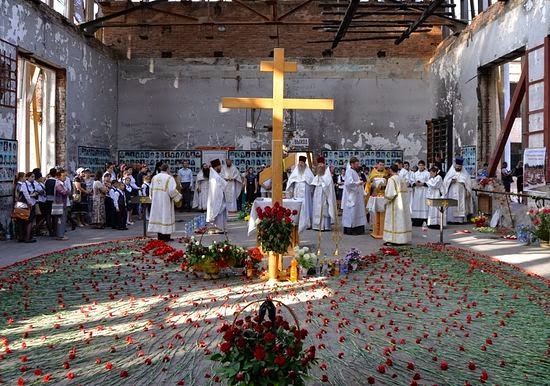
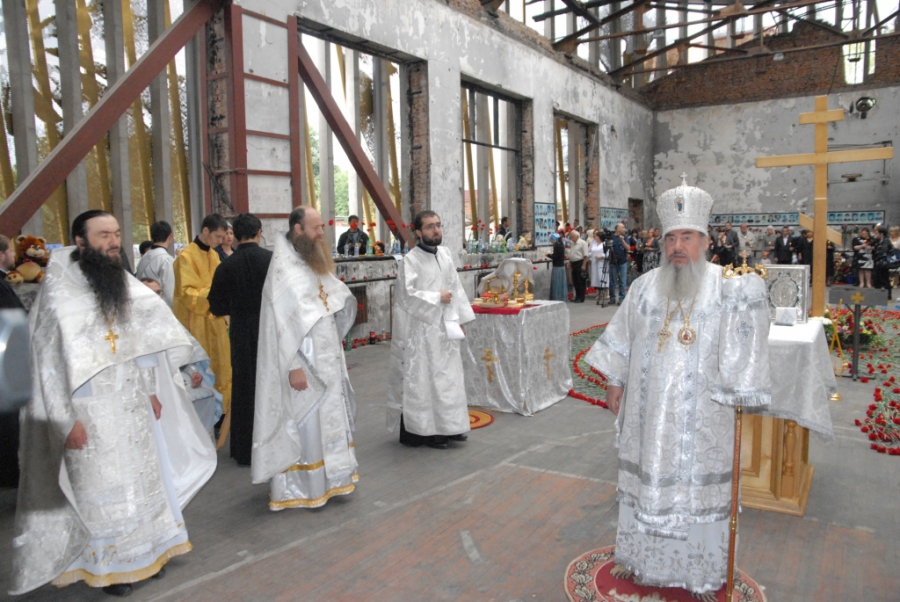
Archbishop Zosima serves Divine Liturgy at Beslan School No. 1

Pravoslavie — September 7, 2014


On September 3, 2014, the 10th anniversary of the end of the tragedy in Beslan, Archbishop Zosima of Vladikavkaz and Alania served a Divine Liturgy in the gym of School No. 1 in the town of Beslan, reports Pravoslavnaya Ossetia.

The secretary of the Diocese of Vladikavkaz Priest Savva Gagloev, Rectors and other clergy of North Ossetian Churches concelebrated with the archpastor. Relatives of the dead, former hostages, residents of Beslan and other towns of the republic gathered on the site of the tragedy to pray together.

Tuesday, May 20, 2014

‘Defeat the Infidels’: Could Jihad Be Headed to Ukraine?

Moscow and Poland also targeted in video call to 'path of jihad' by Al Qaeda-linked Muslim extremists.

by Sharona Schwartz, The Blaze — May 19, 2014

Leaders of the Muhajireen Army tell Ukrainian Muslims to “start on the path of jihad” (Image source: YouTube)
Islamist rebels fighting in Syria are apparently calling on Muslims in Ukraine to wage jihad on their home front and have suggested eventually taking the battle to Moscow and Poland.


In a new video posted online, Abdul Karim Krymsky, the deputy head of the Al Qaeda-linked group the Muhajireen Army, challenged Ukrainian Muslims to “start on the path of jihad” against the Russian government.

Quotes from the video, which was posted online last week, were provided by the Washington-based research organization Foundation for Defense of Democracy’s publication the Long War Journal which covers jihadi movements.

“You have to open up lands yourselves and defeat the infidels,” Krymsky said.

Tuesday, December 31, 2013

Putin pledges "full annihilation" of terrorists; Dozens rounded up in Volgograd

CBS News reports:
Police detained dozens of people on Tuesday in sweeps through Volgograd after the attacks raised security fears ahead of the Winter Olympics. 
There has been no claim of responsibility for either bombing, but they came only months after the leader of an Islamic insurgency in southern Russia threatened new attacks on civilian targets in the country, including on the Winter Games that are to begin Feb. 7 in Sochi.

Putin pledges "full annihilation" of terrorists
From RT.com — 12/31/2013

Volgograd trolley bus blast: LIVE UPDATES

At least 16 people have been killed in a trolley bus blast in Volgograd, emergency services report, only a day after a suicide bomb ripped through the city's railway station, killing 18. Security has been ramped up across the nation.

Read our full story of the second Volgograd suicide bombing.

Tuesday, December 31

13:45 GMT: Putin declared that Russia would "fiercely and consistently continue the fight against terrorists until their complete annihilation", speaking at a New Year’s reception in the Russian Far East city of Khabarovsk that suffered massive flooding this summer.

“This year, we had to face problems, including inhuman terrorist attacks in Volgograd and unprecedented natural disasters in Russia’s Far East,” Putin said.

According to the latest data, 34 people were killed in the terrorist attacks in Volgograd, while 72 others were wounded, with 62 of them currently in hospitals, Russia’s Health Ministry reported, as cited by Interfax news agency.

13:05 GMT: Over 150 units of firearms, as well as almost 5 kilograms of drugs, have been seized in Volgograd in a special operation, Interfax reported citing the region’s security forces as saying.

Following the terrorist attacks in Volgograd, people have been actively helping the security forces, calling them and reporting on any suspicious objects in the city.

Much more on the RT Volgograd page, updated throughout the day...

Monday, December 30, 2013

Russia: Rush-hour blast kills 14 on trolley bus in Volgograd, Russia; 3rd deadly attack in four days.


NBC News — 12/30/2013
By Albina Kovalyova and Daniel Arkin

MOSCOW -- At least 14 people were killed and 28 wounded when an explosion ripped through a trolley bus in the Russian city of Volgograd on Monday, the country's third deadly attack in four days.

Members of the emergency services work at the site of a bomb blast on a trolleybus in Volgograd December 30, 2013. (Reuters / Sergei Karpov)

The explosion, which authorities blamed on a suicide bomber, tore out much of the electric bus' exterior, left mangled bodies on the street and raised fears about more violence in the lead-up to the Sochi Winter Olympics that Russia will host in six weeks.

"For the second day, we are dying -- it's a nightmare," a woman near the scene told Reuters, her voice trembling. "What are we supposed to do, just walk now?"

Volgograd, a city of around one million about 400 miles northeast of Sochi, is a key transport hub for southern Russia, with many bus routes linking it to the volatile provinces in the North Caucasus.

On Sunday, 17 people were killed in a terror attack by a suspected female suicide bomber at a railway station in Volgograd. And on Friday, a car bomb killed three people in the southern Russian city of Pyatigorsk, 170 miles east of Sochi, where the Olympics will be held.


The blasts on Sunday and Monday were probably connected because the TNT and shrapnel-packed bombs were "identical," said Vladimir Markin, spokesman for Russia's main investigative agency.

Russian terror attacks could be chilling prelude to Olympic violence, say experts


Related:


Fox News — 12/30/2013

A pair of suicide bombings that left 31 dead in Russia could be a chilling tune-up for the Olympic Games, where a Muslim terrorist leader has vowed to put Chechnya’s long-standing grievance with Moscow in the international spotlight, according to terrorism experts.

Although no one has claimed responsibility for the twin bombings, which occurred less than 24 hours apart in the city of Volgograd, formerly known as Stalingrad, terror experts strongly suspect they were inspired, if not ordered, by Chechen Muslim rebel leader Doku Umarov. Umarov, who calls himself the emir of the terror group the Caucasus Emirate, has called on Muslims to attack civilians and to prevent the Olympics from occurring.

Thursday, September 5, 2013

Archbishop Zosima of Vladikavkaz serves Divine Liturgy on 9th Anniversary of Beslan Tragedy

"If we learn to overcome evil by prayer for bearers of the evil, then the world around us will become kinder." — Archbishop Zosima

Pravoslavie.ru — 9/4/2013


On September 3, 2013, the 9th anniversary of the end of the tragedy in Beslan, Archbishop Zosima of Vladikavkaz and Alania served a Divine Liturgy in the gym of School No. 1 in the town of Beslan, reports Pravoslavnaya Ossetia.

The secretary of the Diocese of Vladikavkaz Priest Savva Gagloev, Rectors and other clergy of North Ossetian Churches concelebrated with the archpastor. Residents of Beslan and other towns of the republic, relatives of the dead, and former hostages gathered on the site of the tragedy to pray together.

Wednesday, September 4, 2013

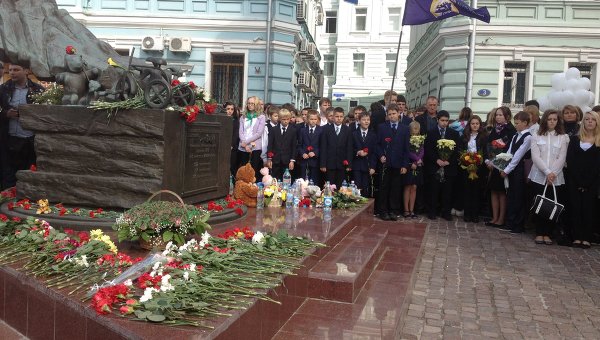
Moscow Marks 9 Years Since Beslan School Tragedy

This story does not report how horrific the Beslan massacre was. It was, in fact, a deliberate jihad terrorist attack upon school children, who were tortured, sexually molested and raped by the Chechen jihadists before being killed.


Pravmir — 9/4/2013

MOSCOW, September 3 (RIA Novosti) – In a solemn memorial ceremony on Tuesday, Moscow marked nine years since more than 300 hostages, most of them children, were killed in a school seized by Chechen separatists in the southern city of Beslan.

The ceremony, which took place at a downtown Moscow memorial to the tragedy, began with a moment of silence, during which 334 white balloons – the number of people killed in the siege – were released into the sky.

Wednesday, May 29, 2013

The Seed of Christianity: New Priest-Martyr Igor Rozin

This is my second post on New Priest-Martyr Igor Rozin, from an article at Pravoslavie.ru, which presents his life in a somewhat journalistic manner, yet with great reverence and feeling. There are vignettes into the dangerous situation in the Caucasus, but also descriptions of the unique beauty of this region.

(See my earlier post here. And, for a rich and edifying life of Fr Igor, I highly recommend issue 291 of The Orthodox Word.)

Above all, this is a rare, astonishing glimpse into the making of a saint. Heed the words of Archimandrite Lev Akhidov in his sermon reported at the end of the article:

Who killed Fr. Igor? Satan himself. He is the adversary: the adversary of Christ and the adversary of faith. He is the adversary of truth. But the blood of martyrs is the seed of the Church. Here, on an empty place, Fr. Igor began his ministry. He was successful, for which reason the envier of the human race could not stand it and decided to eliminate him, so that Christian singing and the preaching of the Gospel would die down here… A beautiful church has been erected on this place. I repeat Tertullian’s maxim: "The blood of martyrs is the seed of Christianity."
I sense that a new 'cloud of witnesses' is being assembled in the early years of the 21st century. This calls for faith, vigilance, and patient endurance from us all. May the adversary of Christ and His Church, the adversary of Truth, not find us unprepared.


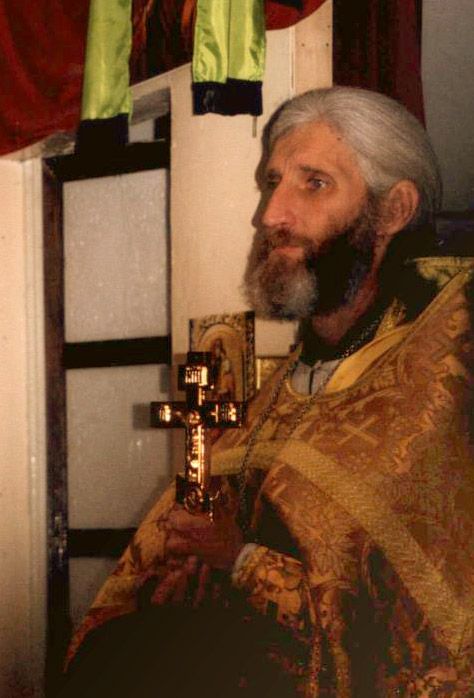
Fr. Igor serving a Moleben

May 13, 2013, marks the twelfth anniversary of the martyric death of Priest Igor Rozin on the feast day of St. Ignatius, Bishop of the Caucasus, in the city of Tyrnyauz in the North Caucasus.

One cannot drive to the foot of Mount Elbrus except through Tyrnyauz. The road from the city takes a rapid turn upwards until it reaches Terskol. There it ends: above that, one can proceed only by cable or on foot.

There is, however, one more way: from the north, from Kislovodsk, on a mountain road. That is the way that stubborn mountain climbers took when the road through Tyrnyauz was closed for nearly an entire year, from February to November 2011, when a counter-terrorist operation was underway here. Today this operation is often still declared, but not for long: usually for a day or two, during which the news shows stories of how a cache of explosives was located or an apartment in which militants were entrenched was stormed. Few people outside of Tyrnyauz pay attention to this news: today television shows too much of it. But it is another story when you live here. People entering the city encounter roadblocks. Resting his elbow on the butt of a machinegun hanging from his chest, a solider in body armor smokes next to an armored personnel carrier. A black mask covers his face. Other gunmen beside him check the Soviet-era cars parked at the roadside.

In the distance one can see the empty-eyed skeletons of buildings belonging to the Tyrnyauz Mining and Ore-Dressing Integrated Plant, which was once famous throughout the entire Soviet Union. In the beginning of the 1930s tungsten-molybdenum ore was discovered and the city was built, but the plant began to fade in the early 1990s and has since completely shut down. This once flourishing garden city has been plunged into poverty and desolate chaos. But what has not been taken away from this place is the beauty of God’s world, which shows through the distorted features of modernity.

The unusual, almost radiant air gives the landscape a certain unreality – perhaps this is a quality of the mountain, or perhaps of this place. The velvet sides of the mountain, the ragged cliffs, the grey peak of Totur, looking down on Tyrnyauz, the eagles pumping their wings in the air currents – everything is so beautiful that it is as if you were in one of the fabulous countries you read about as a child.

To the right, on the mountain slope, one can see the city cemetery. Over one of the graves is a tall canopy topped by a cross. It was installed recently, a couple of years ago, as was the black marble cross, now hugged by a viburnum bush. Before this, the grave of Priest Igor Rozin looked like almost all the others, with the exception that beyond its fence, both then as now, one could often see people praying.

A pilgrim prays at the grave of Fr. Igor, 2012.

Despite the fact that getting to Tyrnyauz is not easy, and not always without danger, people come to Fr. Igor’s grave constantly: from the Caucasus, from Moscow, from St. Petersburg. We drive into the city. The winding road, making its way through the new region, finally becomes an avenue that is straight as an arrow.

+++

In the Soviet years, as it still is today, it was called Elbrus Avenue. Commander Igor Rozin of the avalanche squad, a rescuer and mountain climber, travelled on it more than once. Priest Igor hurried the same way from Terskol to services. He was ordained in 1999, being given the only surviving building from 1937 as a church. “Once I happened to meet him—I hadn’t seen him in a long time. He asked if I could restore an old Bible for him. I was surprised,” related Dmitry, a neighbor of the Rozin family in Terskol and a colleague from the Vysokogorny Institute. “And he said: ‘I’ve become a priest.’ ‘Where?’ ‘In Tyrnyauz. We were given the dirtiest place in the city.’” Is that what he really said: the dirtiest place? “That’s what he said. In fact, it was dirty: a bacteriological laboratory. It couldn’t have been any dirtier: they brought all the diseases there. But he said: ‘We’ll pray away this dirtiest of places: nothing’s impossible.’”

I still think that he put it differently: all things are possible to him that believeth [Mark 9:23].

They did indeed clean and pray away. The entire community took care of the repairs: there was neither a window, nor a door, nor a floor. There is a photograph in which the first rector of the first church in the history of Tyrnyauz, Fr. Igor Rozin, is captured along with the dean, Fr. Leonid, and his daughter.

Fr. Igor in front of his church. Photo described in the paragraph below

Murdered Priest Hailed a Martyr


May 13, 2013, marked the twelfth anniversary of the martyric death of Priest Igor Rozin on the feast day of St. Ignatius, Bishop of the Caucasus, in the city of Tyrnyauz in the North Caucasus.


MURDERED PRIEST HAILED A MARTYR
By Yuri Akbashev
via IWPR

The brutal murder of a Russian priest in his church has sent a fresh wave of terror through the Orthodox community in Kabardino-Balkaria.

Since the outbreak of hostilities in Chechnya in September 1999, the Orthodox Church across the North Caucasus has been like a city under siege.

Now the killing of Igor Rozin in the town of Tyrnyauze is likely to reinforce the sense of isolation in a predominantly Muslim society and increase resentment against Islamic militant groups.
Valentina Varapaeva was cleaning the church early in the morning when a young man appeared at the door asking for Father Igor. She told him to come back towards midday when the priest was due to arrive.

The man duly returned at the appointed time and was greeted by Father Igor who, to Varapaeva's surprise, invited him into his room. "In all the time that I knew him, I never once saw Father Igor invite a stranger into his room," she later told the police.

The two men spoke quietly and calmly for some time but finally Varapaeva heard the priest say, "If you have come for my soul, then take it!"

She rushed into the room to find the stranger standing over Father Igor's blood-soaked body with a curved dagger in his hand. The man turned towards her. "Don't kill me, I have small children!" she cried and the killer ran out into the street.

Father Igor, who had suffered two knife wounds to the chest, died on the way to hospital.

An hour later, Ibragim Khapaev appeared at Tyrnyauze police headquarters and confessed to the killing. Police discovered that Khapaev had previously been given a four-year suspended jail sentence for attacking his cousin with a knife.

But local parishioners insist that Father Igor's murder was part of a wider plot to drive the Orthodox Church out of the North Caucasus.

The priest had established the Tyrnyauze parish last summer and enjoyed increasing popularity in the local community. However, the Tyrnyauze church was a tiny outpost of Orthodoxy in Balkar (Muslim) territory and Father Igor had received death threats in the past.

Now the priest is being hailed as a martyr to his faith. Local parishioners argue that the champion mountain climber who was nearly two metres tall could easily have defended himself against the murderer.

"He chose to die so that, by spilling his blood, he could show the strength of his faith," said one. "He simply bowed down before the will of God."

Father Igor's funeral was attended by both Christian and Muslim residents of Tyrnyauze. In an address to the crowd, his wife said, "I have forgiven his murderer and you must do so too because it is God's will."

The priest was buried in his native Tyrnyauze while a service in Nalchik was attended by Orthodox leaders and priests from across the region.


O Righteous Father Igor, pray for us feeble and cowardly ones!


Monday, May 27, 2013

New Martyr Evgeny Rodionov of Chechnya (May 23)

Saint Evgeny, the widely venerated Russian soldier who was beheaded by Chechen Muslims for refusing to remove his cross and deny Jesus Christ, is a real saint for our times. How many would not hesitate to remove their cross in order to save his earthly life? Such a simple thing, such a seemingly small confession of faith which we poor and weak ones take for granted every day, yet this young soldier persevered in faith in spite of horrible tortures, and earned a glorious, heavenly crown.

As Hieromonk Joachim exhorts us at the end of his sermon on St Evgeny (below):
And may we, dear brothers and sisters, learn from Evgeny's constancy, dignity and bravery to face and overcome our own daily temptations to betray Christ. May we bear our cross daily and NEVER, EVER be ashamed to wear our baptismal cross and be ready at all times to defend our holy Orthodox Christian Faith by living a holy life in accordance with the commands of Christ.

* * *

Short Life of New Martyr Evgeny
from Death To The World

When he was 11 years old, Yevgeny Rodionov received from his grandmother a little cross on a chain. He wanted to wear it to school, but his mother, a devout atheist, warned him against it, since the communist authorities frowned on such things. Yevgeny wore it anyway and refused to ever take it off. When Yevgeny grew, up he enlisted as a soldier in the Russian army. When he was 19, he was violently taken hostage by Muslim Chechen rebels. They kept him hanging by his wrists in a basement. He was left days without food and was severely beaten. He did not take off his cross even at the hardest moment of beastly tortures. The Muslims ordered Yevgeny and several other Russian prisoners to deny Christ and convert to Islam. Unlike most of his fellow prisoners, Yevgeny refused to betray his Savior and was beheaded by his torturer, Ruslan Khaikhoroyev, on May 23, 1996. The Muslim executioner told his mother, “Your son had a choice to stay alive. He could have converted to Islam, but he did not agree to take his cross off.” Yevgeny’s mother, Lubov, has been able to recover her son’s body to give him a proper burial. After seeing her son’s boots in a shallow grave full of four dead soldiers, she would not believe it was him until she saw his cross still around his neck. She found his head later. Veneration of this Holy Martyr has been spreading and pilgrims are flocking from miles away to venerate his miracle working relics. An Icon that was made of Yevgeny has begun weeping myrrh. Yevgeny’s father died shortly after the return of his son’s body, not being able to live with the torment of loosing his son. Yevgeny’s mother, who never before set foot in a church, put off the world and is now an Orthodox Christian believer, saved by the example of her son, the Holy Martyr Yevgeny Rodionov.

* * *

Icon of Saint Evgeny the New Martyr
available from Uncut Mountain Supply.


* * *

Saint Evgeny Rodionov the New Martyr of Chechnya

From a post compiling several sources on John Sanidopoulos' Mystagogy blog:

Below is a story of the courage and faith of a young man in Post-Soviet Russia whose memory we celebrate on May 23rd and August 20th.

Evgeny Aleksandrovich Rodionov was born thirty minutes after midnight on May 23, 1977 in the village of Satino-Russkoye near Moscow in what was then the Soviet Union. According to his mother, as a boy in this small village, all he really wanted was to be a cook. When he was eleven years old, Evgeny Rodionov received from his grandmother a little Cross on a chain. He wanted to wear it to school, but his mother, then an atheist, warned him against it, since the communist authorities frowned on such things. Evgeny wore it anyway and refused to ever take it off.

In 1995 Evgeny turned eighteen and was drafted into the Russian armed forces as is required for all Russian men. Right before being drafted, Evgeny was baptized in the Russian Orthodox Church on his own accord seperate from his parents who were still atheists. For his duty he was chosen to work in a frontier guard unit (something of a mix between the US Border Patrol and the National Guard) and sent for training in the Kalingrad area of what was formerly East Prussia. After training he was sent to the border of Chechnya and posted near the town of Galashki. This was towards the end of the controversial First Chechnyan War. On the night of February 14, 1996, just six months after he started his service, Evgeny and three comrades were captured by a force of Muslim Chechen guerillas who were disguised in an ambulance while the Russian soldiers were manning a checkpoint.


According to a report in Pravda from 2003:

"They [Evgeny and the soldiers with him] patrolled the border between the republics of Chechnya and Ingushetia. Their control and registration post was located some 200 meters far from the security detachment. The post was just a small cabin, without any light or wire communication. The cabin did not even have a military support, in spite of the fact that it was a single cabin on the mountainous road, which was used for carrying weapons, ammunition, captives, drugs and so on. The border guards stopped an ambulance vehicle to check it. More than ten armed Chechens got out of the vehicle. Needless to mention that it was very easy for them to cope with young inexperienced soldiers. The guys showed as much resistance as they could, but the outcome of the fight was evident before it even started."

Upon capture they were held in the cellar of an abandoned house for 100 days as ransom demands were sent to their families. Kidnapping and demanding ransom was almost a cottage industry in Chechnya during that time period. They kept Evgeny hanging by his wrists in a basement. They starved and beat him. Rodionov's ransom was reported to be 50 million rubles (1.6 million dollars) - at the time an impossible sum. Another report says it may have been in the $10,000 range. Whatever it was, the ransom was not met.

Chechen field commander Rusland Haihoroev (also spelled Khaikhoroyev in some sources) eventually beheaded Evgeny with a rusted saw that took over an hour to complete on May 23, 1996 (his 19th birthday) near the settlement of Bamut. His body, along with four other Russian prisoners were placed in a bomb crater outside the village of Alexeevskaya and covered up with lime and dirt. Haihoroev stated later in an interview that he only killed Rodionov after the soldier denied conversion to Islam and refused to give up his Orthodox Cross, while two others with him had converted to Islam. Russian troops occupied the village where Evgeny was murdered the following day after the execution.