Saturday, May 17, 2014

Camels and Urine and Goats — Oh My!

Mark Steyn explores some homeopathic aspects of traditional Islamic culture and health care:
May 16, 2014

American Millie Hinkel, Camel-milk advocate

...A Minnesota university has canceled a "Hump Day" event featuring a real camel because, like everything else in America, that too is racist:
Students at the University of St. Thomas in Minnesota have cancelled an event to celebrate the end of the year after complaints that bringing a camel on campus could offend those of Middle Eastern cultures. 
The "Hump Day" event, put on by the Residence Hall Association (RHA), was supposed to be "a petting zoo type of atmosphere" in which students could hang out and take photos with a live camel.

But now the RHA has folded like a cheap Bedouin tent and canceled "Hump Day"...

Why exactly would the presence of a camel "offend those of Middle Eastern cultures"? 

I assumed at first, even by the standards of privilege-checking self-neutering American college students, they must be, as they say in Britain, "taking the piss". Well, it turns out they are:

While camels are clearly a major part of the MERS [Middle East Respiratory Syndrome] story, which the majority were found infected with a strain genetically almost identical to the strain that's infecting people, yet questions arise if the transmission occurs through the drinking of unpasteurized camel milk, consumption of cheese made from it, or is it the drinking of camel urine?

That's the invaluable Walid Shoebat on the root causes of MERS, which, lethal-disease-wise, is this year's SARS. 

[If you can "stomach" it, pardon the pun, there are several videos and much more info on the Muslim world's love for camel urine on the Shoebat Foundation site. It is used in beauty products, and is often mixed with camel's milk to drink, which has finally been legalized for sale in the U.S. by the FDA. If that's not a sign of the apocalypse, I don't know what is.] 

If you've spent any time in Araby, you'll know that camel urine is as vital to the economy as oil:
Western health experts are unfamiliar with litany of Muslim products that are produced from Camel's urine... 
Even CNN Arabic promoted under its "Health and Technology" column an article titled "A mouthful a day" and even in capsule form – just like you would with fish oil, massage it into your hair or apply it directly to your face. For best results, the CNN report recommends "to take mouthfuls of camel urine daily for an entire year" and to make sure the camel be a female virgin. Surveys are even done to conclude from patients that, the urine of a virgin camel has a "preferable distinct flavor and aroma." 
Westerners are not accustomed to how camel urine is an essential aphrodisiac to many Muslims as Ginseng is to Chinese.

Friday, May 16, 2014

Pregnant Woman Facing Execution in Sudan for Apostasy

Another brave confessor of Jesus Christ willing to witness to her Muslim persecutors of her faith — even unto death.  Perhaps one or two Hagarenes will be converted through this. Prayers up for Mariam!

This is Islamic Sharia Law being applied in Sudan. As Robert Spencer notes in his coverage of this case: 

Islamic apologists in the West routinely claim that Islam has no death penalty for apostasy. Unfortunately, misunderstanders of Islam abound in large numbers, and for some reason they cannot shake the notion that Islam does mandate death for those who are considered to have left the faith. 
Why do they persist in this misunderstanding? Maybe it’s because Muhammad commanded: “Whoever changed his Islamic religion, then kill him” (Bukhari 9.84.57). This is still the position of all the schools of Islamic jurisprudence, both Sunni and Shi’ite. 
Sheikh Yusuf al-Qaradawi, the most renowned and prominent Muslim cleric in the world, has stated: “The Muslim jurists are unanimous that apostates must be punished, yet they differ as to determining the kind of punishment to be inflicted upon them. The majority of them, including the four main schools of jurisprudence (Hanafi, Maliki, Shafi`i, and Hanbali) as well as the other four schools of jurisprudence (the four Shiite schools of Az-Zaidiyyah, Al-Ithna-`ashriyyah, Al-Ja`fariyyah, and Az-Zaheriyyah) agree that apostates must be executed.”

Pregnant Woman Facing Execution in Sudan: 'I am a Christian'
by Frances Martel, Breitbart News — May 15, 2015

Mariam Yahia Ibrahim Ishag, a 27-year-old pregnant mother, has been sentenced to death in Sudan for "apostasy" for marrying a Christian, despite being raised a Christian, because her father was Muslim. Ibrahim has refused to accept Islam after a three-day stay on her execution and is slated to be killed today.

Ibrahim, who is almost nine months pregnant, is married to an American citizen of South Sudanese descent, who has applied for her to come to the United States but has not yet received approval from the American government. Her marriage is considered void by the Sudanese government because of her husband's Christian faith, and she was sentenced to hanging and 100 lashes for both adultery and apostasy. She was given three days to abandon the Christian faith and her husband and children-- her unborn child and an 18-month-old boy-- and "revert" to her father's religion. The court did not make clear what would happen to the children should she renounce Christianity-- and thus her family-- and accept their version of Islam.

Ibrahim refused to abandon her religious faith, telling the judge, "I am a Christian and I never committed apostasy."

"We gave you three days to recant but you insist on not returning to Islam," Judge Abbas Mohammed Al-Khalifa told her, according to Al Jazeera, announcing his death sentence and the additional lashes for "adultery." The judge only addressed her by her father's name, emphasizing his Muslim background.

Metropolitan Hierotheos Vlachos: 'Ferocious Persecution in the Middle East against Christians'

"This past Holy Week and Easter I frequently thought of the Christians in the Middle East... I thought how they must have spent those days like our ancestors who were under terrible enslavement to the Ottomans. How much they must have felt the nails of hate against them, against the Body of the Church that is being persecuted..." 
—Met. Hierotheos of Nafpaktos


EASTER IN THE MIDDLE EAST
By His Eminence Metropolitan Hierotheos of Nafpaktos and Agiou Vlasiou
MYSTAGOGY — May 9, 2014


The Easter issue of the American magazine TIME was dedicated to Christians who are "persecuted" in the Middle East and Egypt. A few items are suggestive of the situation in these countries in relation to its Christian element. Reference will be made according to reports from Kathimerini.

One critical and important element is that "in the last population census during the Ottoman Empire, one in four residents of the Middle East were Christians. Today, Christians represent less that 5%, and there are strong pressures in countries like Syria or Egypt."

Of course, at this time there are Christians of various Confessions, even Coptic Monophysites, and not only Orthodox Romans.

Also in TIME magazine it is reported that "in war-torn Syria, some Christians are persecuted for their faith, while others had a choice for survival in reference to previous centuries. In today's war-torn Rakka in North Syria, the Islamic organization ISIS asked $650 from Christian families who stayed behind for protection.

At least one in four Christians in Syria fled the country after the outbreak of the Civil War, while in Iraq, about one million Christians fled after the overthrow of Saddam Hussein in 2003, leaving behind about 300,000 Christians. If current demographic trends continue, of the twelve million Christians currently residing in the Middle East, in 2020 only half will remain" (Kathimerini Holy Saturday April 19 - Easter Sunday April 20, 2014).

From this data it appears that in the Middle East a ferocious persecution has evolved in the Middle East against Christians, expressed in various ways, namely murder, extortion, displacement, exile, trauma, refugees etc. 

Thursday, May 15, 2014

U.S. Becomes Chief Enabler of Christian Persecution: Muslim Persecution of Christians, January 2014

by Raymond IbrahimGatestone Institute — May 14, 2014

Human rights organization Open Doors published its 2014 World Watch List in January, highlighting and ranking the top 50 nations that persecute Christians.  The overwhelming majority of countries making the list—and nine of the top ten worst offenders—are Muslim, and include nations from among America’s allies (Saudi Arabia, Kuwait) and its contenders (Iran); from among economically rich nations (Qatar) and poor nations (Somalia and Yemen); from among “Islamic republic” nations (Afghanistan), “democracies” (Iraq), and “moderate” nations (Malaysia and Indonesia).

The report also indicates that every Muslim nation that the U.S. has helped “liberate,” including in the context of the “Arab Spring,” has become significantly worse for Christians and other minorities. Previously moderate Syria is now ranked the third worst nation in the world to be Christian, Iraq fourth, Afghanistan fifth, and Libya 13th. All four receive the worst designation in the ranking process: “extreme persecution.”

Three of these countries—Iraq, Afghanistan, and Libya—were “liberated” in part thanks to U.S. forces, while in the fourth, Syria, the U.S. is actively sponsoring “freedom fighters” against the regime, many of whom have been responsible for any number of atrocities—including massacres, beheadings, and the crucifixion of Christians and others.

Despite this track record of interfering in Islamic nations only for the human rights of minorities to plummet, and despite the fact that Syria has gotten dramatically worse for Christian minorities, Secretary of State John Kerry declared in January that, if only Bashar Assad goes away, “I believe that a peace can protect all of the minorities: Druze, Christian, Isma‘ilis, Alawites—all of them can be protected, and you can have a pluralistic Syria, in which minority rights of all people are protected.”

The same was predicted of Iraq over a decade ago, yet today, well more than half of the Christians are either dead or fled, after years of constant attacks on their churches and persons once Arab dictator Saddam Hussein was ousted.

Libya offers a more recent precedent.  Since U.S.-backed “rebels” overthrew Qaddafi, Christians—including Americans—have been tortured and killed (some for refusing to convert), their churches bombed, and their nuns threatened.

January’s roundup of Muslim persecution of Christians around the world includes (but is not limited to) the following accounts, listed by theme and country in alphabetical order, not necessarily according to severity.

Egypt: Christian arrested for using home as church

This brave soul is a Confessor of Jesus Christ. He is willing to place his life in jeopardy, applying principles of non-violent resistance against the seventh-century 'Conditions of Omar' under which Christians in Egypt are subjugated as dhimmis, second-class non-Muslims, prevented by law from openly practicing their faith.  ICXC + NIKA

by Raymond Ibrahim, JihadWatch — May 14, 2014

A Coptic Christian man in Egypt has been arrested on complaints from local Muslims that, without a permit, he has converted his home into a church and is supposedly even holding religious rituals.

The 55-year-old man, known only by his initial, “BH,” is a laborer in the al-Minya district in Upper Egypt, where Christians are especially targeted.  It was back in 2011 that the Copt first turned his home into a church, prompting angry, local Muslims to report him.   He was arrested by police but later released after agreeing that he would never again try to use his home as a church.

Apparently not one to be deterred, “after a while, Muslims in the village were shocked to see the Christian worker do it again [use his home as a church]—only openly this time.”

So police have arrested him once again, pending investigation.


In Egypt, as well as most other Muslim countries, Christians need special permits, often from the presidency itself, to build churches—permits which are next to impossible to acquire—shedding some light on this Copt’s actions.

Wednesday, May 14, 2014

Why We're Only Now Paying Attention to Boko Haram Is a Disgrace

THE essential primer on the history and dynamics of Islam in Nigeria.

"Boko Haram began as a local Nigerian jihadist group, but it has linked up with the global jihad movement, and so has transformed into a regional threat across not just Nigeria but Cameroon, Niger, Chad and possibly Mali, Mauritania, Algeria and even Libya." — Timothy Furnish

by Timothy R. Furnish, History News Network — May 12, 2014


Timothy R. Furnish holds a PhD in Islamic, African and World history and works as an author, analyst and consultant to the US military. His website is www.mahdiwatch.org and he is on Twitter as @occidentaljihad

The Nigerian Islamic terrorist group Boko Haram has finally grabbed the world’s attention via its seizure of almost 300 Christian girls and its threats to sell them into (sex) slavery. But the group has actually been active for some 12 years, and in point of fact constitutes not some new, virulent form of African Islam but, rather, simply the latest in a long series of similar jihadist and shari`a-imposing groups going back for centuries in that part of the continent. 

Nigeria is the most-populous nation in Africa, and its 160 million inhabitants are almost evenly divided between Christians (in the south) and Muslims (in the north). There are also a number of important ethnolinguistic divisions—notably Hausa, Fulani, Yoruba, Ibo and Ijaw. Nigeria is the world’s 14th-largest oil producer and the fifth-largest supplier to the US. It is also, according to revamped metrics, the largest economy on the African continent. Despite its enormous size, Nigeria has a relatively small military: only about 85,000 troops. (Compare that with Egypt, which has half Nigeria’s population but an army of over 400,000 men.)

Modern Nigeria was created by the British in 1903. The major polity they incorporated into the new colonial territory was the Sokoto Caliphate, which had encompassed not just modern northern Nigeria and Cameroon, but also parts of Niger and Chad, from its creation in the early 19th century at the guidance of Usman Don Fodio (d. 1817), the great Hausa Muslim mujaddid (“renewer” of Islam) whom many considered the Mahdi. Don Fodio’s movement was the most successful of a legion of Muslim jihads in West Africa (modern Mauritania, Senegal, Nigeria, etc.) between the 16th and 20th centuries. During its century of existence, the Sokoto state enforced shari`a law, which included brutal criminal punishments and the relegation of Christians to second-class dhimmi status. (Also, under Caliph Don Fodio and his successors, other jihads in West, Central and North Africa were given ideological and, if possible, financial support.) Don Fodio’s Islamization campaign was so successful that to this day in Nigeria the denizens of the former caliphal areas identify themselves first and foremost by their religion, Islam, rather than by their ethnolinguistic group—unlike most other Nigerians for whom the latter took priority. (This, however, does seem to be changing as Ibo, Yoruba and Ijaw peoples are increasingly identifying themselves as Christians, over against the depredations of Boko Haram.)

Under British rule, northern Nigeria and its former caliphal rulers and subjects were actually insulated from Western influences, under a well-meaning British policy of tolerance. However, the major result of this policy—in effect for almost six decades, until Nigerian independence in 1960—has been the underdevelopment and ideological isolation of the Muslim communities of the former Sokoto Caliphate, and the sowing of fertile ground for the likes of Boko Haram. 

However, that group did not spring into existence ex nihilo in 2002; rather, it emerged from the re-imposition of Islam into Nigeria’s political sphere which began only about a decade after independence. The most important Islamic political party was Jama`at Izalat al-Bida wa-Iqamat al-Sunna (“Society for the Eradication of Innovation and Establishment of the Sunna”), founded in 1978 by Abubakr Gumi (d. 1992), former Chief Mufti of Nigeria. He had strong Wahhabi leanings and so, too, did Izala, which received support from Saudi Arabia (despite the heretical belief that women could be educated). 

William Kilpatrick: Taking the Islamic Challenge Seriously

"As long as Muslims believe that Muhammad received his marching orders from God, the Islamic jihad will continue. If we want to put a stop to the jihad, we need to put a dent in that belief." — William Kilpatrick

It is my firm belief that the greatest service to Christians, to civilization, and indeed, to Muslims themselves, is to boldly live and proclaim the Truth which is in Christ Jesus. 

Jesus Christ is "the Way, the Truth, and the Life, and no one comes to the Father" but through Him. He showed us the Way of the most extreme humility, of the most brave and profound love, and of the most gentle compassion and care, in order to restore us to the high calling of humanity which we had from the Father "In the beginning." Let us live in and through Him, that we may actualize in our lives this life-changing love which the world needs so desperately now.

In my book, Facing Islam, I featured these two quotes immediately before my Preface. They sum up the Christian response to the "Islamic Challenge" which William Kilpatrick writes of in his essay:

"I think it is very important for Christians to wake up and return to their roots, to be serious about their faith, and to try to share that faith with Moslems. This is the greatest defense against Islam."  
~ Archimandrite Daniel Byantoro


"Christian compromise in thought and word and negligence in deed have opened the way to the triumph of the forces of the absurd, of Satan, of Antichrist. The present age of absurdity is the just reward of Christians who have failed to be Christians.

"It is futile, in fact it is precisely absurd, to speak of reforming society, of changing the path of history, of emerging into an age beyond ab- surdity, if we have not Christ in our hearts; and if we do have Christ in our hearts, nothing else matters.

"Now one cannot be a half-hearted Christian, but only entirely or not at all."


~ Hieromonk Seraphim Rose (+1982)

Taking the Islamic Challenge Seriously
By William Kilpatrick
May 13, 2014

Better get used to it.
When Muslims commit acts of terror, it is standard operating procedure for some authority or other to assure the populace that "this has nothing to do with Islam." This is said so frequently as to induce a boy-who-cried-wolf reaction in anyone with an ounce of contrariness. Nowadays, if there's a fender bender on the next block or a glitch in our computer, we automatically assume that it probably has something to do with Islam. So it's refreshing to finally hear a world leader (in this case, a former world leader) admit that global Islamic terror actually does have something to do with Islam.

In a keynote address in April at Bloomberg Headquarters in London, former British Prime Minister Tony Blair described radical Islam as the single biggest threat facing the world today. He went on to criticize Western commentators who "go to extraordinary lengths" to avoid linking terrorism with Islam. "It is bizarre," he said, "to ignore the fact that the principal actors in all situations express themselves through the medium of religious identity."

Although Blair suggested that radical Islamic ideology "distorts and warps Islam's true message," he nevertheless emphasized that this extremist movement is based in religious belief. He added that we in the West can gain a better understanding of the Islamist ideology by remembering "the experience of revolutionary communism and fascism." His main message? The "defeating of this ideology" should be at the top of the global agenda. In short, Blair is calling for ideological warfare against "Islamism" (his term for radical Islam).

Tuesday, May 13, 2014

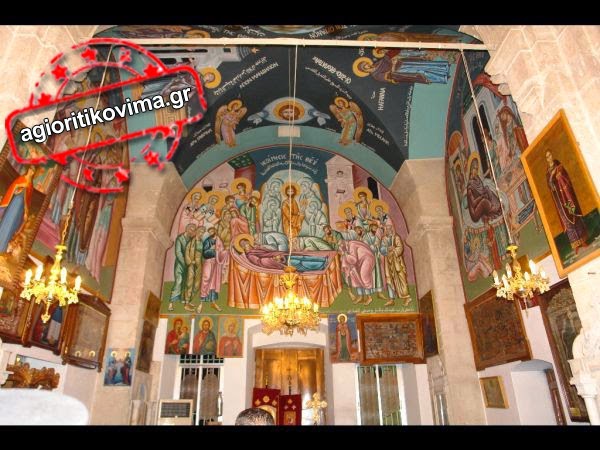
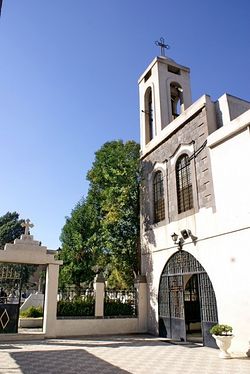
Saint Thekla Monastery in Maaloula, Before and After the Catastrophe (photos)

This is the women's monastery in Syria which was destroyed by Muslims, and from which were abducted Mother Pelagia and her sisters, who were released from captivity back in early March.

Source: MYSTAGOGY — May 12, 2014


‘They Are Slaughtering Us Like Chickens’: Muslim Persecution of Christians, December 2013

Raymond Ibrahim's December Report
Published April 8, 2014

As happens at Christmas every year throughout the Muslim world, Christians and their churches were especially targeted—from jihadi terror strikes killing worshippers, to measures by Muslim authorities restricting Christmas celebrations.  Some incidents follow:

Iraq:  “Militants” reported the Associated Press, “targeted Christians in three separate Christmas Day bombings in Baghdad, killing at least 37 people, officials said Wednesday.  In one attack, a car bomb went off near a church in the capital’s southern Dora neighborhood, killing at least 26 people and wounding 38, a police officer said. Earlier, two bombs ripped through a nearby outdoor market simultaneously in the Christian section of Athorien, killing 11 people and wounding 21.”

Iran:  Five Muslim converts to Christianity were arrested from a house-church during a Christmas celebration. Plain clothes Iranian security authorities raided a house where, according to Mohabat News, “a group of Christians had gathered to celebrate Christmas on Tuesday, December 24.” Before arresting the five apostates, authorities “insulted and searched those in attendance, and seized all Christian books, CDs, and laptops they found. They also took the Satellite TV receiver.”  The original report received by Mohabat stated: “These Christians had gathered to worship and celebrate [the] birth of Jesus.”

Indonesia: Muslims in the Aceh province protested against Christmas and New Year celebrations and called on authorities to ban them. Days earlier, an influential Islamic cleric organization, the Ulema Consultative Assembly, issued a fatwa, or edict, “prohibiting Muslims from offering Christmas wishes or celebrating on New Year’s Eve,” said the Associated Press.  Aceh is the “only province in predominantly Muslim Indonesia that is allowed to implement a version of Islamic Shariah law.”

Kenya: “Youths,” reported Reuters, “threw petrol bombs at two Kenyan churches on Christmas day … in the latest bout of violence against Christians on the country’s predominantly Muslim coast.”  The attacks occurred “in the early hours of December 25 after churchgoers held services to usher in Christmas.”  The churches were located in Muslim-majority regions. One church was “completely destroyed.”

Somalia: The more “moderate” government—as it is often portrayed in comparison to Al Shabaab (“The Youth”) opposition—banned Christmas celebrations. Hours before Christmas Day, the Ministry of Justice and Religious Affairs released a directive banning any Christian festivities from being held in the east African nation.  In the words of one ministry official: “We alert fellow Muslims in Somalia that some festivities to mark Christian Days will take place around the world in this week. It is prohibited to celebrate those days in this country.”  All security and law enforcement agencies were instructed to quash any Christian celebrations.

Pakistan:  During Christmas Eve services, “Heavy contingents of police were deployed around the churches to thwart any untoward incident.”  In some regions, “prayer service at major churches focused on remembering the Pakistani Christians who lost their lives in terror attacks.” For example, three months earlier, Islamic suicide bombers entered the All Saints Church compound in Peshawar following Sunday mass and blew themselves up in the midst of some 550 congregants, killing some 130 worshippers, including many Sunday school children, women, and choir members, and injuring nearly 200 people.

Even in Western nations like Denmark, Christmas Eve witnessed Islamic demonstrations and cries of “Allahu Akbar” (or “Allah is greater”).

Also in December, Syria’s Greek-Catholic Church declared that it had three “true martyrs”—men from the small town of Ma’loula, an ancient Christian site where the inhabitants still spoke the language of Christ.  According to Asia News, “When the town fell [in September, to al-Qaeda linked rebels], a climate of fear was imposed… When three men refused to repudiate their religion, they were summarily executed in public, and six more were taken hostage. This was followed by a failed attempt by Syrian government forces to retake the town.”  In the words of Patriarch Gregorios III to Pope Francis in a meeting: 

Holy Father, they are true martyrs. Ordered to give up their faith, they proudly refused. Three others however gave in and were forced to declare themselves Muslim, but later returned to the faith of their ancestors.

According to the families who fled from Ma’loula, “some of their Muslim neighbors took part in the attack that devastated this historic village where people still speak Aramaic, the language of Jesus. Muslims are approximately one third of the population of the village…”

The rest of December’s roundup of Muslim persecution of Christians around the world includes (but is not limited to) the following accounts, listed by theme and country in alphabetical order, not necessarily according to severity.

Ancient Icons Miraculously Survive in 6th Century Syrian Church damaged by Muslims

Pravoslavie — May 11, 2014

In the Syrian Old Homs, "Eleven Christian churches are either completely destroyed or heavily damaged," related a local priest named George Abu Zahem to the Lebanese The Daily Star newspaper. 

He has described the situation in the al-Hamidiyah Christian quarter as disastrous. According to the priest, the churches were robbed and desecrated by militants. 

"A true miracle happened at Holy Martyr Elian's Orthodox Church in Homs (6th century). The gunmen set it on fire. However, the fire did not touch the ancient icons on the walls—they just slightly darkened," the priest said. 

The thick walls have saved the Cathedral of Holy Theotokos, the "calling card" of Old Homs, where is the city's main relic—a small portion of the Girdle of the Mother of God. 

According to Abu Zahem, the bell-tower was damaged as a result of fighting: its bell collapsed in the cathedral's courtyard.


© Pravoslavie.Ru