Monday, July 8, 2013

Egypt’s Christians face arson, beatings, and forced conversions amid upheaval


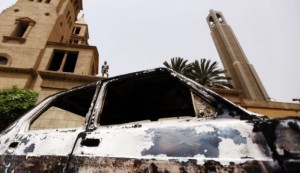
A car burnt in Muslim attacks on Cairo’s main
Coptic Cathedral. Photo by Reuters
Violent clashes across Egypt have been taking place not just between the supporters and opponents of deposed President Mohammed Morsi of late. During times of upheaval, the Coptic Christians in Egypt always suffer abuse, and now is no exception. The Coptic community comprises roughly 10 percent of Egypt’s population of 80 million. They belong mostly to the Coptic Orthodox Church although some subscribe to Greek Orthodoxy. The Copts live primarily in Egypt’s largest cities, Cairo and Alexandria.

Since the beginning of the 2011 revolution that toppled Hosni Mubarak, they have suffered constant harassment, and dozens have lost their lives to violence. Their churches have been torched. Coptic women have been beaten, forced to wear hijabs, or forcibly converted to Islam, according to human rights organizations.

The Muslim Brotherhood has taken a public stance against the targeting of Copts. Not only did Morsi condemn violence against the group during his presidency, he appointed numerous Copts as ministers and advisers in his government. The main group antagonistic to the Copts has been the Salafi movement, a conservative Islamic group that recently joined the liberals in coalition against Morsi.

The central flashpoint in a sea of instability of the past week is Luxor, a tourist city in south-central Egypt. One person was killed there, and 23 Coptic homes were torched. The Egyptian army has been guarding the local church, to prevent it from being set aflame as well.

A Coptic Christian priest was shot dead in the lawless Northern Sinai on Saturday, sources said, adding that they believe the shooting is the first sectarian attack since Morsi’s ouster. The shooting in the coastal city of El Arish was one of several attacks believed to be by Islamist insurgents that included firing at four military checkpoints in the region, the sources said.

Since Morsi’s his ouster, the Muslim Brotherhood has fiercely criticized Coptic Pope Tawadros, spiritual leader of Egypt’s 8 million Christians, for giving his blessing to the removal of the president and attending the announcement by armed forces commander General Abdel Fattah al-Sisi suspending the constitution.

In Cairo things have been relatively quiet, but the Copts there are terrified. In a widely circulated YouTube clip taken from Egyptian television, a pro-Morsi demonstrator in a niqab face covering threatens to burn all the Christians in the world, saying they cause conflicts among Muslims. This is not just empty talk. On Saturday morning, a large police contingent was dispatched to the Copt neighborhood in old Cairo.

46-year-old Ibrahim Halil sits quietly on the street. He has made his living in tourism. In the past, he has offered tour guide services, sold souvenirs, and even operated a money changing booth. There are no tourists anymore. After losing his livelihood, he is weary of the clashes that will surely come. “They will come here one day, I know,” said Halil. “They’re crazy. They hate the Christians. They think Islam is the only religion, and everyone who doesn’t believe in Islam must be killed.”

Halil has a 15-year-old daughter. “Sometimes they shout at her in the street: ‘heretic,’ and ‘cover your head,’” he recounted. “She has not been attacked, but it could happen. It happens to people everywhere.”


Nadia Daif, a woman in her fifties, sits near the ancient cemetery. She is not employed. “I’m not afraid. Our youth are strong, they will defend me. They can start to attack us for so many reasons, but there is police here, and we have our young men, and it will be okay,” she said. Daif supports the military’s ouster of Morsi. “Look how empty [of tourists] it is here. There is no food. People have no food.”

Watching Egypt: A Policy Suggestion

With news reports across the media spectrum indicating dozens of deaths, hundreds injured, and Muslim Brotherhood members being targeted, arrested and killed by the Egyptian military, the threat of all out civil war in Egypt is now very real.

The religious cleansing and genocidal attacks by Islamist rebels against Christians in Syria show the horrors of what might happen to Coptic Christians in Egypt if battle lines are drawn. The threat has already been made perfectly clear, as in this video, where a "religious Muslim woman" screams,

"I have one word for you Christians: You live by our side. We will set you on fire! We will set you on fire!"

In light of these very real threats, the need for protection of the Christian minority in Egypt (and of course Syria) should be the primary foreign policy stance of the United States and the Western world.

What happens when the West ignores the reality of Muslim threats against Christians can be seen in the Armenian/Orthodox genocide perpetrated by the Muslim Turks from 1894 to 1922, which left 4 million Christians dead.


Christianity in Peril in Turkish Cyprus


by Michael Curtis at American Thinker - via OCP

Violence against Christians has become all too frequent in recent years, with attacks on them in a wide variety of countries in Africa, Asia, and the Middle East.  Repression and intolerance have been displayed against the Christian community in Nigeria; against the Coptic Christians in Alexandria, Egypt ; by bombing in a chapel in Sulu, Philippines; by bomb arracks against Assyrian Christians in Iraq; by discrimination against them in the Islamic Republic of Iraq; by prosecution under the blasphemy laws in Pakistan and elsewhere.

It was the interruption and disruption by force of the celebration of Christian Mass in the villages of Rizokarpaso and Ayia Triada in northern Cyprus that led the European Parliament in a resolution on January 19, 2011 to comment on the situation of Christians in the context of freedom of religion.  Since the “Arab Spring,” thousands of Christians have fled the countries of the Middle East except Israel.  Christian communities have existed for two thousand years in the Middle East, though they are now declining as a result of low birth rates and emigration caused by discrimination and persecution in most of the Arab and Muslim countries in the area.  The case of northern Cyprus is a recent example of that discrimination and intolerance towards a Christian community.

Sunday, July 7, 2013

Obama Doctrine makes U.S. a ‘Sinister Bystander’

Global Negative Perceptions revealed by Egyptian and Syrian Victims of Islamic Persecution

by Ralph Sidway
(Originally published at RaymondIbrahim.com)

My late grandmother used a clever turn of phrase to describe shady characters who, while protesting their innocence, somehow seemed linked to the crime in question. Today, my grandmother’s expression — “sinister bystander” — seems the most apt way to describe the global perception of the Obama administration and its failed policy towards Egypt, Libya, Syria, Iran, and the Islamic world in general.


Perceptions are important, in international as well as national politics. All politics ultimately become local, as people make up their minds who they can trust… and who they can’t.


As is clear from the large number of anti-Obama posters and banners in Tahrir Square, Cairo, leading up to the ouster of President Mohammed Morsi by the Egyptian Military, the perception has crystallized in Egypt that our President, Barack Obama, was no friend to the Egyptian people, but rather was an enabler to the terrorist-linked Muslim Brotherhood. “Obama Supports Terrorism!” one huge banner screamed. Others were quite a bit more colorful in their choice of language.

One can readily see how this perception was formed. 

Saturday, July 6, 2013

Orthodox Priests Continue To Be Targeted By Syrian Rebels

This report from Voice of Russia suffers tremendously from having been composed with the aid of the Deputy Chairman of the Russian Muslims Committee, who clearly seeks to deflect away from Islam any blame or responsibility for the wave of genocidal persecution against Christians in Syria. It's almost like reading CNN. My comments interspersed in brackets, in italics.


By Milena Faustova 
Voice of Russia via Eurasian Review  – h/t OCP 
July 1, 2013

The Interparliamentary Assembly on Orthodoxy (IAO), which unites 29 countries, made a statement saying that according to information available, two Orthodox metropolitans have been killed in Syria during the past few months. For the time being, it is the only official statement providing information about victims among Christian clergymen. In their dialogue with the Voice of Russia, Archpriest Nikolai Balashov, Deputy Chairman of the Russian Muslims Committee Albir Krganov, and editor-in-chief of the Moscow-based “Geopolitics” journal Leonid Savin are trying to understand who is benefitting from this bloodshed and why, whether it is possible to halt it, and what measures the world community should take right now.

Several days ago a short video clip from Syria was posted on the Internet. Although the quality of this video was not very good, one could see masked people massacring two clergymen. However, it is somewhat premature to claim that those two clergymen who were kidnapped near Aleppo in late April were from Antiochian Church or Syrian Jacobite Church, says Nikolai Balashov:

“An attempt to establish the identity of the executed clergymen as well as the time and place of execution that was filmed brought no results. Neither the Antiochian Patriarchate nor the Russian embassy in Syria can confirm that the two executed men were definitely the kidnapped hierarchs. Both the Antiochian Church and the Russian embassy are doing their utmost to return the kidnapped hierarchs to their place of service. Meanwhile, there is reason to believe that the above-mentioned video-clip shows a demonstration execution of Syrian Christians. Taking into account other evidence of the persecution of national minorities in Syria – above all Christians – one can say that the situation there is very bad.”

Besides the execution of Orthodox priests is Syria, there are other similar cases that occurred there recently. According to the Vatican, a Catholic priest – a Franciscan – was killed there several days ago. His death was strongly denounced by the Holy See and other countries including Russia.

[Here is where this reporting turns into political spin and outright taqiyya, as the following narrative removes responsibility from this wave of atrocities from Islam.]

The murders of people belonging to different confessions are committed in Syria by bandits, not by Muslims. These bandits are trampling on spiritual norms and canons and are trying to destabilize the situation in the country even more, First Deputy Chairman of the Central Spiritual Administration of the Muslims of Russia Albir Krganov said in an interview with the Voice of Russia.

“The Muslims of Russia can’t conceal their indignation while they are closely following the events occurring in the Arab world, including Syria. Regrettably, there is a tendency in the world today to use a religious factor in the settlement of political and geopolitical issues. When politicians use piety for their mercenary motives, it is not only disgusting, it is blasphemy.”

[It is not only "disgusting," but this statement turns into sheer taqiyya at this point. Extensive reporting from a variety of sources — see here, here, here, here, and here — have proven that the deliberate targeting and murdering of Christians is a jihad being waged by Muslims — not "bandits" — to cleanse Syria of all non-Muslims, just as Muhammad set out to cleanse the Arabian peninsula of Christians and Jews in the seventh century. According to Islamic teaching and by their own words, the Muslim rebels in Syria are mujahideen, jihad fighters, following the Koran, the shariah, and Muhammad's example.]

The civil war in Syria has been going on for more than two years now. What gave rise to it were anti-government rallies and disturbances against Syrian President Bashar al-Assad. Shortly after, the armed opposition forces got support from the West and USA. This was one of their most serious blunders, Editor-in-Chief of the Moscow-based “Geopolitics” journal Leonid Savin says:

“The experience of the Iraq war has already shown that it’s no good to put a stake on religious forces. In Iraq this led to the strengthening of the inter-religious differences and terrorism. When the civil war broke out in Syria, it became clear that the Sunnis and the terrorist groups linked to Al Qaeda would stake on the extermination of representatives of all other religions, including both the leaders of the Alawites and Christians.”

[Here it is reported correctly that it is the Sunni Muslims and those affiliated with Al Qaeda who are conducting this jihad and religious cleansing against Syria's Christians. The important thing to keep in mind is that they justify their actions from the Koran and Islamic doctrine.  At its heart, this report shreds the Obama Doctrine of trying to legitimize the Islamic radicals to transform them into democratic partners in the 21st century. Instead, the Syrian Christians are asking, Why is America at War with Us?]

Coptic Priest Shot and Killed in Egyptian Sinai

Open season now on the Copts as the enraged Muslim Brotherhood retaliates for Morsi's ouster.


Egypt: Coptic Christian Priest shot dead
OCP via UK Telegraph - July 6, 2013

Martyred Coptic Priest,
Fr. Mina Aboud Sharween
A Coptic Christian priest in Egypt’s Northern Sinai has been shot dead, in what could be the first sectarian attack since the military overthrow of Islamist Mohammed Morsi.

The priest, Mina Aboud Sharween, was attacked in the early afternoon while walking in the Masaeed area in El Arish.

The shooting in the coastal city was one of several attacks believed to be by Islamist insurgents that included firing at four military checkpoints in the region, the sources said.

Saturday’s attacks on checkpoints took place in al-Mahajer and al-Safaa in Rafah, as well as Sheikh Zuwaid and al-Kharouba.

The violence follows attacks in which five police offers were killed in El Arish on Friday.

Mr Morsi’s Muslim Brotherhood has fiercely criticised Coptic Pope Tawadros, spiritual leader of Egypt’s eight million Christians, for giving his blessing to the removal of Mr Morsi and attending the announcement by armed forces commander General Abdel Fattah al-Sisi suspending the constitution.

Orthodox Christians in Moscow set up Organization for Defense of Christian Refugees


Moscow, July 4, 2013 - Pravoslavie.ru

The association of public organizations "Christian defense" has been established in Moscow.

The association aims for the defense of rights and freedoms of Christian refugees in Russia, persecuted on grounds of religious enmity in their historical homeland, reported "Christian defense" to Interfax-Religion on Thursday.

As the spokesman noted, the decision to set up the association was made after the recent message of his Holiness Patriarch Kirill of Moscow and All Russia to the faithful in which he asks them to do what they can to support persecuted Christians in Syria.

The association is currently comprised of the Association of Orthodox Experts, the international foundation "Christian Solidarity", the charitable foundation of Protection of Family, Motherhood and Childhood, the Institute for Demographic Research, and the medical educational center, "Life".


Friday, July 5, 2013

What Can We Do to Fight for Traditional Values?

Fr. John Whiteford has another excellent entry in his "Stump the Priest" Q&A series. Orthodox readers will be especially interested in this one.  Fr. John supplied the photo, which shows an Orthodox saint engaging in battle with an invading Muslim Tatar (see caption)...  Do read all the way to the end.   AXIOS Fr. John!!!


Stump the Priest:
What Can We Do to Fight for Traditional Values?

 St. Alexander Peresvet in single combat with the Tatar champion Chelubey 
at the opening of the Battle of Kulikovo (8 September 1380).

Question: What are the ways (either derived from doctrine, history, or as guided by current leadership) that ordinary members of the Church--those who need to go to work everyday and may not have a whole lot of extra time to devote--contribute in trying to influence our culture to affirm traditional values and "push back" against those forces that are trying to destroy them?

Answer: There are a number of different levels on which we have to push back:

1). The most important thing for us to do is to begin with ourselves, and to make sure that we are living a pious Christian life, in accordance with the Orthodox Tradition. If we do so, we will influence those around us, and what we say and do otherwise to defend traditional values will carry weight, whereas if we speak out about these values, but do not live them ourselves, everything else we say and do will be a waste of time.

2). Going one step further, we must make sure that our homes reflect traditional Orthodox Christian values. Aside from working on ourselves, ensuring that our children will grow up to be devote Orthodox Christians is the greatest work we can accomplish.

3).We should also work within our parish to make sure that there is one more welcoming spiritual haven for those seeking salvation. A parish has many things that need to be done, and not everyone can do them all, but everyone can do something. We should ask God to show us what our part is, and take it as seriously as we would our secular jobs… in fact we should take it more seriously.

4). Beyond that, there are a number of things that we can do impact those outside of our parishes:

Thursday, July 4, 2013

Sudanese Islamic Leader Calls for Decisive Action Against Christians


A Special Report by ICC/Persecution.org

7/4/2013 Washington D.C. (International Christian Concern) – An Islamic leader has rebuked his government for not taking decisive action against Christians operating “boldly” in the country, typifying the disturbing response of Islamic leaders to the growth of the Church in Sudan.

On May 14, Ammar Saleh, the chairman of the Islamic Centre for Preaching and Comparative Studies, bemoaned the increase in apostasy, the growth of the Church and the alleged failure of the state to protect Islam from the double threats of Christianity and Atheism.

Saleh pointed out the disturbing decline in people’s interest in converting to Islam, stating that it was non-existent. He argued that anyone who believes there’s growth in Sudan’s Islamic faithful is “living on Mars,” drawing attention to increasing proselytizing and an exodus of Muslims to Christianity.

Taking Khartoum as a pattern of things, he pointed out that aggressive missionary work resulted in 109 “apostates” who abandoned Islam and turned to faith in Christ. He also added that cases of apostasy and atheism are on the rise, while authorities are negligent in addressing the issue. He expressed concern over the way the figures were rising in a “continuous” and “scary” fashion, especially with the presence of atheists and homosexuals.

Although Islamic law has not yet been fully implemented, Saleh derided his government for neglecting the issue of apostasy, appealing to official bodies and the community to take a stand against the “Christianization” of Sudan and find a long-term solution to the problem. He also stated that the government’s efforts to curb the rise of Christianity were timid as compared to the efforts of missionaries to lead people to Christ.

In response to his comments, Open Doors USA Spokesman, Jerry Dykstra, says, “The bad news is that he wants to put more pressure on the government and the army to crack down on the Christians there. But the good news is that many there are coming to Christ. It's been difficult for them obviously, but they are growing in numbers.”

Accusation

Saleh’s derision of the government was paired with accusations against the church by Adam Mudawi, a member of Sudan’s ruling National Congress Party (NCP), who claimed the NCP has information that the Orthodox Church in Ombadda is hiding a large cache of weapons. He also accused Christians of exploiting the poor by offering financial support and assistance if they convert to Christianity.

Saleh and Mudawi’s criticism of the government and accusations against the church come at a critical time in Sudan, when Sudanese Christians have seen a dramatic increase in pressure over the past few months.

In February, at least 55 Christians linked to the evangelical church in Khartoum were detained without charge. On Feb. 18, the cultural center of the Sudan Presbyterian Evangelical Church in Khartoum was raided by the National Intelligence and Security Services. Three people were arrested and several items were confiscated, including books and media equipment, according to Charisma News.

Spike in Repression

Churches are being forced to close down, foreign workers are being kicked out of the country and Christians are constantly pressurized by the government and society in all kinds of ways, so much so that the recent increase in Christian persecution in Sudan moved the country from being ranked 16th on the 2012 Open Doors World Watch List to 12th in 2013.

Christian Solidarity Worldwide’s (CSW) advocacy director, Andrew Johnston, says, “The recent spike in religious repression in Sudan is deeply worrying. The minister’s claims of guaranteeing freedom to worship are at odds with regular reports of Christians being harassed, arrested and, in some cases, expelled from the country at short notice.”

According to a briefing published by CSW in April 2013, Sudan has witnessed an “increase in arrests, detentions and deportations of Christians and of those suspected of having links to them, particularly in Khartoum and Omodorum, Sudan’s largest cities. There has also been a systematic targeting of members of African ethnic groups, particularly the Nuba, lending apparent credence to the notion of the resurgence of an official agenda of Islamisation and Arabisation.”

The report also stated that, “In addition to the arrests and deportations, local reports cite a media campaign warning against ‘Christianisation,'" a concern that was confirmed in Saleh’s comments at the press conference.

It is feared that Saleh’s reckless indictment of the government and public denouncement of Christianity will only fuel the rising hostility against Christians, inviting unwarranted backlashes from government and society.

The Sudanese government is called upon to respond to Saleh’s comments with wisdom and fortitude, recognizing the suffering inflicted on Christians for simply choosing their religion. Sudan is a signatory of the International Covenant on Civil and Political Rights (ICCPR), and it must honor its responsibility to bring an end to its campaign of harassment against the Christian community and work towards establishing a just society where people are free to choose their faith.

VIDEO: Morsi Supporters threaten wave of suicide bombings, to set Christians on Fire

Only a minute and a half, watch to the end to see Muslima in niqab promising to set Christians on fire.
Lord have mercy...