
According to Abdel Fattah Zarawi, the Muslim leader of the Salafi party, also known as the Free Front of Algeria, any and all Christian churches remaining in the north African nation must be closed and reopened as mosques.


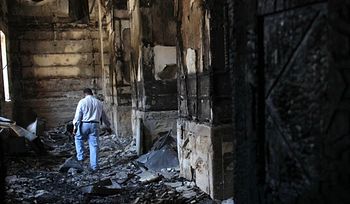
With at least 20 attacks against churches, Christian schools and orphanages, Minya Governorate is the part of Egypt where Islamists struck with greatest violence and brutality.
"The Islamists", one resident said, "burnt and destroyed everything. Their goal was to erase all the traces of a Christian presence; even the orphanages were looted and destroyed."
|
Salafis and the Muslim Brotherhood: what is the difference?
Dr. Mark Durie - MarkDurie.com
06 Jun 2013
For western lay people, it can be hard to distinguish one radical Muslim from another. What is the difference between Salafis and the Muslim Brotherhood? Are they really all that different? And why do Western governments seem to favour and even partner with Brotherhood-backed groups, but denigrate Salafis?
The 2011 People’s Assembly elections in Egypt focused the world’s attention on the Salafis when they proved to be the ‘dark horse’ of that poll, winning 25% of the seats. This, together with the Muslim Brotherhood’s 47%, gave Islamists almost three quarters of the seats in the Assembly. How do these two powerful Islamic groups compare?
Today the Brotherhood and Salafis also figure prominently in reports from Syria. Both brands of Islamists field rebel forces in Syria, and Brotherhood leaders dominate the Syrian National Council, which has been recognized by the Arab League and some UN states as the legitimate representative of Syria.
Often the past Western politicians have made the mistake of dismissing the Salafis as marginal extremists, while being all too willing to lap up the Brotherhood’s propaganda about their democratic credentials. A good example was David Cameron’s statement in Parliament this past week concerning the Syrian National Council, as he sought to downplay any suggestion that the conflict in Syria had a religious basis:
“When I see the official Syrian opposition I do not see purely a religious grouping; I see a group of people who have declared that they are in favour of democracy, human rights and a future for minorities, including Christians, in Syria. That is the fact of the matter.”
As troubling as Cameron’s ignorance about Brotherhood ideology appears to be, even more disturbing is his intent to forward military support to rebel groups, at the very time that a report has come from Syrian refugees of genocidal measures being enacted by Islamist rebels against the Syrian Christian minority.
This past week evidence has also emerged that among the insurgents who attacked the American Embassy in Benghazi in September 2012 were Egyptians, captured on video saying that ‘Dr Morsi sent us’. Yet Dr Morsi, the Brotherhood President of Egypt, is claimed by the US as an ally, and Brotherhood operatives have had long-standing high-level access to and support from the US Government.
Salafism
Salafism is a movement which emphasizes close adherence to the model of the Salaf or ‘predecessors’. These were the first few generations of Muslims. To understand Salafism, one needs to grasp why the model of the Salafs is important to Muslims.
In normative Islam it is an article of faith that Muhammad is the ‘best example’ for other human beings to follow (Sura 33:21). As a result a great many features of Islamic practice go back to what Muhammad did and said. For example, conservative Muslim men grow beards precisely because Muhammad commanded this again and again: for example he stated that he would have nothing to do with men who shaved their beards; he gave specific instructions to men to let their beard grow; and he commanded his followers to be different from non-Muslims precisely in this, that they should not shave their beards.
The example and teaching of Muhammad — the Sunna — is an absolutely central and unassailably prestigious concept for mainstream Islamic faith and practice.
Knowledge about Muhammad’s example and teaching was, according to pious understanding, mediated to the world through Muhammad’s companions and the first few generations of Muslims. The Salaf thus form the lens through which the example of Muhammad has been passed on to humanity.
Muhammad himself said that ‘The best people are those of my generation, and then those who will come after them (the next generation), and then those who will come after them [the next generation after that]’ (Sahih Bukhari 76:437). ‘Best’ implies the most rightly guided and most deserving to be emulated.
What all this means is that the Islam of the first generations of Muslims — the Salaf — is considered the purest and most prestigious form to follow. If a Muslim walks close to the Salaf in how they live, then they will be rightly guided and on the path to gaining Allah’s favour.
The Qur’an even declares a blessing in paradise for all those who follow the model of the first Muslims:
“The vanguard (of Islam) — the first of those who forsook (their homes) and of those who gave them aid, and (also) those who follow them in (all) good deeds, — well-pleased is Allah with them, as are they with Him: for them hath He prepared gardens under which rivers flow, to dwell therein for ever: that is the supreme felicity” (Sura 9:100).
Relying on such logic, the Salafi movement emphasizes the life of Muhammad, and the way of life of the first generations of Muslims. |
