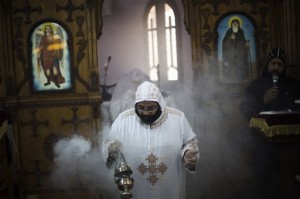
Perhaps it should be mentioned that the current wave of genocidal persecution of Christians in the Muslim world may soon leave a great many more monasteries, churches and other ancient Christian sites and communities derelict and forgotten, as devoted followers of Islam continue their push to exterminate non-Muslims from the Middle East.
The Holy Cross Monastery in Turkey
AINA via OCP Media — 10/21/2013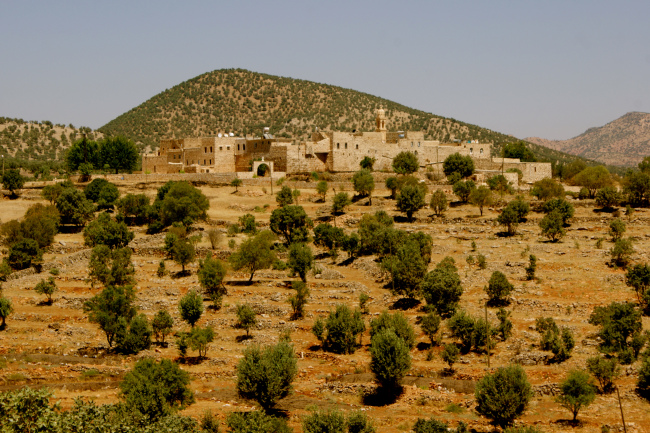
To find Catalcam, access Google Maps and in the search engine type “Midyat, Turkey”. From the centre of Midyat, follow the main road north (the road goes through stunning Hasankeyf on its way to Batman) for about 6 kms to a junction for Dargecit on the right. Take the road to the right. After about 15 kms you pass beside the pretty village of Izbirak. Continue for another 5 kms and a turning to the left leads to Catalcam, which is about 4 kms from the main road. It is an asphalt road all the way from Midyat to Catalcam. Public transport exists between Midyat and Dargecit and the minibus driver will know where to drop you for Catalcam. It is a relatively easy walk across undulating plateau from the main road to Catalcam, but almost everyone with a motor vehicle will provide you with a lift all or part of the way.
Catalcam is the Turkish name for a village known to Syriac [Assyrian] Christians as Dayro Daslibo. Nowadays, the monastery is, but for one or two nearby buildings, all that remains of the village (although later, when touring the monastery, I was told that Dayro Daslibo is really an abandoned village that exists just over the ridge). From a distance of about 1 km, the monastic complex looks larger than some that remain in Tur Abdin, and its sturdy outer walls resemble those of a castle. It soon became apparent why it is so large and why it is protected by formidable walls. At times during the history of Dayro Daslibo, the monastery was also the village. For greater security houses were built within the complex, and evidence for such houses survives to this day.
An elderly Syriac Christian who has lived in the village for most of his life, and a young Syriac Christian man whose family live in Sweden, led me on an astounding tour of the monastic complex. The elderly man knew a vast amount about the history and the folklore associated with the monastery, and the young Swedish-born Syriac Christian kindly translated what he could from Turoyo into English. At one point we stopped to drink coffee and eat a platter of fruit prepared by the young man’s mother (the young man’s family were living in the monastery for a month so they could re-engage with their roots). When I asked about sayfo (the large-scale massacre of Syriac Christians that began in April 1915), the elderly man told stories from those terrible times as if the events had happened only a few weeks’ ago. It was obvious that sayfo (the year of the sword) has left an indelible mark on Syriac Christian consciousness, a mark comparable to the one that metz yeghem (the big calamity) has left on Armenian consciousness, and shoah (the holocaust) has left on Jewish consciousness.